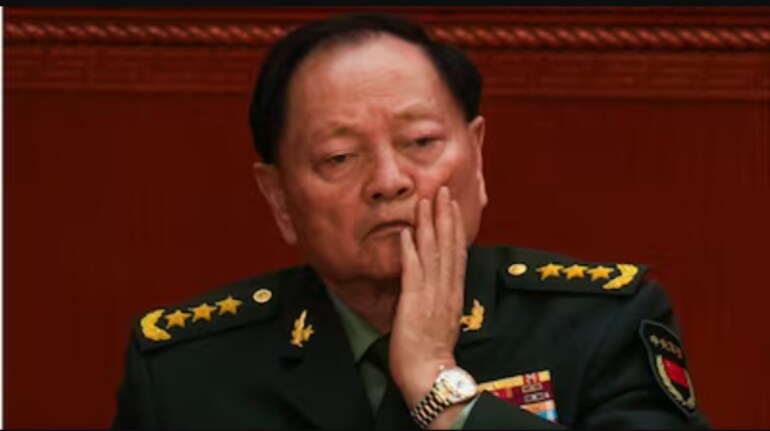

When General Zhang Youxia met senior American officials in Beijing in 2024, he came across as someone who did not need to measure every word. According to Jake Sullivan, who attended the meeting, Zhang spoke plainly and confidently, like a man certain of his standing.
That confidence now looks misplaced.
Over the weekend, China’s defence ministry announced that Zhang was under investigation for violations of law and political discipline. The statement was brief and vague. Its implications were anything but.
For years, Zhang was widely seen as the most trusted military deputy of Xi Jinping, the man entrusted with helping reshape the People’s Liberation Army. His sudden fall has stunned even seasoned China watchers, the New York Times reported.
Why Zhang’s downfall is different
Xi’s anti-corruption campaign has already brought down dozens of senior officers. But Zhang’s case stands apart.
He was not a marginal figure or a recent appointee. He was Xi’s vice chairman of the Central Military Commission, effectively the leader’s enforcer and representative inside the armed forces. At 75, he could have been quietly retired. Instead, he was publicly disgraced.
An editorial in the PLA’s official newspaper went further than most purge announcements. It accused Zhang and another commander of undermining the military chairman’s authority and damaging the Communist Party’s absolute control over the armed forces.
To many analysts, the language suggested something more serious than graft.
Corruption, or betrayal?
Official commentary mentioned corruption, but the emphasis was political. Zhang was accused of disloyalty — a far graver sin in Xi’s China.
“It reads as a personal betrayal,” said Shanshan Mei, a political scientist who studies the PLA. Corruption, she noted, often serves as the legal pretext, but loyalty is the real issue.
Speculation has since spiralled. Some believe Xi came to see Zhang as too powerful, especially after rival commanders were purged. Others think Xi concluded that corruption within the military ran so deep that even his closest allies could no longer be spared.
There are also more explosive allegations. The Wall Street Journal reported that Zhang is suspected of leaking nuclear secrets to the United States — a claim Chinese authorities have not publicly detailed.
A trusted interlocutor with the United States
The timing of Zhang’s investigation has raised eyebrows because of his role in high-level military diplomacy.
During talks with U.S. officials in 2024, Zhang was one of the most senior Chinese figures willing to engage directly. Sullivan has said the discussions were broad and unspecific, including references to nuclear issues only in general terms.
Nothing in those meetings, Sullivan stressed, involved sensitive disclosures.
Still, Zhang’s prominence as a channel to Washington may now count against him in an environment where suspicion has become routine.
A shared revolutionary lineage
Zhang and Xi shared more than professional proximity. Both were “princelings” — sons of Communist revolutionaries who fought alongside Mao Zedong.
Zhang’s father served with Xi’s father in northwest China, creating a historical bond that may have helped cement trust later in life. Xi kept Zhang in service past normal retirement age and elevated him to oversee day-to-day military affairs.
That background once seemed to place Zhang beyond reach. His fall now sends a chilling message through Beijing’s elite.
A rare combat veteran at the top
Unlike most senior PLA commanders, Zhang had seen real war. He joined the army in the late 1960s and fought in China’s bitter border conflict with Vietnam after 1979. Fellow soldiers later described him as bold, aggressive and tactically sharp — traits that set him apart in a military where few leaders had experienced sustained combat.
That experience made him valuable to Xi as China embarked on an ambitious military modernisation drive.
Architect of Xi’s military overhaul
After Xi took power in 2012, he launched sweeping reforms to dismantle old power centres, curb corruption and transform the PLA into a modern force capable of joint operations.
Zhang was central to that effort. He helped oversee a major reorganisation of command structures and later ran the military’s armaments department, one of the most corruption-prone institutions in the system.
Other officers from that department were later purged. Zhang survived — until now.
What his fall means for Xi’s inner circle
Zhang’s removal has unsettled China’s political elite. If someone with his history, rank and personal ties to Xi can be taken down, no one is truly safe.
“Even Zhang Youxia’s relationship with Xi was not a guarantee,” said Deng Yuwen, a former party editor now living in the United States. “That removes one of the last safety boundaries for the elite.”
For Xi, the purge reinforces absolute control. For everyone else, it reinforces fear.
Implications beyond the purge
Zhang’s absence could have consequences beyond internal politics. Some former US officials viewed him as a stabilising voice who understood the costs of war and could speak candidly to Xi about military risks, including a conflict over Taiwan.
With Zhang gone, analysts worry that advice reaching Xi may become narrower, more ideological and less grounded in combat experience.
Loyalty above all
Zhang Youxia’s downfall underscores a hard truth about power in Xi’s China. Past service, revolutionary lineage, combat credentials and personal trust can all be swept aside. What ultimately matters is perceived loyalty — absolute, unquestioned and ongoing.
In that system, even the mightiest general is expendable.
Discover the latest Business News, Sensex, and Nifty updates. Obtain Personal Finance insights, tax queries, and expert opinions on Moneycontrol or download the Moneycontrol App to stay updated!
Find the best of Al News in one place, specially curated for you every weekend.
Stay on top of the latest tech trends and biggest startup news.