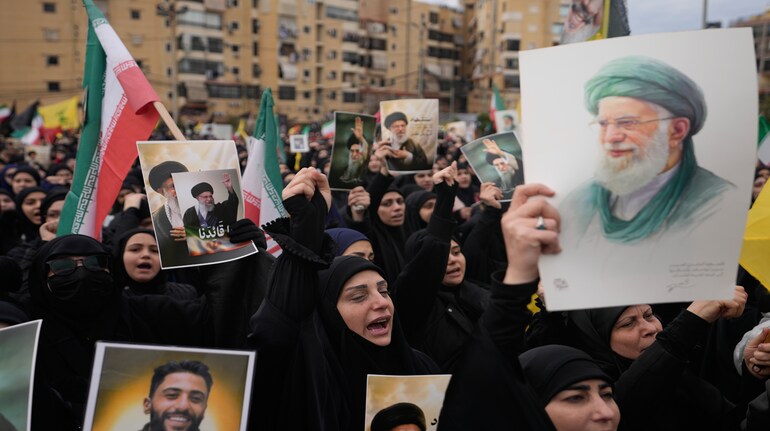

Iran is expected to announce a new supreme leader within two days, but the final contenders are reportedly unwilling to accept the powerful post amid fears of being targeted.
Iranian lawmaker Mohsen Zangeneh, who represents Torbat-e Heydarieh, said a successor to the late Ayatollah Ali Khamenei will be introduced shortly, reported News18. However, he acknowledged that the two remaining candidates have both been “reluctant to accept the position."
The semi-official Tasnim news agency reported that the Assembly of Experts, the clerical body constitutionally tasked with selecting the supreme leader, will convene to begin the process, though no specific timeline was given.
The succession marks only the second in the Islamic Republic’s history. The last transition took place in June 1989, when the ailing Ayatollah Ruhollah Khomeini transferred power to Ali Khamenei.
The urgency around the decision comes after Khamenei was killed over the weekend in U.S. and Israeli attacks on Iran.
Israel’s warning: Next supreme leader will be targeted
Security concerns are reportedly shaping the succession process, particularly after Israel signalled that any new leader could be targeted.
Israeli Defence Minister Israel Katz wrote on social media on Wednesday that whoever replaces Khamenei would be “an unequivocal target for elimination,” adding that “it does not matter what his name is or the place where he hides.”
The New York Times reported, citing two unnamed Iranian officials, that Khamenei’s second-eldest son, 56-year-old Mojtaba Khamenei, has emerged as the strongest contender for the role. However, Iranian authorities have refrained from publicly naming candidates amid fears they could become immediate targets.
Despite his growing profile as a possible successor, US President Donald Trump has openly dismissed the idea.
“They are wasting their time. Khamenei’s son is a lightweight,” Trump told Axios on Thursday, adding that it would be “unacceptable” if the Iranian leadership selected Mojtaba Khamenei. “We want someone who will bring harmony and peace to Iran.”
Trump also suggested Washington should have a role in shaping the outcome. “I have to be involved in the appointment, like with Delcy in Venezuela,” he said, referring to Delcy Rodríguez, who became Venezuela’s acting president with Trump’s backing after the U.S. captured Nicolás Maduro earlier this year.
Speaking to NBC News, Trump said he would prefer a complete overhaul of Iran’s leadership structure. “We want to go in and clean out everything,” he said. “We don’t want someone who would rebuild over 10 years. We want them to have a good leader.”
In an interview with TIME magazine, Trump added that his goal is to see Iran led by someone “that is rational and sane.”
Who are the candidates?
Mojtaba Khamenei
The leading contender is Mojtaba Khamenei, the late leader's second son.
Unlike many figures in Iran's hierarchy, Mojtaba Khamenei has never held elected office. But for years he has operated quietly behind the scenes from within his father's office, cultivating influence across the security establishment, particularly within the Islamic Revolutionary Guard Corps.
He studied theology in Qom and fought as a young volunteer during the Iran-Iraq war in the 1980s, credentials that still carry weight within the revolutionary elite. Yet his authority has largely come from proximity to power rather than his religious stature.
He is believed to have deep relationships with senior figures in the Revolutionary Guard, an institution that wields enormous military, economic and political influence in Iran.
If ultimately selected, Mojtaba Khamenei’s appointment would signal that Iran’s ruling elite has chosen stability over experimentation at a moment of extreme pressure. It would also mark an unprecedented moment in the Islamic Republic’s history, a leadership transition that effectively keeps power within the same family.
Alireza Arafi
Another prominent name is Ayatollah Alireza Arafi, a senior cleric deeply embedded within Iran’s religious institutions. Arafi serves on both the Guardian Council and the Assembly of Experts and has spent years overseeing Iran’s influential network of seminaries in Qom.
Following Khamenei’s assassination, Arafi was reportedly elevated to a temporary leadership council tasked with guiding the country during wartime and through the succession process.
Sadeq Larijani
Another potential candidate is Ayatollah Sadeq Larijani, a former judiciary chief and member of one of Iran’s most powerful political families. Larijani has long been viewed as a plausible successor because of his clerical credentials and deep ties to the country’s political establishment.
Hassan Khomeini
Some people have also pointed to Hassan Khomeini, the grandson of Islamic Republic founder Ayatollah Ruhollah Khomeini. Among clerics and reformist circles he commands respect, though his relatively moderate reputation could make him a difficult choice for Iran’s hardline establishment.
Mohammad Mehdi Mirbagheri
Hardline cleric Mohammad Mehdi Mirbagheri has also been floated as a possible contender due to his ideological alignment with the most conservative factions within Iran’s political system.
Discover the latest Business News, Sensex, and Nifty updates. Obtain Personal Finance insights, tax queries, and expert opinions on Moneycontrol or download the Moneycontrol App to stay updated!
Find the best of Al News in one place, specially curated for you every weekend.
Stay on top of the latest tech trends and biggest startup news.