
co-presented by
ASSOCIATE SPONSORS
co-presented by


ASSOCIATE SPONSORS




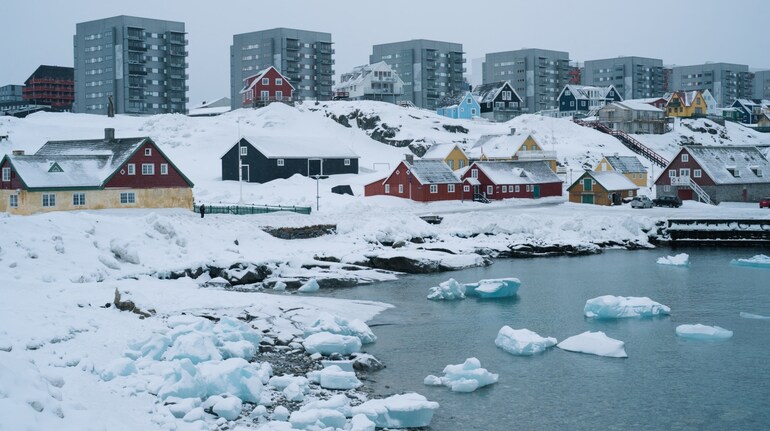

What happens in Greenland does not stay in Greenland. The world’s largest island plays an outsized role in the planet’s climate system, and as it loses ice at an accelerating pace, the consequences extend far beyond the Arctic.
Most of Greenland’s landmass, roughly two million square kilometres, is covered by ice. That ice is melting rapidly as the polar regions warm faster than the rest of the world, driven largely by emissions from burning coal, oil and gas. The Arctic is now warming at least twice as fast as the global average, the New York Times reported.
The scale of Greenland’s ice loss
In the 12 months ending on August 31, 2025, Greenland lost 105 billion metric tons of ice, according to scientists at the Danish Meteorological Institute, whose findings were published in Carbon Brief. This loss was not an anomaly. Greenland’s ice sheet has been thinning steadily for nearly three decades.
Between 1985 and 2022, the ice sheet shrank by almost 2,000 square miles, according to research published in Nature. Scientists say Greenland is on a long-term trajectory of ice loss that cannot be easily reversed within this century.
The immediate consequence is rising sea levels. Global sea levels have already risen by about four inches since 1993. If Greenland’s ice were to melt entirely, an outcome not expected this century, sea levels could rise by around 23 feet, dramatically worsening flooding during storms and high tides around the world.
How melting ice affects the planet
As Greenland’s ice melts, fresh water flows into the ocean, raising sea levels and altering ocean chemistry. There is also a feedback effect. Ice reflects sunlight back into the atmosphere. As it disappears, darker ocean water absorbs more heat, accelerating warming.
Scientists are also concerned about ocean circulation. Recent research suggests that meltwater from Greenland is slowing a major network of ocean currents, with potential implications for weather patterns far beyond the Arctic, including in the southern hemisphere.
A warming Arctic becomes a strategic prize
Climate change is also making the Arctic more accessible. Retreating ice is opening new shipping routes and revealing mineral resources that were previously locked beneath ice.
Greenland sits atop significant deposits of graphite, zinc and rare earths, materials critical for clean energy technologies. A large share of the European Union’s identified critical raw materials can be found there. China currently dominates global graphite markets, adding to the strategic value of these resources.
This growing importance has not gone unnoticed in Washington. President Donald Trump has repeatedly expressed interest in Greenland, with some analysts noting that this focus implicitly acknowledges the reality of climate change.
Mining, oil and environmental limits
Extracting Greenland’s resources is far from straightforward. Ice coverage makes mining difficult, and the government of Greenland has banned uranium mining, citing environmental risks.
Oil exploration has also been contentious. Companies have attempted for decades to extract oil from Arctic waters off Greenland’s coast. In 2021, Greenland’s government announced it would stop granting new oil exploration licenses, citing climate, environmental and economic considerations.
New shipping lanes and rising tensions
As Arctic ice retreats, new shipping routes are emerging. One of the most closely watched is the Northern Sea Route, which runs along Russia’s northern coast and is open only for part of the year. China refers to this corridor as the “Polar Silk Road,” seeing it as a faster route for trade with Europe.
Environmentalists warn that increased shipping poses serious ecological risks, including pollution from black carbon emitted by ships burning heavy fuel oil.
The opening of these routes has also triggered a race to build icebreakers. Russia has the largest fleet, followed by several NATO countries including Canada, Finland and Sweden.
Why alliances matter in the Arctic
Greenland is a semiautonomous territory of Denmark, and any attempt to assert control over it risks straining alliances. Analysts argue that cooperation within North Atlantic Treaty Organization offers the United States greater strength than confrontation with allies.
As climate change redraws the Arctic map, Greenland has become a focal point where environmental change, global security and economic ambition collide.
What is unfolding there is not a distant problem. It is a preview of how a warming world reshapes power, risk and responsibility across the planet.
Discover the latest Business News, Sensex, and Nifty updates. Obtain Personal Finance insights, tax queries, and expert opinions on Moneycontrol or download the Moneycontrol App to stay updated!
Find the best of Al News in one place, specially curated for you every weekend.
Stay on top of the latest tech trends and biggest startup news.