






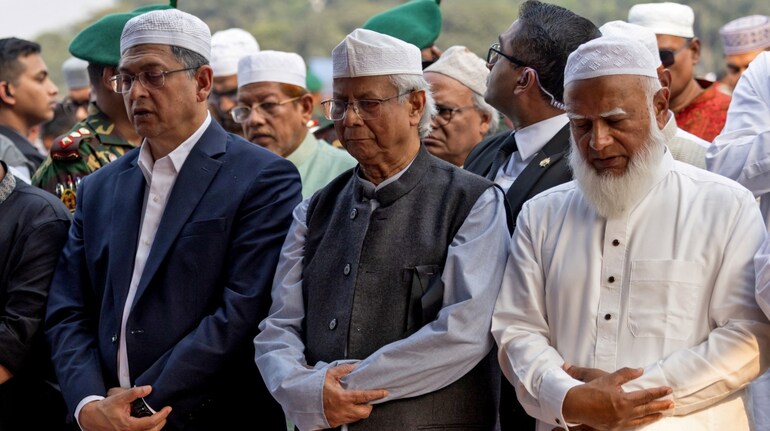

As Bangladesh grapples with political instability, street unrest and a growing sense of insecurity among minority communities, the country’s interim leadership has increasingly pointed to India as a source of its troubles. Officials and political allies of the Muhammad Yunus–led administration have suggested that external interference is contributing to the crisis unfolding inside the country.
However, a closer examination of recent events suggests that Bangladesh’s current turmoil is driven far more by internal political and administrative failures than by any action from New Delhi. From the killing of youth leader Sharif Osman Hadi to the surge in violence against Hindus, the fault lines appear to lie within Bangladesh’s own governance structures.
India, meanwhile, has repeatedly denied any role in Bangladesh’s internal affairs. More important is the fact that instability in Dhaka offers New Delhi little strategic or economic benefit.
Allegations after Hadi’s killing deepen political fault lines
The narrative blaming India faced its first major challenge following the killing of youth leader Sharif Osman Hadi. The controversy intensified when Hadi’s brother publicly accused the Yunus-led interim government of being complicit in the killing, alleging it was intended to derail the electoral process.
The allegation did not come from opposition politicians or foreign actors, but from within Bangladesh itself. It triggered widespread protests and intensified scrutiny of the interim administration’s ability to maintain law and order.
Rather than calming the situation, the period following the killing saw growing unrest. Media offices were attacked, demonstrations spread to multiple cities and security agencies struggled to assert control. The episode raised questions about whether the administration had underestimated the scale of the political challenge it faced.
Minority violence highlights governance gaps
One of the most visible consequences of the current instability has been the rise in attacks on Hindu minorities. Over recent months, Bangladesh has witnessed lynchings linked to allegations of blasphemy, arson attacks on homes, threats issued through public notices and a general atmosphere of fear among minority communities.
Human rights groups and local media reports indicate that in many cases, police response has been slow or ineffective. Critics argue that the interim government has failed to send a strong signal that communal violence will not be tolerated.
Such violence cannot be attributed to foreign interference. Mob attacks, police inaction and the spread of extremist rhetoric are domestic law-and-order issues. The failure to contain them has further eroded confidence in the state’s ability to protect its citizens.
India’s interests lie in stability, not disruption
The claim that India stands to gain from Bangladesh’s instability has also drawn scepticism. India and Bangladesh share extensive economic, infrastructural and security ties. New Delhi relies on stable relations with Dhaka for trade, transit routes to its northeastern states, energy cooperation and regional connectivity projects.
Instability in Bangladesh creates risks rather than advantages for India, including refugee flows, border management challenges and diplomatic complications. There is little evidence to suggest that New Delhi would deliberately undermine a neighbour with which it has invested heavily in long-term cooperation.
Moreover, no concrete evidence has been presented to support allegations of Indian involvement in Bangladesh’s internal unrest. Claims against India have largely remained rhetorical.
Reassessing Sheikh Hasina’s legacy
An interesting shift has been observed in public discourse within Bangladesh regarding former prime minister Sheikh Hasina. While her tenure was often criticised for centralisation of power and curbs on dissent, recent events have prompted a reassessment.
Some political commentators now describe Hasina as a stabilising force who kept extremist groups and street violence in check. Under her rule, communal violence was less frequent and the state maintained stronger control over law and order, despite criticisms of democratic backsliding.
This reassessment appears to be driven less by admiration and more by comparison with the present situation. The contrast has sharpened public dissatisfaction with the interim administration.
Growing unease over Yunus’ foreign alignments
Another factor drawing attention is the Yunus administration’s warming engagement with Pakistan. Reports of renewed political and intelligence-level contacts with Islamabad have raised concerns in policy circles.
Pakistan’s historical involvement in Bangladesh has often been viewed through the lens of regional rivalry with India. Analysts caution that closer alignment with Islamabad could complicate Bangladesh’s foreign policy and risk pulling it into broader geopolitical tensions.
In this context, anti-India rhetoric serves as a convenient political narrative. It redirects public frustration outward while justifying new regional alignments. However, critics warn that such positioning may reduce Bangladesh’s strategic autonomy rather than enhance it.
Accountability versus attribution
Taken together, recent developments suggest that Bangladesh’s crisis has been shaped primarily by internal factors. Political uncertainty, weak enforcement of law and order, tolerance of extremist mobilisation and an absence of clear administrative direction have all played a role.
Blaming India may offer short-term political cover, but it does little to address the structural problems facing the country. The continuing violence against minorities, unresolved questions around political killings and the erosion of public trust point to a need for accountability within Bangladesh itself.
For India, the situation remains one of concern rather than opportunity. Stability in Bangladesh remains in New Delhi’s interest, both for regional security and economic integration.
As Bangladesh navigates this difficult phase, the effectiveness of its interim leadership will ultimately be judged not by whom it blames, but by whether it can restore order, protect vulnerable communities and rebuild confidence in the state.
Discover the latest Business News, Sensex, and Nifty updates. Obtain Personal Finance insights, tax queries, and expert opinions on Moneycontrol or download the Moneycontrol App to stay updated!
Find the best of Al News in one place, specially curated for you every weekend.
Stay on top of the latest tech trends and biggest startup news.





