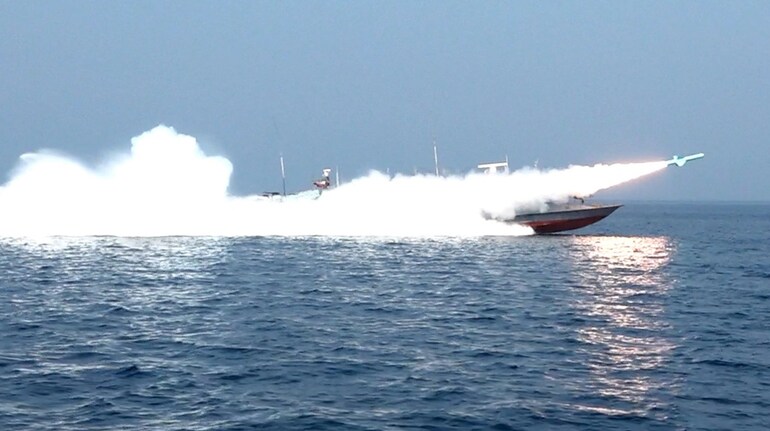

Two American carrier strike groups now sit within operational reach of Iran, sharpening fears that the long-running standoff between Washington and Tehran could tip into open conflict. One, the USS Abraham Lincoln, has been tracked roughly 700 kilometres from Iran’s coastline, while another carrier group has been dispatched to reinforce the US military posture across the Gulf. In Tehran, the response has been characteristically defiant. Iran’s Supreme Leader Ayatollah Ali Khamenei has warned that American power would not succeed in destroying the Islamic Republic and that a US warship could itself be sunk.
Between these signals of force and defiance, a quieter diplomatic track is unfolding in Geneva. Indirect talks between the United States and Iran, mediated by Oman, are aimed at preventing escalation. The central question, however, is whether this moment marks a genuine slide toward conflict or yet another cycle in the decades-long confrontation that has defined US–Iran relations.
“This is a very serious moment right now, given that the stakes are incredibly high, we’ve already seen the US and Israel strike Iran within the past year, and Trump has been very very clear with his rhetoric that if there is no deal reached, then there will be force used,” Simon Mabon, professor of International Politics at Lancaster University, told NDTV.
A precedent that raises the stakes
The threat of force cannot be dismissed as mere posturing. During the 12-day Iran–Israel war in June, the United States briefly joined Israeli strikes on Iranian nuclear facilities. That intervention established a precedent and reinforced the credibility of Washington’s warnings. According to Professor Mabon, the volatility is compounded by a lack of clarity over US objectives.
“Part of the problem is right now that there is no clear set parameter as to what is included within his so-called deal,” he told NDTV. “There’s a distance between some of the various parties involved over what should be covered by these talks, and that doesn’t bode well, particularly when you’ve got increasing tensions and an increased military build-up in the Gulf.”
Mabon argued that Washington’s approach reflects coercive diplomacy, using military pressure to force concessions at the negotiating table. “It’s trying to put pressure on Iran to say, look, we are serious, we are going to do what we say we’re going to do, and we’ve got the firepower to do it,” he said, adding that this raises the risk of instability.
The danger of miscalculation
That strategy, however, carries inherent risks. “If there is any type of miscommunication, misreading of the situation, or misunderstanding, then it can lead to a conflict, even if neither side necessarily wants it,” Mabon told NDTV. He described the situation as a classic security dilemma, where mutual suspicion drives escalation despite the absence of intent to fight.
Iran has issued its own threats, including the possibility of targeting US bases across the region. Yet Tehran’s deterrence posture is constrained. Many American bases are located in countries with which Iran currently has relatively positive relations.
“Iran struck a target, a US base in Qatar, and that really fractured a lot of relations with Qatar and Iran,” Mabon noted. “So Iran’s in a bit of a bind here, because it doesn’t want to target states with whom it now has broadly positive relations, but it needs to have that credible deterrent.”
This dilemma helps explain why Gulf states have intensified diplomatic efforts to defuse tensions. Saudi Arabia, Qatar, Kuwait and Oman are all working behind the scenes to prevent a wider regional escalation, Mabon said.
More than just nuclear talks
While the Geneva talks are formally focused on Iran’s nuclear programme, the agenda is far broader. “If it’s just the US, then perhaps it is just about the nuclear issue. But if the US is being swayed by Israel, then it also involves support for, quote unquote, proxy actors such as Hezbollah and Hamas,” Mabon told NDTV.
Washington is also concerned about Iran’s ballistic missile programme and its growing ties with China and Russia. These overlapping agendas make a clean diplomatic breakthrough more difficult.
Iran’s bargaining position is further weakened by domestic pressures. “Iran is on its knees financially. It’s facing a huge set of domestic unrest. People are angry. Inflation has skyrocketed. Some basic foodstuffs have gone up over 100%,” Mabon said, referring to protests earlier this year that were met with a deadly crackdown.
The Hormuz factor
Perhaps the most dangerous escalation point lies not in missiles or militias, but in geography. The Strait of Hormuz, through which around a quarter of global seaborne oil flows, remains Iran’s most potent pressure lever.
“That possible threat has always been a big fear for policymakers around the world, that Iran would close the Strait of Hormuz,” Mabon told NDTV. “That would have a dramatic impact on the price of oil and reverberate around the world.”
Iran has repeatedly demonstrated its capacity to disrupt shipping, and Revolutionary Guard exercises have included temporary closures of parts of the waterway. While international pressure would seek to restrain Tehran, Mabon warned that the option remains real if Iran feels cornered.
A high-stakes waiting game
Predicting where this crisis leads is unusually difficult, in part because of the unpredictability of US decision-making. “Normally, I would say if the talks are continuing, then that’s a good sign. But with Trump, it’s not entirely clear,” Mabon said.
For now, indirect negotiations continue through Omani mediators, with cautious optimism from Tehran and stern warnings from Washington. Between diplomacy and deterrence, the US and Iran appear locked in a high-stakes game of poker, one where the cost of miscalculation could be far higher than either side intends.
Discover the latest Business News, Sensex, and Nifty updates. Obtain Personal Finance insights, tax queries, and expert opinions on Moneycontrol or download the Moneycontrol App to stay updated!
Find the best of Al News in one place, specially curated for you every weekend.
Stay on top of the latest tech trends and biggest startup news.