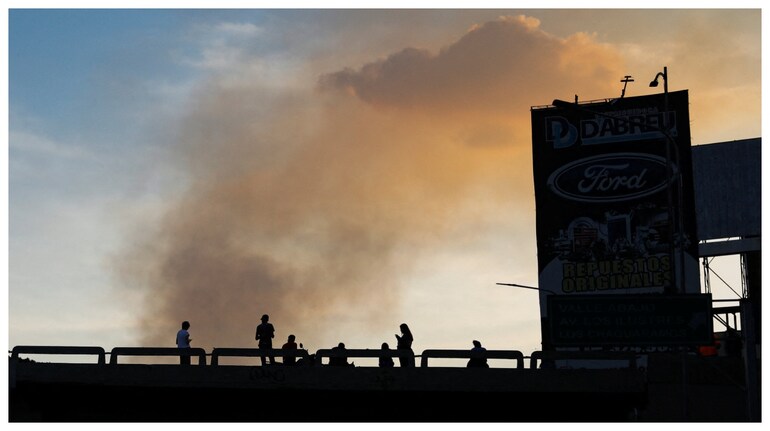

In the 1970s, Venezuela appeared unstoppable. Oil money poured into the country, financing grand infrastructure projects, modern cities and a booming consumer culture. The slogan of the era captured the mood: “It’s cheap. Give me two.”
Yet even at the height of the boom, some warned that oil wealth would destroy the country rather than save it. Juan Pablo Pérez Alfonzo, a former oil minister and a founding figure of Organization of the Petroleum Exporting Countries, predicted that oil would bring Venezuela “ruin,” famously calling it “the devil’s excrement.”
It took decades, but his warning proved prophetic, the New York Times reported.
From oil boom to national collapse
Over the past 20 years, Venezuela has undergone one of the most dramatic economic and political collapses in modern history. A once-stable democracy slid into dictatorship. Foreign-owned assets were nationalised. A prolonged confrontation with the United States ended in sweeping sanctions. When oil prices eventually crashed, the state ran out of cash.
Hyperinflation followed. Millions fled the country on foot. Basic goods vanished. Hospitals ran out of supplies. The economy, almost entirely dependent on petroleum, buckled.
On January 3, Donald Trump ordered the capture of Venezuela’s president, Nicolás Maduro, to face drug trafficking charges in the US Trump declared that Washington would “run” Venezuela for years, asserting near-personal control over the world’s largest proven oil reserves.
The paradox of plenty
When the author arrived in Caracas in 2016 as The New York Times bureau chief, Venezuela was already in crisis. Food shortages forced families to queue for hours. Hospitals lacked basic equipment.
Seeking explanations, he was pointed not to a political biography but to a book by Stanford political economist Terry Lynn Karl, The Paradox of Plenty. The book traces how oil wealth often destabilises countries instead of strengthening them.
The pattern began in 1973, when OPEC successfully set oil prices for the first time, triggering what Karl called the largest transfer of wealth without war. Prices surged from $3 to $10 a barrel, later reaching $40. Many believed oil-rich nations would gain lasting prosperity and power.
Instead, economies became distorted. Oil sectors absorbed government budgets and skilled labour. Strong currencies crushed agriculture and manufacturing. This phenomenon became known as “Dutch Disease,” after similar effects were observed in the Netherlands.
Oil wealth and authoritarian power
Oil revenues also reshaped politics. Governments that could fund themselves without taxing citizens were less accountable. In Iran, oil money helped sustain the Shah’s rule until he was overthrown in 1979, only to be replaced by another authoritarian regime.
The same pattern emerged elsewhere. Easy revenue allowed leaders to consolidate power, weaken institutions and suppress opposition, insulated from public pressure.
Venezuela followed this path.
Chávez and the expansion of the oil state
Venezuela’s modern oil era began in 1922, long before it developed strong manufacturing or industry. While the country stood out as a democracy by the 1960s, falling oil prices in the 1980s destabilised the system. In 1989, austerity measures sparked riots and a deadly crackdown known as the Caracazo.
In 1992, a young army officer, Hugo Chávez, led a failed coup. He later won the presidency in 1998, riding popular anger at decades of inequality.
Chávez expanded social programmes dramatically, funded by soaring oil prices that rose from about $10 a barrel to nearly $150 by 2008. He also severed longstanding ties with the United States, aligned with Cuba, and expropriated billions of dollars from foreign companies including Exxon Mobil and ConocoPhillips.
His popularity rested not only on ideology, but on money. Oil revenues gave him an unmatched budget to distribute benefits and consolidate power.
Collapse under Maduro
Chávez died in 2013, leaving Maduro to inherit a system dependent on high oil prices. In 2014, prices collapsed. By 2016, oil was trading near $30 a barrel.
The hollowed-out economy could no longer function. Venezuela produced little and could not afford imports. Years of price controls made production unviable. Toilet paper, eggs and basic food items disappeared, not because of scarcity of resources, but because supply chains had collapsed.
Political repression intensified. In 2017, Maduro sidelined the opposition-controlled legislature. Protesters were jailed or killed. In 2024, after banning opposition leader María Corina Machado, Maduro declared victory in an election international observers said he lost.
Will the curse spread?
Some scholars argue oil is not a curse but a double-edged sword. In earlier decades, petroleum brought Venezuela prosperity and democratic stability.
But today, Trump’s intervention raises a new question. By asserting US control over Venezuela’s oil, Washington may inherit not just its resources, but its political wreckage.
Major companies remain wary. Exxon has labelled Venezuela “uninvestable.” Oil can be produced more easily elsewhere, including neighbouring Guyana. The US itself became a net oil exporter in 2020 due to fracking.
If Venezuela’s oil wealth once corrupted its own state, the article asks whether the United States can extract the oil without absorbing the instability, responsibility and moral cost that come with it.
As Karl warns, a return to a colonial-style extraction model could leave Venezuela without resources to rebuild, regardless of who governs it.
Oil once promised Venezuela everything. Instead, it consumed the country. The question now is whether the same resource will entangle Washington in a century-old curse it believes it can control.
Discover the latest Business News, Sensex, and Nifty updates. Obtain Personal Finance insights, tax queries, and expert opinions on Moneycontrol or download the Moneycontrol App to stay updated!
Find the best of Al News in one place, specially curated for you every weekend.
Stay on top of the latest tech trends and biggest startup news.