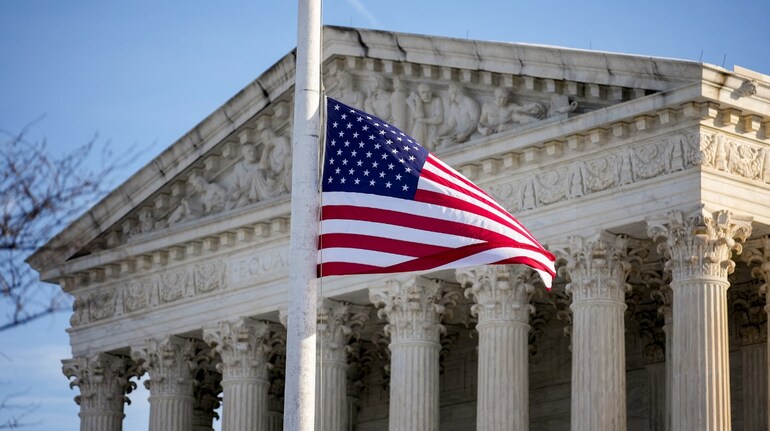

US President Donald Trump's sweeping global tariffs will face a major test on Friday with the Supreme Court set to issue rulings on the legality of the move which could significantly impact America's trade policy.
The case is about Trump’s April 2 “Liberation Day” tariffs, which imposed levies of 10-50% on most imports, along with duties imposed on Canada, Mexico and China over "fentanyl trafficking".
Over 900 lawsuits had been filed in the US Supreme Court on behalf of businesses seeking tariff refunds, according to a tally compiled by Bloomberg. Company executives, customs brokers and trade lawyers are now bracing for the ruling, which can open up the possibility of obtaining perhaps $150 billion in refunds from the US government for duties already paid by importers in case Trump loses.
According to Reuters, anticipation is growing that the court may strike down the tariffs Trump imposed under the International Emergency Economic Powers Act of 1977 (IEEPA), especially after both conservative and liberal justices voiced skepticism in November about whether that law gave Trump the authority to levy the duties.
“We have a big Supreme Court case. I hope they do what’s good for our country. I hope they do the right thing. The president has to be able to wheel and deal with tariffs," Trump had told House Republicans earlier this week.
What is the Supreme Court set to decide
At the heart of the case is whether IEEPA, a law historically used for sanctions and asset freezes against US adversaries, gives the president the legal authority to impose broad tariffs. Trump is the first president to invoke IEEPA to impose tariffs.
If the Supreme Court rules the tariffs were unlawful under this Act, it could trigger a massive refund process for importers and reshape how future presidents use emergency powers for trade measures.
The decision will affect tariffs on goods imported from countries like India, China, Canada, Mexico, and dozens others.
What’s at stake here
Importers and trade advisers say the refund question could be the real battleground.
Trump's IEEPA-related tariffs generated $133.5 billion in estimated collections between February 4 and December 14, Reuters reported citing the most recent US Customs and Border Protection (CBP) data.
Reuters estimates the current total is approaching $150 billion, based on continuation of average daily collection rates from late September through mid-December.
However, some companies anticipate that even if the court invalidates Trump’s tariffs, the administration will not make refunds easy.
Why these tariffs were imposed — and how Trump used IEEPA
Trump imposed IEEPA-related tariffs in two ways:
A ruling against the tariffs could mean importers seek refunds for duties already paid — but the process could be complex and slow. Each companies will have to sue separately.
US Treasury Secretary Scott Bessent said the court’s decision may be “somewhat clouded,” but if it goes against Trump’s tariffs, the administration could replace lost revenues by switching to other tariff authorities.
On the other hand, if the court upholds the tariffs, it may cement a reading of IEEPA and allow presidents in the future to slap broad economic measures without the kind of tailored findings and time limits found in more traditional tariff statutes, a report in the Law Commentary said.
The court may also take the middle ground by narrowing the IEEPA tariffs to a smaller set of countries with which the US runs trade deficits, Morgan Stanley policy strategists have said.
Companies may not keep the money
According to a report in Forbes, while many companies are seeking refunds for tariffs they have paid, some may not end up keeping the money.
Trade experts and attorneys told Forbes that Wall Street financial firms are striking deals with importers to buy the rights to any future tariff refunds. In exchange, the firms pay companies an upfront percentage of what they paid in tariffs, giving importers guaranteed cash now — regardless of how the Supreme Court rules.
In case of a favourable ruling, the financial firm collects the full payout instead of the original importer, betting it will earn more than it paid for the rights. Experts said these arrangements likely won’t show up in court filings, since any refund would probably need to be claimed by the importer first — and then transferred to the firm it sold the refund rights to.
Impact on markets
According to Bloomberg, a ruling striking down the tariffs would likely give a boost to stocks by promising to improve profit margins and remove a burden on consumers.
At the same time, Treasuries may come under pressure as that potential stimulus complicates the outlook for the Fed’s rate-cut path and threatens to worsen the government’s budget deficit.
The ruling against the tariffs would boost the earnings of companies in the S&P 500, before interest and taxes, by 2.4% in 2026 over last year’s levels, Bloomberg said quoting Wells Fargo & Co. Chief Equity Strategist Ohsung Kwon's estimates.
This could drive investors to push up prices to reflect higher profits if the Supreme Court rules against Trump.
James St. Aubin, chief investment officer at Ocean Park Asset Management, said that would be “a catalyst for a little bit of a rally.”
However, the report said that some stocks stand to benefit more than others. The tariffs have been particularly painful for businesses that are heavily dependent on imported goods, such as companies that cater to the US consumer. Financial firms like banks are seen likely to benefit from a more confident or flush consumer as well.
(With inputs from agencies)Discover the latest Business News, Sensex, and Nifty updates. Obtain Personal Finance insights, tax queries, and expert opinions on Moneycontrol or download the Moneycontrol App to stay updated!
Find the best of Al News in one place, specially curated for you every weekend.
Stay on top of the latest tech trends and biggest startup news.