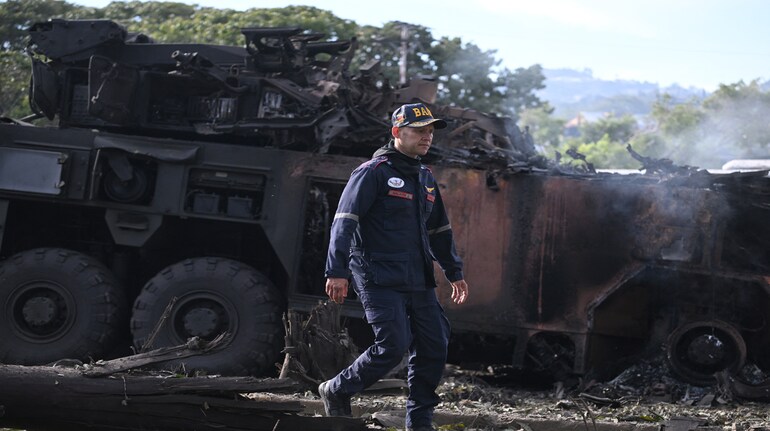
The United States’ decision to carry out strikes on Caracas in January 2026 — and President Donald Trump’s claim that Venezuelan president Nicolás Maduro was captured — has pushed Washington’s confrontation with Venezuela into unprecedented territory. What had long been a campaign of sanctions, diplomatic isolation and law-enforcement pressure has escalated into overt military action, framed by the Trump administration as part of a wider war against transnational drug cartels. US officials say the strikes were necessary to counter what they describe as an imminent security threat posed by narco-terrorist networks operating from Venezuelan territory. Critics, however, argue the move stretches legal authority, risks regional instability and blurs the line between counter-narcotics operations and regime-change policy in a country already crippled by economic collapse, political repression and a deepening humanitarian crisis.
Here are the top 10 developments:
1. US launches strikes on Caracas
In January 2026, the United States carried out strikes on Caracas, marking the sharpest escalation in its long-running confrontation with Venezuela’s leftist government. Trump said the operation resulted in the capture of Nicolás Maduro.
2. Trump frames operation as counter-narcotics campaign
The Trump administration said the strikes were part of a broader effort to stop illegal drugs entering the United States, accusing Maduro of leading the Cartel de los Soles, which Washington has designated a “global terrorist organisation”.
3. US declares ‘armed conflict’ with drug cartels
The administration informed Congress that the United States is in a formal “armed conflict” with drug cartels it classifies as “unlawful armed combatants”, a significant departure from past US counter-drug policy.
4. Military force authorised against Latin American cartels
In August 2025, Trump signed a classified directive authorising the Pentagon to use military force against select Latin American drug cartels, including Venezuelan-linked groups.
5. Naval build-up in the Caribbean intensifies
Following the directive, the US deployed warships and thousands of sailors and Marines towards Venezuelan waters, expanding naval patrols and enforcing what Washington has described as an oil blockade.
6. First confirmed naval strike without Coast Guard involvement
On September 2, 2025, US forces struck a vessel allegedly operated by the Tren de Aragua gang, killing 11 people. The operation was conducted solely by the Navy, bypassing the Coast Guard and raising questions about the legal basis for the strike.
7. Long-standing US push to remove Maduro
The United States has refused to recognise Maduro as Venezuela’s legitimate leader since contested elections in 2018. In 2020, Washington charged him with narco-terrorism and offered a bounty that later rose to $50 million.
8. Sanctions deepen Venezuela’s economic collapse
US sanctions targeting Venezuela’s oil sector and third-party traders intensified after 2019, further contributing to a sharp economic decline in a country already suffering from hyperinflation, infrastructure collapse and shortages of food and medicine.
9. Venezuela’s geopolitical alliances harden
Maduro has retained power with backing from Russia, China, Iran and Cuba, undermining US pressure. Russia deployed troops to Venezuela in March 2019, while China has supported infrastructure projects and energy exports.
10. Escalation risks regional instability
Analysts warn that continued US military pressure risks destabilising the region, worsening refugee flows — already numbering around eight million since 2015 — and raising uncertainty over governance and security if Maduro is removed.
Discover the latest Business News, Sensex, and Nifty updates. Obtain Personal Finance insights, tax queries, and expert opinions on Moneycontrol or download the Moneycontrol App to stay updated!





Find the best of Al News in one place, specially curated for you every weekend.
Stay on top of the latest tech trends and biggest startup news.