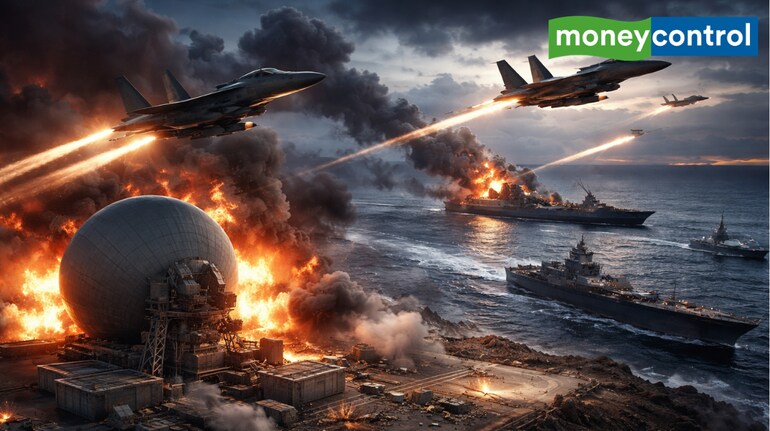

Barely a week into the escalating military confrontation between the United States, Israel and Iran, the war is already leaving behind a trail of destroyed hardware worth billions of dollars.
Radar systems valued at over a billion dollars, advanced fighter jets, missile defence infrastructure and major naval platforms have been damaged or sunk as the conflict rapidly expands across the Middle East.
At the same time, the daily operational cost of the war is climbing sharply.
Estimates compiled from defence budget data suggest the United States alone spent about $779 million in the first 24 hours of strikes, largely on cruise missiles, aircraft sorties and naval operations.
Analysts cited by the New York Times estimate the early phase of the campaign has already crossed $5 billion in military spending within just a few days, as aircraft carriers, bombers and hundreds of missiles have been deployed.
Israel’s economy is also beginning to feel the impact. The country’s finance ministry estimates the conflict could cost around $3 billion every week under current emergency restrictions and mobilisation levels.
Taken together, the figures suggest that this may already be one of the most expensive opening weeks of a modern military conflict, even though the overall cost remains far smaller than prolonged wars such as Iraq or Afghanistan.
And the most visible part of the price tag is the hardware being destroyed.
A $1.1 billion early-warning radar system
Among the most costly assets reportedly damaged in the conflict is a US-built AN/FPS-132 early-warning radar system deployed at Qatar’s Al Udeid air base.
The radar forms part of a long-range ballistic missile detection network used to monitor launches across the Middle East.
According to the US Defense Security Cooperation Agency, Qatar’s purchase request for the AN/FPS-132 system was valued at around $1.1 billion, placing it among the most expensive single systems affected in the conflict.
Such radars are critical for missile defence because they provide early warning and targeting data for interception systems.
Damage to one does not just represent a financial loss, it also affects the region’s missile-tracking capability.
Three US F-15E Strike Eagle fighter jets
Another costly loss came from the air.
According to Reuters, three US F-15E Strike Eagle fighter jets were mistakenly shot down by Kuwaiti air defences during a missile interception attempt. All crew members ejected safely.
The aircraft are among the US Air Force’s most capable strike fighters.
Publicly cited historical procurement figures place the unit cost of an F-15E at roughly $31 million, although modern replacement aircraft and upgrades can push the effective cost significantly higher.
Losing three aircraft therefore represents well over $90 million in hardware, even before accounting for training, equipment and weapons carried on board.
THAAD missile defence radar in the UAE
Iranian retaliatory strikes have also reportedly targeted components linked to the Terminal High Altitude Area Defense (THAAD) missile defence system deployed in the Gulf.
Satellite imagery analysis and regional reporting indicate damage to an AN/TPY-2 radar, which is used to detect and track ballistic missiles.
Contracts for THAAD radar systems provide a sense of the scale involved.
Raytheon received a $582.5 million contract for radars and services in a THAAD deal for the United Arab Emirates, according to company announcements.
Even partial damage to such a radar therefore represents the loss of hundreds of millions of dollars worth of high-end military infrastructure.
Iranian naval vessels sunk in the conflict
Iran has also lost several large naval platforms in the conflict.
According to Reuters and US Central Command statements, US forces sank an Iranian Jamaran-class warship at the port of Chah Bahar.
Separately, the Iranian frigate IRIS Dena was struck by a torpedo and sunk in the Indian Ocean, according to reports from Associated Press and Reuters citing regional officials.
While Iran does not publish procurement costs for its naval vessels, such ships typically require years to build and represent a significant portion of the country’s blue-water naval capability.
Satellite imagery analysed by defence observers has also suggested damage to large Iranian support vessels including IRIS Makran, one of the country’s largest naval platforms.
The hidden burn rate of the war
The destruction of hardware grabs headlines. But the daily cost of running the war may be far higher.
Modern missile defence is extremely expensive.
Each Patriot interceptor missile costs roughly $3–4 million, while THAAD interceptors are estimated to cost around $12 million per missile, according to US defence procurement data.
When dozens of missiles and drones are launched during a single attack wave, defending forces may spend hundreds of millions of dollars in interception costs in just one night.
Strike operations also carry heavy costs.
Tomahawk cruise missiles, widely used by the US Navy, are estimated to cost around $1.5–2 million per missile.
Carrier strike groups operating in the region also burn significant resources. Analysts estimate that maintaining a deployed aircraft carrier with its escort ships and air wing can cost several million dollars per day.
Taken together, the operational burn rate of the conflict can quickly run into billions even if the physical destruction on the battlefield appears limited.
The systems that will be hardest to replace
Not all losses in war are equal.
Some equipment can be replaced quickly. Others cannot.
Early-warning radar systems such as the AN/FPS-132 and AN/TPY-2 take years to manufacture and install.
They require specialised components, large fixed infrastructure and extensive calibration to integrate with missile defence networks.
Naval vessels are similarly difficult to replace.
Warships like Iran’s frigates and support vessels require years of construction and complex supply chains, especially for countries facing sanctions that limit access to components.
Even fighter jets, while easier to procure than radar networks or ships, still require long production queues and pilot training pipelines.
The real price may still lie ahead
History shows that the cost of wars often becomes clear only months or years later.
The United States spent over $2 trillion during two decades of war in Afghanistan, while the Iraq war cost Washington well over $1 trillion.
The current conflict is nowhere near those totals.
But the scale of destruction and spending within the first week alone suggests that if the confrontation continues at the current intensity, the financial cost could climb rapidly, not just for the countries directly involved, but for global energy markets and the broader world economy.
Discover the latest Business News, Sensex, and Nifty updates. Obtain Personal Finance insights, tax queries, and expert opinions on Moneycontrol or download the Moneycontrol App to stay updated!
Find the best of Al News in one place, specially curated for you every weekend.
Stay on top of the latest tech trends and biggest startup news.