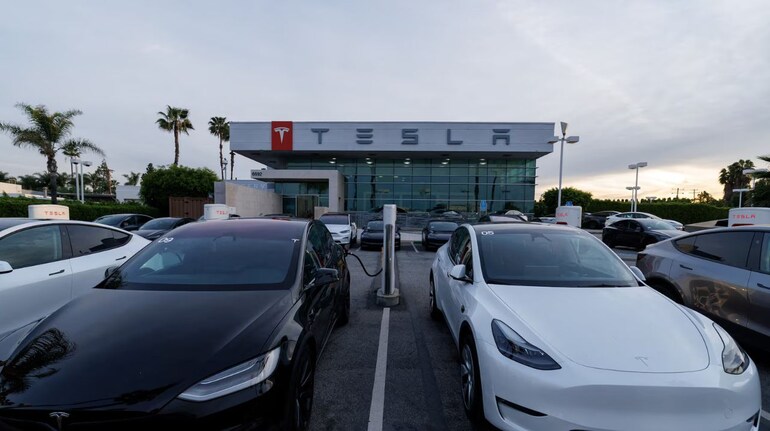

A Tesla owner in the United States has said his vehicle may have saved his life after he lost consciousness while driving on a freeway, triggering a sequence of automated safety actions that brought the car to a stop and alerted emergency services.
According to the account shared publicly and later acknowledged by Tesla, the man was using the company’s Full Self-Driving software when he suddenly fainted mid-drive. He said the vehicle detected that he was not responding, slowed down, switched on hazard lights, and pulled over safely to the shoulder of the road. He was later taken to hospital, where doctors confirmed he had passed out due to a medical emergency.
The driver said the car did not simply stop in traffic. Instead, it followed a controlled sequence designed for when the driver is incapacitated. Tesla vehicles equipped with advanced driver-assist systems are programmed to monitor steering input, driver engagement, and responsiveness. When the system determines that the driver is no longer responding, it can reduce speed, warn surrounding traffic, and bring the car to a halt.
In this case, the owner said the vehicle also directed him toward medical assistance once it had stopped, although Tesla has not publicly confirmed whether navigation to a hospital was fully autonomous or guided by the driver after regaining partial consciousness.
Elon Musk reacted briefly to the incident on social media, responding to the driver’s account with a short message expressing relief that he was safe.
The episode has drawn attention because it highlights a narrow but important use case for driver-assist technology. While Tesla’s Full Self-Driving system is marketed as capable of handling many driving tasks, the company has consistently stated that it requires active human supervision and does not make the car fully autonomous. Drivers are expected to remain alert and ready to take control at all times.
Safety experts note that systems designed to handle driver incapacitation are increasingly common across carmakers, especially as vehicles take on more automated functions. These features are not meant to replace medical judgment or emergency response, but to reduce the risk of collisions when something goes wrong behind the wheel.
At the same time, regulators continue to scrutinise how such incidents are described. In the United States, authorities have previously warned against overstating the capabilities of driver-assist software, particularly when individual stories are framed as proof of full autonomy.
In this case, the man’s experience appears to show the technology working within its intended safety boundaries. The car did not drive itself indefinitely or make complex medical decisions. It did what it was designed to do in an emergency: slow down, stop safely, and buy time.
As more vehicles incorporate similar systems, incidents like this are likely to fuel debate about how much automation is enough, and where responsibility ultimately lies when software steps in during moments humans cannot.
Discover the latest Business News, Sensex, and Nifty updates. Obtain Personal Finance insights, tax queries, and expert opinions on Moneycontrol or download the Moneycontrol App to stay updated!
Find the best of Al News in one place, specially curated for you every weekend.
Stay on top of the latest tech trends and biggest startup news.