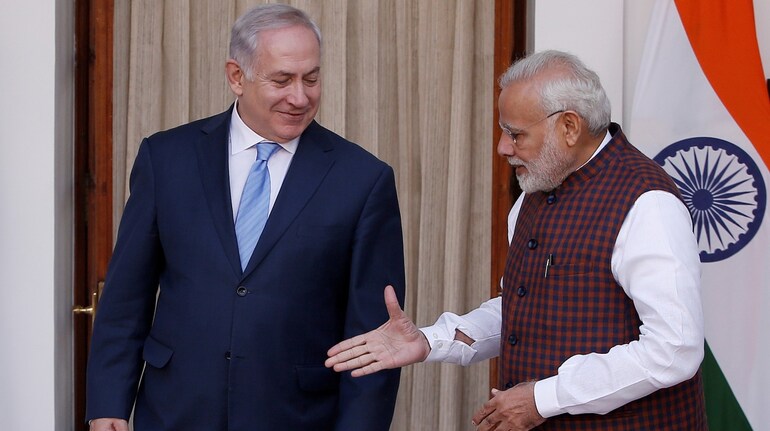

As Prime Minister Narendra Modi prepares for his two-day visit to Israel starting Wednesday, a new geopolitical concept unveiled by Israeli Prime Minister Benjamin Netanyahu has drawn attention across West Asia and beyond.
Netanyahu has proposed what he calls a "Hexagon of Alliances," a six-nation strategic framework designed to link countries in and around West Asia through security, diplomatic and economic cooperation. India has been publicly named as a potential pillar of this emerging bloc.
How the Hexagon of Alliances was announced
Ahead of Modi’s visit, Netanyahu described the India-Israel relationship as a “powerful alliance between two global leaders” and referred to Modi as his "dear friend."
“This morning, at the opening of our Cabinet meeting, I spoke about the historic visit of my dear friend, Prime Minister Narendra Modi, to Israel this coming Wednesday,” Netanyahu wrote on X.
Netanyahu said the two countries are partners in innovation, security and a shared strategic vision, before outlining his idea of building a broader network of aligned nations in the region.
What is the Hexagon of Alliances
According to Netanyahu, the Hexagon of Alliances would consist of six countries located within or around West Asia. While the full list has not been disclosed, he has explicitly named India, Greece and Cyprus as prospective members, along with unspecified Arab, African and Asian nations.
“In the vision I see before me, we will create an entire system, essentially a ‘hexagon’ of alliances around or within West Asia,” Netanyahu was quoted as saying by The Times of Israel.
“The intention here is to create an axis of nations that see eye to eye on the reality, challenges, and goals against the radical axes, both the radical Shia axis, which we have struck very hard, and the emerging radical Sunni axis.”
Netanyahu did not elaborate on what he meant by an “emerging radical Sunni axis.”
What the alliance is meant to do
The Hexagon of Alliances is envisioned as a multi-track framework operating across three core pillars:
Netanyahu has drawn comparisons between the proposed bloc and the India-Middle East-Europe Economic Corridor or IMEC, though Israeli officials and analysts say the hexagon carries a far stronger security dimension.
“All of these nations share a different perception, and our cooperation can yield great results and, of course, ensure our resilience and our future,” Netanyahu asserted.
The strategic target: Iran and its proxies
At its core, the Hexagon of Alliances is intended to serve as a counterweight to Iran and its regional network of armed groups, collectively referred to as the Axis of Resistance.
This network includes Hezbollah, the Houthis, and Iranian-backed militias operating across Iraq and Syria.
Israel has conducted sustained military operations against several of these groups since the Gaza war erupted in October 2023. Netanyahu views the hexagon not as a wartime coalition but as a longer-term diplomatic and security architecture to consolidate gains and curb Iran’s influence across the region.
Hamas pushes back
The proposal has already drawn sharp criticism from Hamas.
Hamas spokesperson Hazem Qassem rejected the plan, calling it “a direct threat to their strategic interests”.
“What is happening is an attempt to reshape the region in a way that serves only the interests of the occupation. These moves are based on the weakness that afflicted Arab nations during the war in Gaza. We call on Arab states to recognise the danger of these schemes and their repercussions on the region’s security and stability,” Qassem was quoted as saying by i24News.
Why India is central to the proposal
India’s inclusion is seen as critical to the credibility of the Hexagon of Alliances.
New Delhi brings economic scale, technological capability, diplomatic reach and growing defence ties with Israel. India is also seen as a bridge between West Asia, Europe and the Indo-Pacific.
Modi’s visit, his second to Israel after the landmark 2017 trip, is expected to focus on deepening cooperation in defence co-development, advanced technology, artificial intelligence, agriculture, water management and trade.
There are also discussions around joint development of anti-ballistic missile shields, laser weapons, drones and long-range stand-off missiles, along with expanded cooperation on Israeli systems such as Iron Dome, David’s Sling and Arrow.
Modi is also expected to address the Knesset, a rare honour that underscores the political weight of the visit.
India’s balancing act in West Asia
Despite Israel’s enthusiasm, India is expected to approach any formal alignment with caution.
New Delhi maintains close ties with Iran, including its strategic investment in the Chabahar Port, and enjoys deep economic and political relationships with Gulf Arab states, which host millions of Indian workers.
“This allows India to deepen cooperation with Israel in areas such as defence, technology and economic integration, while also sustaining diplomatic engagement with the Palestinian leadership and strong ties with Arab states,” Kfir Tshuva, a lecturer at Ramat Gan Academic College, told Al Jazeera.
India continues to support a two-state solution to the Israeli-Palestinian conflict and recently joined more than 100 countries in condemning Israeli settlement expansion in the occupied West Bank, even as it has abstained on UN resolutions calling for a Gaza ceasefire and arms embargo on Israel.
Strategic risks and timing
Some analysts have warned that the timing of Modi’s visit and the hexagon proposal carries reputational risks for India.
Geopolitical analyst Kadira Pethiyagoda told Al Jazeera that the visit could complicate India’s image as a neutral regional actor.
“The timing of the visit, when the US is likely to strike Iran, is not ideal in terms of maintaining this image,” he said.
What comes next
Whether India formally joins the Hexagon of Alliances or chooses to engage selectively will be a key signal of how far New Delhi is willing to reshape its West Asia strategy.
For Israel, the proposal reflects a push to institutionalise partnerships beyond ad hoc cooperation. For India, it presents both opportunity and risk, offering deeper access to technology and security cooperation while testing its long-standing policy of strategic autonomy.
Modi’s discussions in Jerusalem are expected to provide the clearest indication yet of where New Delhi stands on this evolving regional architecture.
Discover the latest Business News, Sensex, and Nifty updates. Obtain Personal Finance insights, tax queries, and expert opinions on Moneycontrol or download the Moneycontrol App to stay updated!
Find the best of Al News in one place, specially curated for you every weekend.
Stay on top of the latest tech trends and biggest startup news.