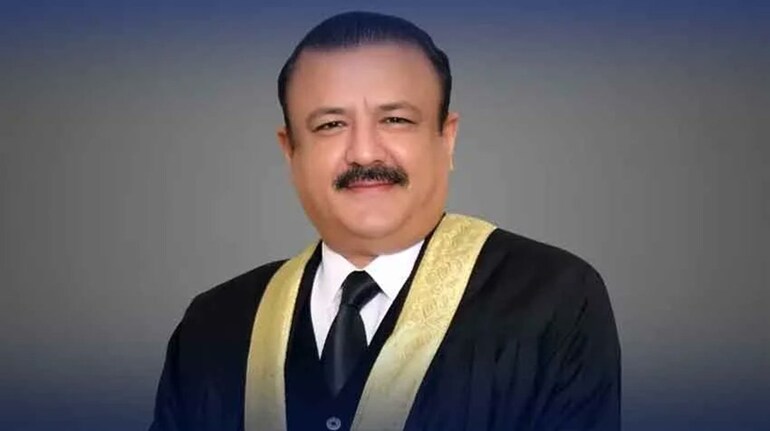

A judge of the Islamabad High Court has been removed from office after a division bench declared his law degree void ab initio, holding that his appointment to the high court was “without lawful authority” and therefore a legal nullity.
In a detailed 116-page judgement issued on February 23, the bench comprising Chief Justice Sardar Muhammad Sarfraz Dogar and Justice Muhammad Azam Khan set aside the appointment of Justice Tariq Mehmood Jahangiri, who had been elevated to the court in December 2020 and had served for nearly five years. He had already been barred from performing judicial functions since September last year.
According to a report by Dawn, the court relied on original records produced by the registrar of the University of Karachi, which revealed serious discrepancies in Jahangiri’s academic credentials.
The judgement concluded that his educational documents were tainted by fraud, impersonation and deliberate attempts to evade disciplinary punishment.
The bench noted that Jahangiri first appeared for his LL.B Part-I examination in 1988 using a fake enrolment number. He was caught using unfair means and, in 1989, was barred for three years under a university disqualification circular. Instead of serving the ban, the court found, he resorted to misrepresentation.
In 1990, he allegedly reappeared for examinations under the name “Tariq Jahangiri,” using an enrolment number originally assigned to another student, Imtiaz Ahmed. While he appeared for LL.B Part-II under his actual name, he used a different enrolment number. The court observed that a university issues only one enrolment number per programme and termed it “impossible” for a student to be assigned two numbers for the same degree. On this basis, his mark sheets and law degree were declared invalid.
The principal of Government Islamia Law College also informed the court that Jahangiri “was never admitted” to the institution, further undermining the legitimacy of his qualifications.
The bench was critical of Jahangiri’s conduct during the proceedings.
Despite being granted multiple opportunities to submit original documents and a written response, he had failed to do so. Instead, he filed applications seeking the constitution of a full bench, the recusal of the chief justice, and an indefinite adjournment, citing related proceedings pending before the Sindh High Court.
The division bench described these moves as “dilatory tactics” and held that once documentary evidence had been produced by the petitioner, the burden shifted to Jahangiri to prove the authenticity of his law qualifications. His failure to present evidence warranted an adverse inference, the court said.
With the degree declared void from the outset, the court ruled that his elevation to the high court stood vitiated in law, bringing an abrupt end to his tenure on the bench.
Discover the latest Business News, Sensex, and Nifty updates. Obtain Personal Finance insights, tax queries, and expert opinions on Moneycontrol or download the Moneycontrol App to stay updated!
Find the best of Al News in one place, specially curated for you every weekend.
Stay on top of the latest tech trends and biggest startup news.