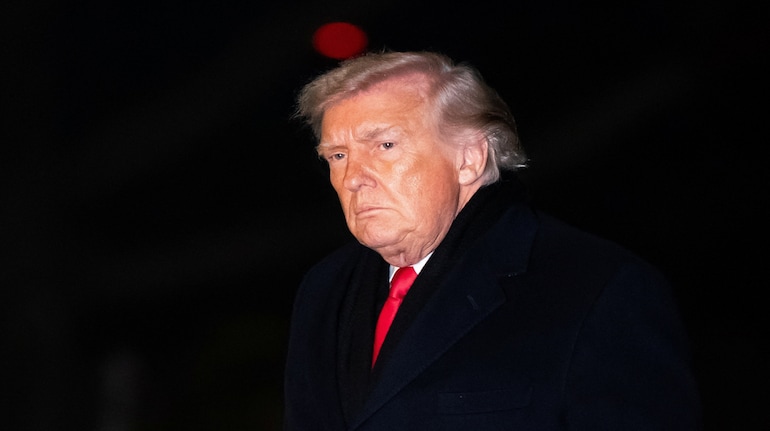

On the first anniversary of his second term, Donald Trump walked into the White House briefing room and did something presidents rarely do anymore. He talked. And talked. And talked.
For more than an hour, largely uninterrupted, Trump delivered a rambling monologue that drifted from immigration and crime to Greenland, NATO, his mother, baseball, God, and the size of a paper clip holding together what he said was a stack of his accomplishments. There was no clear agenda, no tight message discipline, and little effort to explain policy consequences. That, in itself, was the point.
The appearance felt less like a press conference and more like a statement of intent: this is what an unfettered Trump presidency looks like, the Washington Post reported.
A presidency shedding constraints
Over his first year back in office, Trump has steadily stripped away the internal and external limits that once shaped how he governed. Advisors, processes, and norms that might have narrowed his message or moderated his tone appear to matter less. What replaced them on Tuesday was confidence, improvisation, and a president comfortable filling silence with instinct.
In a room usually defined by sharp exchanges with reporters, Trump spoke uninterrupted for roughly 80 minutes before taking questions. His delivery was flat but relentless, moving freely between grievances, boasts, threats, and asides, often without transition.
At various points, he praised the Hell’s Angels for voting for him, claimed crime victims in Washington would no longer see their “lover killed,” speculated about deploying troops in American cities because towns “look better” with soldiers, and brushed aside Somalia as barely a country.
Policy as performance
Trump came armed with props: photos of alleged criminals arrested by immigration authorities, and a thick bundle of papers he said documented his achievements. He joked about injuring himself on the oversized clip holding them together, promising he would hide the pain even if his finger fell off.
The theatrics reinforced a familiar pattern. Policy announcements were often secondary to personal storytelling. Even serious issues, immigration enforcement, military power, sovereignty disputes, were folded into humour, bravado, or personal validation.
He ridiculed foreign leaders hours before heading to the World Economic Forum in Davos, joked that he might not be welcome after threatening to take Greenland, and mused aloud about renaming the Gulf of Mexico the “Gulf of Trump.” He insisted he was joking. Few in the room seemed convinced.
Personal history woven into power
Trump repeatedly blurred the line between the office and the man. While discussing executive orders on mental institutions, he detoured into memories of growing up in Queens, playing Little League baseball, and recalling his mother’s belief that he could have gone pro.
At another point, he fixated on a fatal shooting in Minneapolis, then turned the tragedy back toward himself, noting that the victim’s father was a “tremendous Trump fan,” and wondering aloud whether that support still held.
These moments revealed how Trump continues to centre his presidency around personal loyalty, grievance, and affirmation, rather than institutions or abstract principles.
Threats, insults, and confidence in victory
The president lashed out at perceived enemies with little restraint. He insulted conservative legal activist Leonard Leo, mocked special counsel Jack Smith, and spoke dismissively of Somali Americans as a voting bloc “rigging elections” in Minnesota, saying “they all ought to get the hell out of here.”
At the same time, he portrayed himself as a constant winner. “Here I am in a place called the White House,” he said, marvelling aloud at his own rise. “Who would have thought?”
Throughout, Trump framed his first year as a rescue mission completed. The country, he said, was dead. Now it is “the hottest country in the world.”
An uneasy moment of self-awareness
Briefly, Trump acknowledged a familiar problem: Americans don’t seem to believe prices have come down or that the economy is improving. His explanation was not policy failure but communication failure.
“Maybe I have bad public relations people,” he said, before blaming “fake news” and conceding that his administration had not promoted its accomplishments aggressively enough. The press conference itself, he suggested, was part of correcting that.
It was one of the few moments that hinted at introspection, though it quickly passed.
A leader who didn’t want to leave
Once questions began, Trump visibly perked up. He asked reporters about their nationalities, joked with them, sparred lightly, and repeatedly offered to take “one more” question. He lingered for nearly two hours before finally leaving to take a call with Turkish President Recep Tayyip Erdogan.
Asked whether he was willing to break up NATO over Greenland, he offered reassurance without substance. “I think something’s going to happen that’s going to be good for everybody,” he said.
Asked about divine purpose, he was more certain. “I think God is very proud of the job I’ve done.”
What the moment signalled
The briefing room appearance was not about policy detail or persuasion. It was a demonstration. Trump was showing how comfortable he has become governing without filters, without apology, and with diminishing regard for traditional boundaries.
As his second year begins, the message from the podium was unmistakable. This presidency is no longer negotiating with its constraints. It is operating as though they no longer apply.
Discover the latest Business News, Sensex, and Nifty updates. Obtain Personal Finance insights, tax queries, and expert opinions on Moneycontrol or download the Moneycontrol App to stay updated!
Find the best of Al News in one place, specially curated for you every weekend.
Stay on top of the latest tech trends and biggest startup news.