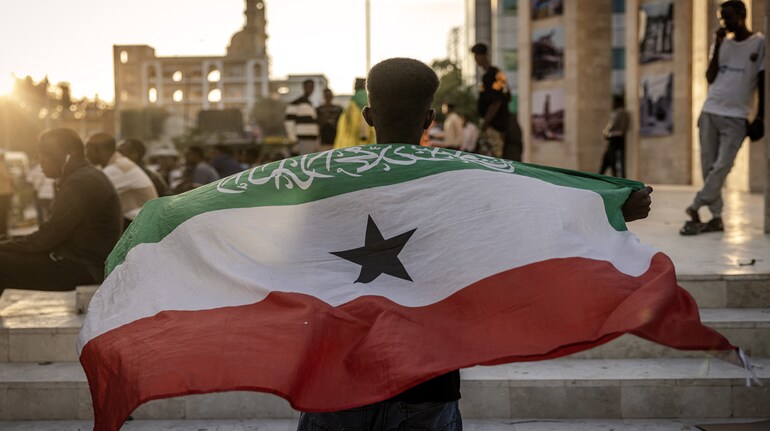

Israel on Friday formally recognised Somaliland as an “independent and sovereign state,” becoming the first country to do so and triggering sharp reactions from Somalia, the African Union and several countries in the Middle East.
The announcement was made by the office of Israeli Prime Minister Benjamin Netanyahu, which said Israel and Somaliland had agreed to establish full diplomatic relations.
Somaliland President Abdirahman Mohamed Abdullahi welcomed the decision, calling it a “historic moment” and the beginning of a “strategic partnership” between the two sides. Netanyahu, speaking to Abdullahi over the phone, said he was “very proud of this day” and extended his best wishes to the people of Somaliland.
Somalia, African Union reject move
The decision drew immediate opposition from Somalia and the African Union (AU). The AU rejected Israel’s recognition, reiterating that Somaliland “remains an integral part” of Somalia and warning that the move could set a dangerous precedent for peace and stability across Africa.
Several African countries echoed these concerns, describing Israel’s move as an attack on Somalia’s territorial integrity and cautioning that it could have far-reaching implications for regional stability.
What is Somaliland?
Somaliland is a self-declared republic in the Horn of Africa that broke away from Somalia in 1991 following the collapse of the Somali state. Despite operating as a de facto independent entity for more than three decades, it has remained unrecognised by the international community.
The region has its own government, constitution, currency, passports and security forces. It has also conducted multiple elections and maintained relative stability, even as Somalia has faced prolonged civil war and political turmoil.
President Abdullahi, who took office last year, has made international recognition a central priority of his administration.
Strategic location, limited recognition
Located along the Gulf of Aden, one of the world’s busiest shipping routes, Somaliland holds strategic importance. However, its lack of international recognition has limited access to foreign aid, international loans and large-scale investment, contributing to ongoing economic challenges.
Tensions over Somaliland escalated last year after landlocked Ethiopia signed an agreement to lease part of Somaliland’s coastline for a port and a military facility, a move Somalia strongly opposed as a violation of its sovereignty.
Despite the absence of formal recognition until now, countries such as the UK, Ethiopia, Turkey, the UAE, Denmark, Kenya and Taiwan maintain liaison or representative offices in the region.
Diplomatic fallout and global reactions
Following Israel’s announcement, Foreign Minister Gideon Sa’ar said both sides had agreed to establish full diplomatic ties, including exchanging ambassadors and opening embassies.
Netanyahu also said he would convey Somaliland’s interest in joining the Abraham Accords to US President Donald Trump. However, Trump ruled out recognising Somaliland, remarking, “Does anyone know what Somaliland is, really?”
The move was also criticised by the Palestinian Authority and Turkey, a close ally of Somalia. Egypt said its foreign minister held consultations with counterparts in Turkey, Somalia and Djibouti, with all sides reaffirming support for Somalia’s unity and sovereignty.
Discover the latest Business News, Sensex, and Nifty updates. Obtain Personal Finance insights, tax queries, and expert opinions on Moneycontrol or download the Moneycontrol App to stay updated!
Find the best of Al News in one place, specially curated for you every weekend.
Stay on top of the latest tech trends and biggest startup news.