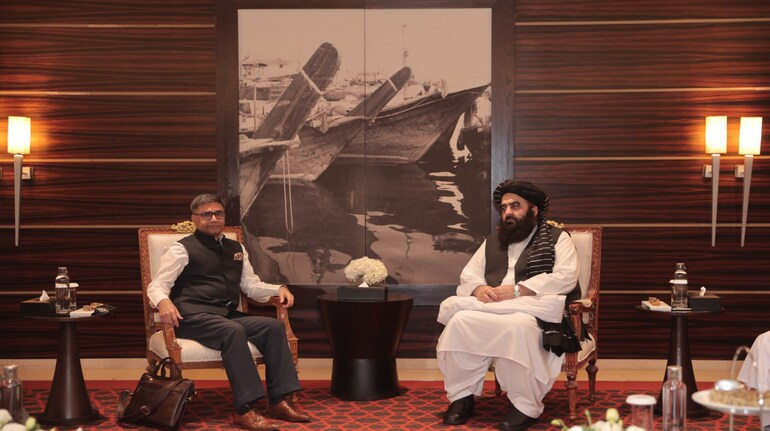
When the Taliban seized power in Afghanistan in August 2021, India promptly shut down its embassy in Kabul, and diplomatic ties between the two countries appeared to have hit a low point. However, with tensions escalating between New Delhi and Islamabad, signs are now emerging that India and Afghanistan may be quietly resetting their bilateral relationship.
India and Afghanistan share a long-standing and comfortable relationship, with strong cultural links stretching back centuries. But is the fresh round of engagements between the two countries a sign of renewed relationship? Let’s take a closer look.
Interaction between foreign ministersOn May 15, External Affairs Minister Dr S Jaishankar held his first conversation with Afghanistan’s acting Foreign Minister, Amir Khan Muttaqi, since the Taliban took control of Afghanistan. The call was seen as a significant step in rekindling diplomatic ties.
During the call, Muttaqi condemned the recent terror attack in Pahalgam, a gesture Jaishankar “deeply appreciated,” according to his post on X.
Jaishankar reaffirmed India’s traditional friendship with the Afghan people and stressed the need to explore avenues for future cooperation, particularly in development.
India’s “special gesture” at Attari-Wagah borderIndia last week allowed the entry of 160 trucks from Afghanistan through the Attari-Wagah border. These trucks were carrying dry fruits and nuts - an important export for Afghanistan. While India does not formally recognize the Taliban regime, it has operated a technical mission in Kabul since June 2022.
Taliban’s keen on renewing tiesIn an interview with Hindustan Times, Taliban spokesperson Suhail Shaheen underscored Afghanistan’s desire to normalise relations with India and invite foreign investment. “Afghanistan has had historical relations with India. There is a need to renew that,” he said.
Strategic and geopolitical considerationsSpeaking to Moneycontrol, strategic affairs analyst Atul Aneja explained why India seems to be engaging more closely with the Taliban, even though it has not formally recognized their regime.
On why India needs to maintain ties with Afghanistan in view of its strained relations with Pakistan, Aneja explained, “There was a time when Taliban 1.0 was very close to Pakistan. And it's not in India’s interest for Pakistan and Afghanistan to come closer because that gives Islamabad a lot of strategic depth. It also gives them access to central Asia. So, from a geopolitical perspective, it’s important for India to maintain good relations with Afghanistan to keep Pakistan in strategic debt.”
He also highlighted the economic aspect of improved ties with Kabul. “Afghanistan actually has a lot of mineral resources, including critical minerals, iron and copper. It's resource-rich. There is also an economic angle why we need to engage with Afghanistan,” he told Moneycontrol.
Aneja, meanwhile, also alarmed about China’s increasing footprint in the region with the China-Pakistan Economic Corridor (CPEC). “The China-Pakistan Economic Corridor, which runs from Gwadar to Kashgar in China, is being extended into Afghanistan. A place called the Wakhan Corridor, which links Afghanistan with China, is being considered for use by the Chinese for trade and transit. This kind of excessive Chinese influence is also not seen as favorable by India,” he told Moneycontrol.
A shared historyIndia and Afghanistan share a longstanding relationship rooted in historical and strategic ties. Their formal diplomatic journey began in 1950 with the signing of a "Friendship Treaty." India recognized Afghanistan’s republic in 1973 and supported successive governments, including Soviet-aligned regimes post-1979. Relations deteriorated in 1996 after the Taliban’s rise to power, which India, like most nations, refused to recognize.
Following the US-led intervention in 2001, India re-engaged by offering development aid and diplomatic support until August 2021, when the Taliban returned. In response, India evacuated diplomats and citizens under Operation “Devi Shakti,” also aiding over 350 Afghan Sikhs.
Initial contact resumed on August 31, 2021, when Indian Ambassador to Qatar Deepak Mittal met Taliban leader Sher Mohammad Abbas Stanekzai in Doha. India later took part in G20 and Moscow Format talks on humanitarian aid. Between November–December 2021, India hosted the “Delhi Regional Security Dialogue” and began delivering assistance, including 500,000 COVAXIN doses and 50,000 tonnes of wheat.
In June 2022, India reopened its technical mission in Kabul. J.P. Singh, India’s point person for Afghanistan, met acting Foreign Minister Amir Khan Muttaqi, and again in November 2024 with Taliban Defence Minister Mullah Yaqoob, marking broader engagement. Diplomatic conditions improved after Pakistan-Taliban ties soured following Pakistani airstrikes in December.
In January 2025, Foreign Secretary Vikram Misri led a delegation to Dubai to meet Muttaqi, focusing on trade and use of Iran’s Chabahar Port to bypass Pakistan. Engagement deepened in April 2025 with Joint Secretary M. Anand Prakash’s visit to Kabul, coinciding with rising India-Pakistan tensions after the Pahalgam terror attack.
India continues to balance strategic interests and humanitarian commitments in its evolving engagement with the Taliban-led Afghanistan.
Discover the latest Business News, Sensex, and Nifty updates. Obtain Personal Finance insights, tax queries, and expert opinions on Moneycontrol or download the Moneycontrol App to stay updated!
Find the best of Al News in one place, specially curated for you every weekend.
Stay on top of the latest tech trends and biggest startup news.