






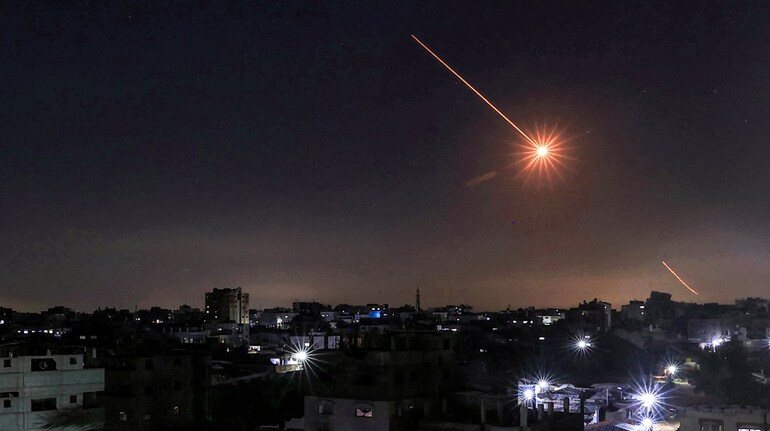

The conflict triggered by the joint US-Israeli strikes on Iran has rapidly transformed into a wider regional confrontation, pulling multiple countries across West Asia into the crisis. Iran has responded with waves of missile and drone attacks targeting Israel, American military bases and strategic infrastructure across the Gulf. Cities and installations in several countries hosting US forces have come under attack, while shipping routes near the Strait of Hormuz have also been hit. The widening battlefield now stretches from Israel to Gulf capitals and key maritime routes. The scale of retaliation shows Tehran attempting to demonstrate that it can resist pressure not just from Israel but from a wider coalition aligned with Washington.
Iran launches new wave of missile attacks
Iran’s Islamic Revolutionary Guard Corps confirmed on Monday that it had launched the "tenth wave of the True Promise 4 Operation," escalating its aerial campaign against Israel.
According to Iran’s Tasnim News Agency, the latest attacks used Khaybar missiles and targeted strategic locations including a government complex in Tel Aviv and military installations in Haifa and East Al Quds, also known as Jerusalem.
In a statement cited by Tasnim, the IRGC claimed the strike “opened doors to a massive inferno” across what it called occupied territories.
Iran also warned civilians in Israel to stay away from military and administrative facilities. The IRGC urged residents to “evacuate immediately from areas near military bases, security centres, and governmental facilities.”
Iranian officials have repeatedly said the attacks will continue. Earlier statements from the IRGC warned that “siren sounds in Israel would never cease,” indicating the possibility of sustained missile strikes.
Israel responds with targeted strikes
Israel has continued its own military campaign against Iranian leadership and security institutions.
The Israel Defense Forces said it killed several senior officials in Iran’s Ministry of Intelligence during strikes carried out as part of Operation Roaring Lion.
In a statement posted on X, the IDF said its attacks were guided by precise intelligence and targeted top figures within Iran’s intelligence apparatus.
Among those killed was Sayed Yahya Hamidi, described by the Israeli military as the "Deputy Minister of Intelligence for ‘Israel Affairs,’ who led terrorist activities targeting Jews, Western actors, and regime opponents in Iran and abroad."
The Israeli military also confirmed the death of Jalal Pour Hossein, identified as the "Head of the Espionage Division."
“The IAF also struck the Ministry's headquarters in Tehran,” the IDF said, adding that additional senior officials were eliminated during the opening phase of the operation.
Gulf countries hosting US bases come under attack
As the conflict widened, Iran expanded its retaliation beyond Israel. Several Gulf countries that host American military bases have reported missile or drone attacks.
These include Bahrain, Qatar, Kuwait and the United Arab Emirates, all of which host key US military installations used in operations across the Middle East.
Bahrain hosts the headquarters of the US Navy’s Fifth Fleet. Qatar houses the massive Al Udeid Air Base, which functions as the forward headquarters of US Central Command. Kuwait and the UAE host major airbases and logistics hubs that support American military operations in the region.
Reports of explosions and air defence interceptions have emerged from several Gulf capitals. According to international media reports, Iranian missiles and drones have targeted US assets and nearby infrastructure across these countries.
Oman too drawn into the crisis
Oman, which had initially stayed outside the direct military exchanges, has also been affected by the escalating conflict.
An oil tanker near the Omani coast came under attack amid the ongoing hostilities. The vessel had a crew of 20 people, including 15 Indian nationals and five Iranians. One Indian crew member was reportedly killed while four others were injured in the incident.
The attack occurred near the strategically important Strait of Hormuz, one of the world’s most critical energy shipping routes. The tanker had to be evacuated after the strike.
The incident highlights how the conflict is now threatening maritime traffic in the Gulf region. The Strait of Hormuz handles a significant portion of global oil shipments, and attacks in the area could disrupt global energy markets.
Maritime routes and energy infrastructure under pressure
The widening conflict is also affecting shipping in the Gulf. Reports indicate that multiple commercial vessels have been damaged as tensions escalated following the US-Israeli strikes. Shipping companies and maritime authorities have warned vessels to exercise extreme caution while navigating near the Strait of Hormuz.
Some shipping operators have begun rerouting vessels away from the region due to fears of missile or drone strikes.
Ports and logistics hubs across the Gulf have also experienced disruptions. Global airlines have diverted flights and temporarily halted operations across several Middle Eastern airspaces as the conflict intensifies.
Iran’s regional network raises stakes
Another key factor shaping the confrontation is Iran’s network of allied armed groups across the region.
Over the years, Iran has developed relationships with militant groups and allied militias in several countries. Analysts often refer to this network as the "Axis of Resistance."
This network includes Hezbollah in Lebanon, militia groups in Iraq and Syria, and the Houthi movement in Yemen. These groups have previously carried out attacks against Israeli and US targets.
The presence of these allied forces means the conflict could potentially expand into multiple fronts across the region.
A growing regional war
The confrontation now represents one of the most serious regional crises in recent years.
Iran possesses one of the largest missile arsenals in the Middle East and has demonstrated its ability to launch large-scale missile and drone attacks across the region.
Following the US-Israeli offensive that struck Iranian leadership compounds and military infrastructure, Tehran has responded with retaliatory strikes against Israel and US military facilities across several countries.
These attacks have triggered air defence responses in multiple countries and caused disruptions to civilian infrastructure.
Diplomatic calls for restraint
As the conflict widens, international leaders have called for de-escalation. Governments across Europe, Asia and the Middle East have warned that a prolonged conflict could destabilise global energy supplies and disrupt major trade routes.
Despite these calls, both sides appear determined to continue military operations.
Iran has indicated that its missile campaign will persist, while the United States and Israel have pledged to sustain strikes targeting Iran’s military and intelligence capabilities.
For now, the confrontation increasingly resembles a broad geopolitical showdown in which Iran is facing not just Israel but a wider coalition of countries aligned with Washington. The outcome could reshape the strategic balance across West Asia for years to come.
Discover the latest Business News, Sensex, and Nifty updates. Obtain Personal Finance insights, tax queries, and expert opinions on Moneycontrol or download the Moneycontrol App to stay updated!
Find the best of Al News in one place, specially curated for you every weekend.
Stay on top of the latest tech trends and biggest startup news.





