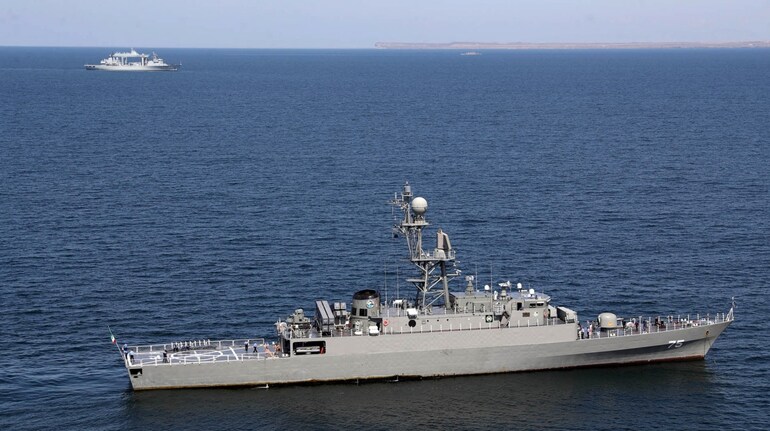

The ongoing war involving Iran, the United States, and Israel entered a new and dramatic phase on Wednesday as a US submarine torpedoed and sank an Iranian warship in the Indian Ocean. The incident occurred off the southern coast of Sri Lanka and has drawn attention in New Delhi because the strike took place in waters relatively close to India’s maritime neighbourhood.
The Iranian frigate Iris Dena was destroyed by a US torpedo attack early Wednesday morning, marking a rare naval escalation in the expanding conflict. While the incident has sparked debate about the implications for India’s security environment, experts say New Delhi has maintained a balanced and cautious approach as tensions move closer to the Indian Ocean region.
What happened to the Iranian warship Iris Dena
According to US officials, the Iranian vessel was sunk by an American submarine operating in international waters off Sri Lanka.
US Defence Secretary Pete Hegseth confirmed the strike and described the attack as a decisive naval action.
“An American submarine sank an Iranian warship that thought it was safe in international waters,” Hegseth said.
He added that the ship was destroyed by a Mark 48 heavyweight torpedo fired late Tuesday night.
“It was sunk by a torpedo, a quiet death -- the first sinking of an enemy ship by a torpedo since World War II,” Hegseth said. “Like in that war, back when we were still the War Department, we are fighting to win.”
The Iranian warship reportedly carried around 180 crewmembers. Sri Lankan authorities later said that 87 bodies were recovered while several sailors were rescued and taken to hospital in the southern port city of Galle.
Sri Lanka’s Foreign Affairs Minister Vijitha Herath said coastguards received a distress call early Wednesday.
“By 6 am, we dispatched a naval vessel, and by 7 am, the second naval vessel,” Herath said.
Sri Lanka responded under its obligations as a signatory to the International Convention on Maritime Search and Rescue.
Naval spokesman Budhika Sampath said rescuers did not initially see any vessel at the scene.
“Though the ship’s location was beyond our waters, it was within our search and rescue region. So we were obliged to respond as per international obligations,” Sampath said.
What was Iris Dena doing in the Indian Ocean
The presence of an Iranian warship in the Indian Ocean raised questions about why the vessel was operating so far from its traditional patrol areas.
Iris Dena was one of the newest frigates in Iran’s navy and part of the country’s southern fleet, which normally operates in the Strait of Hormuz and the Gulf of Oman. The vessel was equipped with surface-to-air missiles, anti-ship missiles, torpedo launchers, and a helicopter landing pad.
In the weeks before the conflict escalated, the warship had been participating in diplomatic naval engagements in the region.
The frigate took part in the International Fleet Review and the Milan-2026 naval exercise hosted by the Indian Navy in February. The multilateral exercise brought together more than 85 ships from 74 countries and aimed to strengthen maritime cooperation and professional interaction between participating navies.
Following the fleet review on February 18, the Iranian warship also docked at Visakhapatnam on February 20.
Local residents in the city told The Hindu that the crew members had interacted with civilians during their visit. One resident said the sailors had taken photographs with locals and visited shopping centres before departing the port.
Why the incident matters for India
The sinking of an Iranian warship near Sri Lanka has triggered debate among Indian strategic analysts about the broader implications of the conflict.
Former Indian Navy Chief Admiral Arun Prakash criticised the escalation and warned that the conflict is moving closer to India’s maritime neighbourhood.
“Sinking of Iranian warship, off southern tip of Sri Lanka, with heavy loss of life is a senseless & inflammatory act. Initiating another dimension of violence in this open-ended conflict will spread alarm across the high seas and disrupt global seaborne commerce. Condemnable!” Prakash wrote on X.
He later told India Today that the episode demonstrates how close the war has come to India.
“The sinking of the Iranian warship shows the Iran-US-Israel war has come to our doorstep,” he said.
International relations analyst Zorawar Daulet Singh also noted that the incident highlights the importance of India’s strategic planning.
“Iranian missiles have pushed the US Navy close to Indian waters. This is precisely one of the scenarios for which the US signed the LEMOA (logistics agreement) with India,” he wrote on X.
He also cautioned that India must act carefully to safeguard its interests.
“But the repercussions for India to be even an inadvertent war party in an aggressive & unprovoked intervention by the US would be dangerous. This is the time for the Indian government to act independently and intelligently to safeguard Indian interests,” he said.
At the same time, some observers pointed out that the incident took place in international waters and does not directly involve Indian territory.
Columnist Kamlesh Singh noted that the geographical proximity should not be confused with jurisdiction.
“While this is bad news and a reaction is imperative, must remember that the Indian Ocean not equal to Indian territory. The ship was on a visit to an Indian port but that was before the war began. Sooner or later, It was bound to be targeted by the enemy like any warship would be,” he wrote on X.
India rejects claims of US using its ports for strikes
As speculation spread about whether the United States may have used Indian facilities in the region to support operations against Iran, the Indian government moved quickly to dismiss such claims.
Indian officials rejected suggestions that US naval forces used Indian ports to launch or support strikes on Iranian targets.
Officials described the claims as “baseless” and reiterated that India has not allowed its ports or infrastructure to be used for military operations related to the conflict.
The clarification underscores New Delhi’s effort to maintain a balanced diplomatic position while protecting its strategic autonomy.
India has continued to focus on safeguarding maritime security and regional stability while avoiding any direct involvement in the expanding conflict.
Discover the latest Business News, Sensex, and Nifty updates. Obtain Personal Finance insights, tax queries, and expert opinions on Moneycontrol or download the Moneycontrol App to stay updated!
Find the best of Al News in one place, specially curated for you every weekend.
Stay on top of the latest tech trends and biggest startup news.