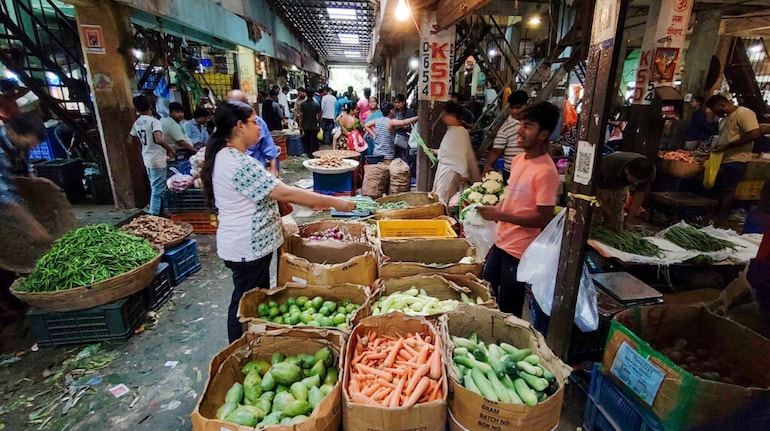

Prolonged conflict in West Asia could push up food and overall inflation as higher energy prices raise the cost of producing and transporting goods across the economy, NITI Aayog Member Ramesh Chand told Moneycontrol in an interview.
He added that rising energy costs could increase fertiliser production expenses and eventually feed into broader inflationary pressures, even though India’s food supply remains relatively secure due to strong domestic production.
“Energy is a basic input. It is used in producing food and across the entire economy. So, any increase in energy prices will have an effect on every sector. If the war prolongs, you will see the impact on overall inflation, including food inflation,” Chand said.
India’s retail inflation edged up to 3.2 percent in February from a revised 2.74 percent in January, according to government data released on March 12. Data from the new Consumer Price Index (CPI) series shows that price pressures have been gradually building in recent months. The CPI index rose to 104.57 in February, up from 104.46 in January and 104.10 in November and December, marking the fourth straight month of sequential increases in the price index.
India relatively insulated on food supplies
Chand said countries that depend heavily on food imports would face greater challenges if the conflict escalates and disrupts global supply chains.
“Countries that depend heavily on food imports will face bigger challenges. Some Gulf countries have very low food self-sufficiency,” he said.
India, however, remains relatively better placed due to its strong domestic food production base.
“India is relatively better placed because we produce most of our food domestically,” Chand said.
He added that the government is also working to ensure that geopolitical tensions do not disrupt India’s supply chains.
“The government is trying to maintain good relations with Iran, so that India’s supplies are least affected,” he said, adding that countries with limited domestic production would face greater risks. “The problem will be much greater for countries that depend heavily on food imports. Some Gulf countries have extremely low food self-sufficiency, and for some it is almost zero.”
Fertilisers the key agricultural risk
While India’s food availability may remain stable, Chand said fertilisers represent the biggest vulnerability for agriculture, if energy prices rise.
“The real concern in agriculture is fertilisers. For urea, roughly 80 percent of our requirement is produced domestically and about 20 percent is imported. Only around 20 percent of urea is imported, and those imports are quite diversified,” he said.
The bigger challenge lies in the energy used to produce fertilisers.
“The raw material for domestic urea production is natural gas, so the real concern is energy availability and prices,” Chand said, adding that import costs could also rise if the conflict continues. “If the war prolongs, the import bill will also go up, at least in the short term.”
Increase fertiliser imports from China
India’s fertiliser imports are spread across several countries, providing some cushion against supply disruptions.
“Urea imports are diversified. If needed, we can procure more from countries like China, which is a large producer. Even on imports, supply sources are quite diversified and we can procure urea from countries like China or Russia, if needed,” Chand said.
Rationalising fertiliser use
He said India could also manage potential supply pressures by improving fertiliser use efficiency across states.
“One option is to rationalise fertiliser use. In some states, there is excessive application beyond the recommended levels, so supply can be aligned closer to the optimal requirement,” Chand said.
“If a state is using more fertiliser than recommended, supply can be moderated accordingly. That would help ensure better distribution,” he added, noting that supply could also be redirected where needed. “In states where fertiliser use is excessive, some supply can be diverted to other states where the requirement is more balanced.”
Urea misuse and diversion concerns
Chand also pointed to past instances of subsidised fertiliser being diverted for non-agricultural uses.
“There has also been leakage of urea for non-agricultural uses in the past. Neem coating helped to some extent, but it does not completely eliminate diversion. In some cases, urea is diverted for uses such as for making adhesives in the plywood or board industry,” he said.
Promote bio-inputs
The current situation could also encourage greater adoption of bio-based agricultural inputs.
“This could also be a good opportunity to promote bio-inputs, which we have been discussing for a long time. Farmers can start preparing bio-inputs by decomposing agricultural waste instead of burning crop residues,” Chand said, adding that converting farm waste into organic inputs could gradually reduce dependence on chemical fertilisers.
Subsidy burden may increase
Higher energy prices could also increase the government’s fertiliser subsidy burden, he said.
“If energy prices increase, the cost of fertiliser production will rise and the subsidy requirement will also go up. That is something the entire world will have to deal with,” Chand said.
He added that the duration of the conflict remains uncertain. “At the moment, everyone is presuming that the conflict will not continue for very long,” he said, noting that economic consequences are inevitable during geopolitical crises. “Certain things inevitably happen during a war situation. You cannot completely wish them away.”

Discover the latest Business News, Sensex, and Nifty updates. Obtain Personal Finance insights, tax queries, and expert opinions on Moneycontrol or download the Moneycontrol App to stay updated!
Find the best of Al News in one place, specially curated for you every weekend.
Stay on top of the latest tech trends and biggest startup news.