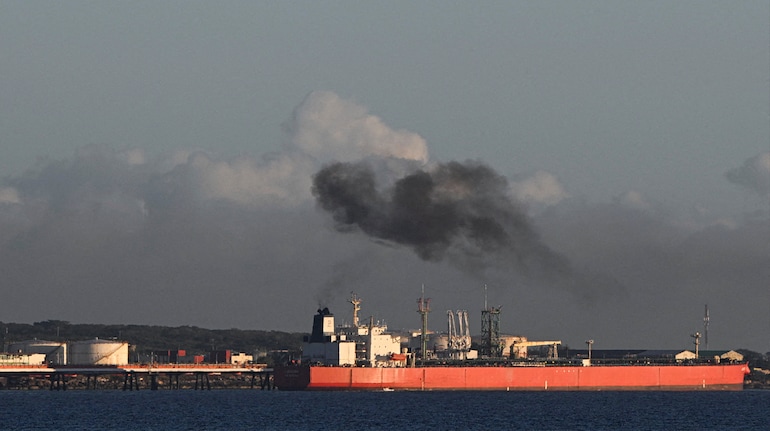
Iran’s move to shut the Strait of Hormuz has sent immediate tremors through global energy markets, with Asian economies expected to bear the heaviest burden if the disruption persists.
A senior commander of Iran’s Revolutionary Guards said on Monday that the strategic waterway had been closed and warned that any vessel attempting to pass through would be targeted, according to Iranian media reports.
The strait — a narrow 33-kilometre corridor between Iran and Oman — is one of the world’s most vital energy arteries. Around 13 million barrels of crude oil per day passed through it in 2025, accounting for roughly 31% of global seaborne crude flows, according to Kpler. Broader estimates suggest about a fifth of the world’s total oil supply moves through the channel.
It is not just oil at risk. Roughly 20% of global liquefied natural gas exports — primarily from Qatar — also transit the strait.
Markets reacted swiftly. Brent crude rose 2.6% to around $80 per barrel and is nearly 10% higher since the conflict escalated. Analysts warn that a prolonged closure could push prices beyond $100.
“The scale of what is at stake cannot be overstated,” said Hakan Kaya, senior portfolio manager at Neuberger Berman. A short disruption may be manageable, he noted, but a full or near-full closure lasting weeks could drive crude “well into triple digits” and lift European gas prices “toward or above the crisis levels seen in 2022.”
Shipping grinds into holding patterns
The Strait of Hormuz links the Persian Gulf to global markets via the Gulf of Oman. While pipelines in Saudi Arabia and the UAE provide limited alternatives, most volumes transiting the strait have no other viable exit route, according to the US Energy Information Administration.
Shipping traffic is already under strain. Major carriers including Maersk, Hapag-Lloyd, CMA-CGM and MSC have suspended operations in the area.
“No one is wanting to navigate it, and there’s no insurer who’s willing to stand behind any transport going through there right now.,” said Tom Goldsby of the University of Tennessee. “Those ships that got stuck in the Gulf are not going anywhere. ... There’s also a whole host of ships that were heading into the Gulf to replace them, and of course they’re anchored or going elsewhere now."
Data from Kpler shows roughly 70 laden crude tankers and 75 refined-product tankers currently inside the Gulf — about double normal levels — while around 60 more are waiting outside the strait.
Country Exposure: Who Is Most at Risk?
India
India faces one of the largest combined exposures in Asia. Around 60% of its oil imports originate in the Middle East, according to UBP. More than half of its LNG imports are Gulf-linked, Kpler data shows. A Hormuz-driven spike in crude prices would raise both oil and LNG contract costs, creating what analysts describe as a dual physical and financial shock.
Pakistan
Qatar and the UAE account for 99% of Pakistan’s LNG imports. With limited storage and procurement flexibility, any disruption would quickly strain power generation and industrial supply.
Bangladesh
About 72% of Bangladesh’s LNG imports come from Qatar and the UAE. The country is already running a structural gas deficit exceeding 1,300 million cubic feet per day, leaving little buffer against additional supply shocks.
China
China is the world’s largest crude importer and buys over 80% of Iran’s oil exports, according to Kpler. Roughly 40% of its oil imports and 30% of its LNG imports pass through Hormuz. However, China holds LNG inventories of about 7.6 million tonnes and maintains strategic reserves. “China is materially exposed but more flexible,” said Kpler analyst Katayama.
Japan
The Middle East supplies around 75% of Japan’s oil imports. Gulf LNG exposure is lower at roughly 6%, but reserves of about 4.4 million tonnes cover only two to four weeks of stable demand. Even without physical shortages, higher prices would weigh heavily on the economy.
South Korea
Around 70% of Korea’s oil imports come from the Middle East, with 14% of LNG sourced from Qatar and the UAE. LNG reserves stand at roughly 3.5 million tonnes. Net oil imports equal 2.7% of GDP, leaving the country exposed to external shocks.
Thailand
Thailand is particularly vulnerable to oil price inflation. Net oil imports amount to 4.7% of GDP, and Nomura estimates that every 10% rise in oil prices worsens the current account by around 0.5 percentage points.
Malaysia
Malaysia stands apart as a net energy exporter and could see some benefit from higher oil prices.
A narrow passage with outsized impact
The Strait of Hormuz has been a flashpoint before. Iran temporarily restricted traffic in February during military drills, sending oil prices up 6%. During the Iran-Iraq war of the 1980s, tanker attacks and naval mines disrupted traffic.
But a sustained blockade would mark a far more serious escalation. With a fifth of global oil and a substantial share of LNG shipments moving through this narrow corridor, even a short disruption can reverberate across continents.
If the closure endures, Asia’s import-dependent economies will face the steepest strain — through higher fuel bills, currency pressure and potential power shortages. For global markets, the message is clear: what happens in the Strait of Hormuz does not stay there.
(With inputs from agencies)
Discover the latest Business News, Sensex, and Nifty updates. Obtain Personal Finance insights, tax queries, and expert opinions on Moneycontrol or download the Moneycontrol App to stay updated!
Find the best of Al News in one place, specially curated for you every weekend.
Stay on top of the latest tech trends and biggest startup news.