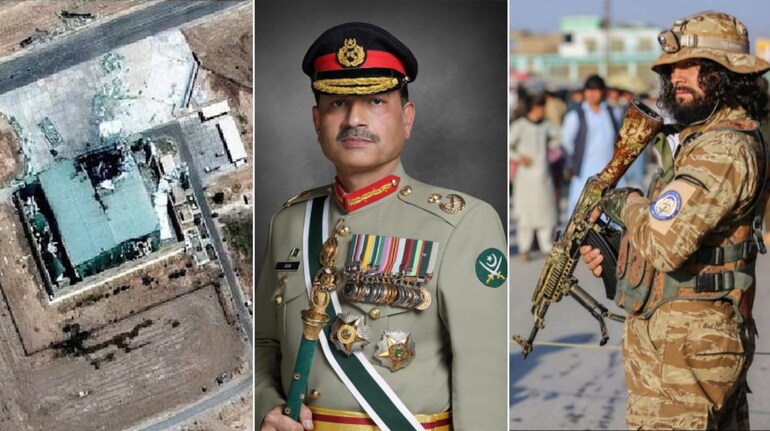
For Pakistan, 2025 was not a year of recovery or reform but one of deeper entrenchment into familiar crises. The country drifted further away from civilian supremacy, economic stability and regional credibility, even as its powerful military tightened its grip over the state. At the centre of this shift stood Asim Munir, who emerged not merely as the most powerful man in Pakistan but as the embodiment of a system where generals rule and elected leaders comply.
Munir’s elevation as the country’s first Chief of Defence Forces while continuing as Chief of Army Staff formalised what had long been true in practice. Civilian authority shrank further, reducing Prime Minister Shehbaz Sharif to little more than a political placeholder. Foreign policy, internal security, economic direction and even nuclear command increasingly flowed from Rawalpindi, not Islamabad.
Externally, Pakistan stumbled into military confrontation with India and faced growing instability on its western border with Afghanistan. Internally, it leaned once again on IMF bailouts, suppressed political dissent led by Imran Khan, and sought legitimacy abroad through carefully choreographed diplomacy with Washington, Riyadh and Dhaka.
Taken together, 2025 reinforced a familiar pattern. Pakistan remained trapped in a cycle where the army dominates, the economy survives on debt, extremism spills across borders and democratic institutions continue to erode.
Military conflict with India
Pakistan’s most consequential setback in 2025 came in the aftermath of Operation Sindoor, launched by India following the Pahalgam terror attack in April this year. The operation marked one of the most direct and punishing military actions against Pakistan’s terror infrastructure in years.
Indian strikes targeted multiple terror hubs across Pakistan and Pakistan-occupied Kashmir, including facilities linked to Lashkar-e-Taiba, Jaish-e-Mohammed and their renamed proxy outfits. Several Pakistani military installations were also damaged during the four-day escalation, exposing vulnerabilities in air defence and command infrastructure that Islamabad had long claimed were impregnable.
Pakistan’s response was chaotic and uneven. While Rawalpindi attempted to project resilience, satellite imagery and independent assessments indicated substantial losses. Terror launch pads that had operated with near impunity were dismantled, disrupting Pakistan’s long-running proxy war strategy against India.
More damaging was the narrative collapse. Pakistan struggled to convince either domestic or international audiences that it had emerged unscathed. Claims of “divine intervention”, later made by Asim Munir, only reinforced perceptions of denial rather than deterrence.
The conflict also deepened Pakistan’s isolation. Unlike previous crises, there was little international sympathy for Islamabad’s position. India’s case that the strikes were targeted, proportionate and anti-terror found broader acceptance.
Operation Sindoor underlined a hard truth for Pakistan. Its long-standing reliance on terror proxies had become a strategic liability rather than an asset. The episode exposed a military overstretched at home, vulnerable to precision strikes and increasingly unable to control escalation on its own terms.
Pakistan–Afghanistan border clashes
If the eastern front exposed Pakistan’s external fragility, the western border revealed its internal rot. Throughout 2025, clashes between Pakistani forces and Afghanistan-based militants intensified, driven largely by the resurgence of Tehrik-i-Taliban Pakistan.
Despite years of denials, Pakistan openly acknowledged that a significant share of TTP fighters were operating from Afghan territory. Cross-border attacks surged, killing Pakistani soldiers and civilians alike, while relations with the Taliban regime in Kabul deteriorated sharply.
Islamabad’s frustration was evident. Military officials issued public warnings to the Taliban, accusing them of harbouring terrorists and “spilling the blood of Pakistani children”. Yet these statements highlighted Pakistan’s own policy failure. Groups once nurtured as strategic assets had turned inward, threatening the state itself.
Border skirmishes displaced civilians, disrupted trade and underscored the absence of any coherent western border strategy. Pakistan found itself squeezed between an emboldened Taliban and a militant movement it could no longer control.
Asim Munir’s appointment as Chief of Defence Forces
The most telling institutional change of 2025 was Asim Munir’s appointment as Pakistan’s first Chief of Defence Forces while retaining his role as Army Chief. The move shattered any remaining illusion of civil-military balance.
In theory, the CDF post was meant to improve coordination among the services. In reality, it concentrated unprecedented power in one individual. Munir gained oversight of conventional forces, intelligence agencies and nuclear command, becoming Pakistan’s most powerful general since Pervez Musharraf.
The appointment exposed Pakistan’s power paradox. A civilian prime minister formally appointed his own boss. Parliament remained sidelined, and no meaningful debate took place on the implications for democracy or accountability.
Munir’s rise entrenched military supremacy at a time when Pakistan needed institutional reform, not further centralisation. It also reinforced fears that strategic decision-making was becoming more insular, ideological and detached from civilian oversight.
Imran Khan’s tightening confinement and political suppression
While the military consolidated power, Imran Khan remained behind bars, increasingly isolated and politically marginalised. In 2025, pressure on Khan intensified through legal cases, media restrictions and limits on family access.
Tensions peaked when Khan’s sisters staged protests outside Adiala Jail, leading to confrontations with security forces. Rumours of Khan’s death inside jail briefly triggered panic and unrest before authorities allowed him to meet his family, denying the claims.
Khan repeatedly accused Asim Munir of orchestrating his downfall, allegations that Rawalpindi dismissed but never convincingly addressed. The episode highlighted Pakistan’s shrinking political space, where dissent is contained rather than debated.
Asim Munir's meetings with Donald Trump
In an unusual diplomatic turn, Asim Munir met US President Donald Trump twice in 2025, once without civilian representation and later alongside Shehbaz Sharif. The optics were unmistakable. Washington dealt directly with Pakistan’s general, not its prime minister.
The meetings were followed by announcements of cooperation on minerals and energy exploration. While framed as economic opportunity, critics saw a familiar pattern of transactional engagement, short-term gains for long-term strategic dependency.
Pakistan–Bangladesh ties under Yunus and ISI’s shadow
In 2025, Pakistan quietly but steadily rebuilt influence in Bangladesh, exploiting political flux under the interim administration led by Muhammad Yunus. What appeared on the surface as a diplomatic thaw carried deeper strategic implications, particularly for India’s eastern flank.
High-level exchanges between Dhaka and Islamabad resumed after years of strain rooted in the 1971 Liberation War legacy. Pakistan framed the reset as economic and cultural engagement, but intelligence assessments and media reports pointed to something more troubling. The Inter-Services Intelligence, long accused of running proxy networks across South Asia, appeared to regain operational space in Bangladesh.
Security analysts flagged increased activity by Pakistan-linked Islamist groups, alongside the re-emergence of ideological narratives that mirrored Islamabad’s own playbook. These included renewed anti-Ahmadiyya messaging and the revival of groups with historical ties to Pakistan-based extremist networks.
The Yunus-led interim government maintained that it was pursuing balanced foreign relations. However, critics argued that Dhaka underestimated the risks of allowing Pakistan back into its security ecosystem. For India, the developments raised red flags about a potential eastern extension of Pakistan’s long-running strategy to encircle New Delhi through indirect influence.
Pakistan’s outreach to Bangladesh also reflected its broader desperation for relevance. Isolated in South Asia and increasingly checked by India in the west, Islamabad sought to open new theatres of influence. Bangladesh, grappling with internal instability, proved a convenient opening.
Rather than reconciliation based on accountability and history, the renewed ties appeared driven by opportunism. The result was a fragile alignment shadowed by intelligence operations and extremist spillover risks, with Bangladesh paying the price for Pakistan’s unfinished regional agenda.
IMF bailouts and economic addiction
Pakistan’s economy in 2025 once again survived not on reform or growth, but on borrowed time. Islamabad returned to the International Monetary Fund yet again, securing fresh bailout tranches tied to an expanding list of conditions. The numbers were stark. More loans, more conditions and little evidence of structural change.
The IMF imposed dozens of requirements, including fiscal tightening, energy price hikes and tax reforms. Yet one area remained conspicuously untouched. Military spending continued unchecked, reinforcing the perception that Pakistan’s generals were insulated from the economic pain imposed on civilians.
This pattern highlighted Pakistan’s addiction to bailouts. Each crisis was met with external financing rather than domestic correction. Export competitiveness stagnated, foreign investment remained weak and inflation continued to squeeze ordinary Pakistanis.
Economists warned that repeated IMF rescues were not stabilising Pakistan but entrenching dysfunction. Instead of addressing loss-making state enterprises, a narrow tax base and chronic dependence on imports, the country leaned on international lenders to plug gaps.
The contradiction was glaring. A state that projects military strength and nuclear capability could not sustain its own economy without external lifelines. Critics argued that IMF money indirectly subsidised Pakistan’s security apparatus, freeing resources that might otherwise have been forced into reform.
By the end of 2025, Pakistan remained trapped in a familiar cycle. Borrow, postpone reform, return for more. The cost was borne not by those in uniform, but by a population facing rising prices, shrinking opportunities and a future mortgaged to debt.
Defence pact with Saudi Arabia
Pakistan’s defence pact with Saudi Arabia in 2025 was projected as a strategic milestone. In reality, it underscored Islamabad’s growing reliance on external patrons to compensate for internal weakness.
The agreement expanded military cooperation, training exchanges and defence coordination between the two countries. Pakistani officials framed it as recognition of Pakistan’s importance in the Islamic world. Yet the optics suggested dependency rather than partnership.
For decades, Pakistan has leaned on Saudi Arabia during moments of economic or diplomatic distress, receiving oil on deferred payment, cash deposits and political cover. The 2025 defence pact followed the same script. Pakistan offered military expertise and manpower, while Riyadh provided financial support and legitimacy.
Critically, the pact did little to enhance Pakistan’s actual security. It did not address the country’s internal militant problem, economic fragility or regional isolation. Instead, it tied Pakistan closer to Middle Eastern power dynamics over which it has limited control.
India watched the agreement carefully but without alarm. New Delhi’s defence partnerships are diversified and transactional. Pakistan’s, by contrast, appeared rooted in necessity.
The pact also raised questions about Pakistan’s strategic autonomy. A military that prides itself on sovereignty increasingly relies on foreign capitals to stay afloat. In 2025, the Saudi defence agreement was less about strength and more about survival.
Why these developments concerned India
Pakistan’s trajectory in 2025 set off multiple alarm bells in New Delhi. India’s concerns were not driven by any single event but by the convergence of military dominance, economic fragility and renewed reliance on asymmetric tools.
The most immediate worry stemmed from Pakistan’s military posture under Asim Munir. Operation Sindoor demonstrated that while Pakistan’s conventional capabilities suffered setbacks, Rawalpindi remained committed to preserving terror infrastructure as a strategic lever. For India, this reinforced the assessment that deterrence would increasingly require swift, punitive responses rather than diplomatic restraint.
Equally troubling was Pakistan’s renewed activism in Bangladesh. Reports of deeper intelligence penetration and ideological influence raised fears of a coordinated attempt to stretch India’s security bandwidth across both western and eastern fronts. New Delhi has long viewed such manoeuvres as part of Pakistan’s playbook to offset its disadvantages vis-à-vis India through indirect pressure.
Pakistan’s instability on the Afghan border also carried implications for India. A resurgent TTP and worsening Pakistan–Taliban ties increased the risk of militant spillover across the region, threatening Indian interests and personnel in Afghanistan and beyond.
Economic weakness added another layer of concern. India has consistently argued at global forums that repeated IMF bailouts allow Pakistan to avoid reform while sustaining military priorities. From New Delhi’s perspective, international financial lifelines risk enabling the same security apparatus that fuels regional instability.
Finally, Pakistan’s deepening defence ties with Saudi Arabia and its transactional engagement with Washington underscored a persistent pattern. Islamabad seeks external backing to compensate for internal decline. For India, 2025 reaffirmed that Pakistan’s challenges are not episodic but structural, requiring long-term vigilance rather than short-term crisis management.
Discover the latest Business News, Sensex, and Nifty updates. Obtain Personal Finance insights, tax queries, and expert opinions on Moneycontrol or download the Moneycontrol App to stay updated!
Find the best of Al News in one place, specially curated for you every weekend.
Stay on top of the latest tech trends and biggest startup news.