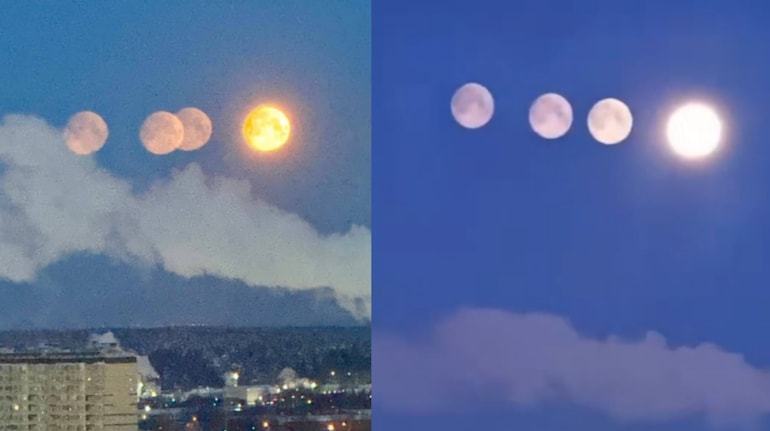

Skywatchers in Russia’s St. Petersburg witnessed a rare and striking sight this week as what appeared to be four moons lit up the night sky, a phenomenon known as a paraselene.
Photos and videos of the spectacle quickly spread across social media, showing multiple glowing orbs seemingly surrounding the Moon. The illusion left many viewers stunned, with the unusual alignment giving the impression that Earth’s natural satellite had suddenly multiplied.
Four moons appear over Russia’s St. PetersburgThe spectacle, known as a paraselene, was created by moonlight bending through ice crystals in the frosty atmosphere pic.twitter.com/J5C5h4uDx8 — RT (@RT_com) February 1, 2026
A paraselene, often called a moon dog or mock moon, is not an astronomical event but an atmospheric optical illusion. It forms when moonlight passes through thin, high-altitude cirrus or cirrostratus clouds filled with flat, hexagonal ice crystals. As the light is refracted by these crystals, bright spots appear on either side of the Moon, creating the effect of additional moons.
🌑🌕🌑A rare phenomenon — a “paraselene” — was observed overnight over Moscow and the surrounding region A paraselene, an optical illusion in which multiple Moon disks appear, occurs when light from the real Moon is refracted by flat ice crystals high in the atmosphere above the… pic.twitter.com/mRfzRu1Ilb — NEXTA (@nexta_tv) January 31, 2026
According to NASA, paraselenae typically appear at an angle of about 22 degrees or more from the Moon. They are much fainter than the Moon itself and are easiest to spot when the Moon is low on the horizon, which reduces glare and allows the surrounding light patterns to stand out more clearly.
The bright spots are always positioned at the same height above the horizon as the Moon. Their vertical shape and size depend on how the ice crystals are oriented in the clouds. When the crystals wobble or vary in size, the paraselenae can stretch vertically, making the illusion even more dramatic. Larger ice crystals tend to produce taller and more defined light pillars, according to Skybrary.
While paraselenae are related to the more commonly seen sun dogs, which occur during daylight, sightings involving multiple mock moons are far less frequent. The St. Petersburg display stood out because several paraselenae were visible at once, creating the appearance of four moons in the sky.
Such events are harmless and purely visual, but they offer a reminder of how atmospheric conditions can transform familiar night skies into something extraordinary. For those lucky enough to witness it, the rare paraselene over St. Petersburg turned an ordinary evening into a moment of quiet wonder.
Discover the latest Business News, Sensex, and Nifty updates. Obtain Personal Finance insights, tax queries, and expert opinions on Moneycontrol or download the Moneycontrol App to stay updated!
Find the best of Al News in one place, specially curated for you every weekend.
Stay on top of the latest tech trends and biggest startup news.