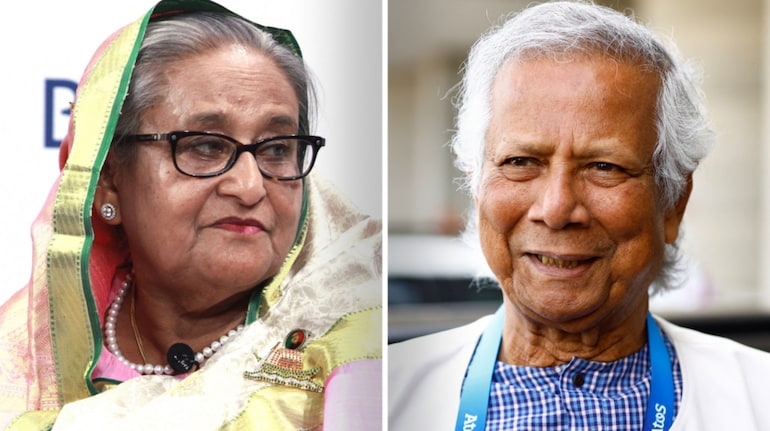
Former Bangladesh prime minister Sheikh Hasina has rejected demands by the Yunus-led interim government seeking her extradition from India, insisting that any such move must be guided by law rather than political motives.
In a rare interview from exile with CNN-News18's Shalinder Wangoo, Hasina said Bangladesh is facing an unprecedented crisis marked by democratic backsliding, institutional misuse, and growing insecurity.
She urged Dhaka authorities to pursue accountability in a way that fosters reconciliation rather than deepening political divisions.
“Any extradition request should follow the law, not politics. I respect the legal process, but such requests must be handled transparently and must safeguard the rights of the accused,” Hasina said from exile in New Delhi.
“My message to the authorities in Dhaka is simple: pursue justice, but do so in a way that heals the country rather than deepens divisions,” she added, stressing that “national healing can only begin when courts are beyond political control”.
Must read: ‘Democracy has ...’: Deposed Bangladeshi PM Sheikh Hasina slams Yunus government
Hasina also launched a sharp attack on the interim administration headed by Nobel laureate Muhammad Yunus, accusing it of exceeding its mandate and failing to deliver meaningful reforms.
She said an unelected interim government should have limited ambitions and focus solely on restoring democratic order and preparing the ground for credible elections.
“An interim government, because it is unelected and thus has no mandate, should be limited in its ambitions and have as short a lifespan as possible,” she said. “Regrettably, Yunus has so far failed on all these counts.”
She alleged that elections have been repeatedly delayed, the Awami League has been barred from participation, and democratic institutions have been misused to target political opponents.
“Judicial institutions have been weaponised as tools of political oppression, our once-free media has been silenced, and the rights of ordinary Bangladeshis to exercise their freedom of belief and political expression undermined,” she said, warning that “chaos and violence are becoming parts of our culture”.
The former prime minister also criticised the freezing of 124 bank accounts linked to her family and the creation of reform commissions on elections and the judiciary, describing these steps as overreach by an interim administration lacking electoral legitimacy.
Hasina’s remarks come amid heightened political tensions in Bangladesh, where she faces multiple cases, including a death sentence handed down in absentia by the International Crimes Tribunal over the 2024 protests, a verdict she has described as politically motivated and constitutionally invalid.
Reflecting on the student-led protests that led to her resignation and flight to India, Hasina acknowledged legitimate grievances but blamed “irresponsible political actors” for escalating unrest.
“What began as peaceful protests were turned into uncontrollable street violence,” she said, calling the loss of innocent lives “tragic”. The UN estimates that up to 1,400 people were killed during the unrest.
She also rejected corruption convictions against her and her family, including sentences handed to her sister, Sheikh Rehana, and niece, UK MP Tulip Siddiq, calling them politically driven. “No persuasive evidence was produced because none exists,” she said, adding that the trials were conducted in absentia and designed for “score-settling, not justice”.
Defending her 15-year tenure, Hasina highlighted economic growth, infrastructure expansion, and poverty reduction, citing IMF data that shows GDP growth of 450 percent during her time in office. She warned that banning the Awami League ahead of the February 2026 elections would undermine the legitimacy of the polls. “We have been elected nine times since 1971,” she said. “It is madness to exclude tens of millions of voters.”
Hasina also expressed concern over rising attacks on Hindu and other minority communities, accusing the interim government of denial and inaction, and warned that Bangladesh’s evolving ties with Pakistan must not compromise national security.
From exile, she said she would consider returning to Bangladesh only when democracy, constitutional rule, and guarantees of safety and due process are restored. “My vision is a reconciled Bangladesh,” she said. “Healing can begin only when the rule of law is real, politics is inclusive, and justice is impartial.”
Discover the latest Business News, Sensex, and Nifty updates. Obtain Personal Finance insights, tax queries, and expert opinions on Moneycontrol or download the Moneycontrol App to stay updated!
Find the best of Al News in one place, specially curated for you every weekend.
Stay on top of the latest tech trends and biggest startup news.