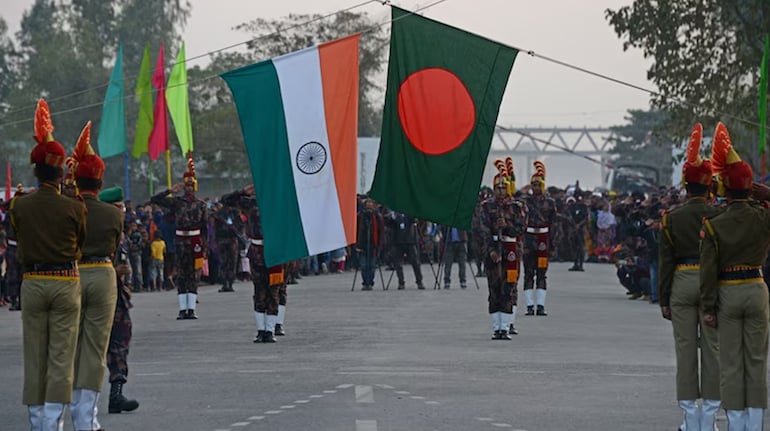
As Bangladesh hurtles toward a critical election, concerns are mounting in New Delhi over rising anti-India rhetoric, the growing influence of Jamaat-e-Islami, and the country’s increasingly unstable political landscape. Former Indian diplomat Veena Sikri warns that without inclusive polls and a fair electoral process, India could face serious security challenges along its eastern borders and North-East, while Bangladesh risks deeper internal unrest and minority-targeted violence.
Anti-India rhetoric ‘weaponised’ for political gain
Sikri told Moneycontrol that anti-India narratives in Bangladesh are being deliberately “weaponised” by political actors for internal purposes.
“The anti-India rhetoric is only part of the political discourse in Bangladesh that has been done by Jamaat-e-Islami ever since they did the regime change operation… Even in the run-up to the regime change operation, they stepped up the anti-India rhetoric and it’s been there at that pitch,” she said.
Sikri emphasised that India must counter this narrative through active engagement. “Because we have a cultural center, we have a lot of activities there in Bangladesh, we have to also reach out… We have to see how to counter that and how to get the message across,” she said.
She noted that ordinary Bangladeshis are already aware that the anti-India stance harms their country. “More and more, the people realise that this anti-India rhetoric doesn’t help them at all. People are saying, it was better earlier, under Sheikh Hasina's time, because everything was… factories were working, people had employment.”
Inclusive elections essential for stability and bilateral ties
Sikri stressed that the future of India-Bangladesh relations is closely tied to Bangladesh holding free, fair, and inclusive elections.
“No, if you have inclusive elections, free, fair and inclusive—not just free and fair… There may not be any observers even. They can just do what they like, which is quite unacceptable. But if you have free, fair and inclusive elections, it doesn’t matter who gets elected,” she said.
She added that inclusive polls would allow India to engage constructively. “Whichever party gets the most number of votes, it may be one party, it may be a coalition, that’s all fine. But the people will be satisfied that, yes, we have voted and we will live with the government. And India, of course, will be able to do business with that government,” Sikri said.
Sikri warned that without broad participation, insecurity and violence would continue. “If you get an election without participation, that election will lead to a lot of dissatisfaction among the people. So that insecurity will continue. The violence will continue. It’s not good for India. That’s not good because we don’t want an unstable Bangladesh. I think it’s better to insist on inclusive elections and see whatever happens at the end of that process.”
India’s strategic restraint and regional security
On India’s broader posture, Sikri noted that New Delhi has so far shown strategic restraint. “India has shown a lot of strategic restraint so far in its actions in Bangladesh… I think the government of India must be looking at the situation and studying it very carefully,” she said.
She warned that prolonged instability could affect India’s eastern security flank and the North-East. “You cannot have a situation that close to two crore minorities over there… It’s a really difficult situation. India has to take strong cognizance of this because it directly impacts the eastern flank and North-East,” Sikri said.
Political turmoil and the role of Jamaat-e-Islami
Sikri highlighted that the political environment in Bangladesh remains dominated by Jamaat-e-Islami. “The interim regime is not a constitutional body. It is not a legitimate organization. So there is no democracy there left at all… In Bangladesh, the Jamaat-e-Islami is in charge. They have got Mohammed Yunus as their spokesperson, as their mouthpiece,” she said.
She linked the current regime to Pakistan’s influence and warned that extremist-backed politics could continue to destabilise the region. “Pakistan wants Bangladesh to return to the pre-1971 level when it was East Pakistan… Even Pakistan state-sponsored terrorist groups like Lashkar-e-Taiba and Jaish-e-Mohammad are all back,” she said.
Call for sustained engagement
Sikri concluded that India must maintain measured yet firm engagement to de-escalate tensions and support democratic processes in Bangladesh. “It’s not good for India to have an unstable Bangladesh. And it’s not good for Bangladesh either… We have to ask for normalcy to return to the situation in Bangladesh. Otherwise, it will be really untenable,” she said.
Discover the latest Business News, Sensex, and Nifty updates. Obtain Personal Finance insights, tax queries, and expert opinions on Moneycontrol or download the Moneycontrol App to stay updated!
Find the best of Al News in one place, specially curated for you every weekend.
Stay on top of the latest tech trends and biggest startup news.