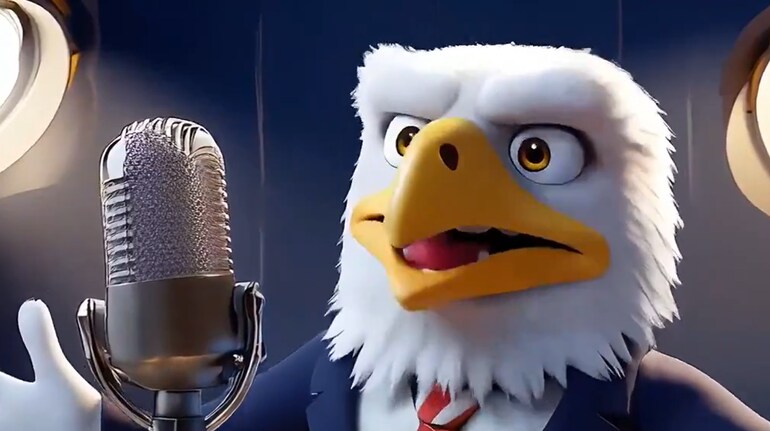

China’s embassy in Washington has taken an unusually playful swipe at the United States, sharing a satirical music video that mocks American fears about China’s economic rise at a time when talk of a so-called “China Shock 2.0” is gaining ground in policy circles.
The short clip, posted on X this week, uses bright animation and a deliberately catchy tune to make its point. A cartoon bald eagle, a familiar stand-in for the US, frets about China’s growing strength, crooning lines that suggest America “panics every time they reach the top”. The tone is light, but the message is not.
The video quickly drew reactions online, with some users seeing it as a clever piece of trolling and others as a reminder of how openly combative the trade relationship between the world’s two biggest economies has become.
The phrase “China Shock” originally entered economic debate to describe the wave of disruption that followed China’s rise as a manufacturing powerhouse in the late 1990s and 2000s, when Western companies shifted large parts of their production to Chinese factories. That first phase helped make China the world’s leading exporter, but it also left deep scars in parts of the industrial heartlands of the US and Europe.
Now, some economists and policymakers are warning about a possible “China Shock 2.0”, not driven by offshoring, but by Beijing’s efforts to push up the value chain in sectors such as electric vehicles, batteries, clean energy and advanced manufacturing, even as the US and its allies tighten tariffs and investment controls.
It is that anxiety the embassy’s video is clearly trying to puncture. Rather than issuing a stern diplomatic statement, Beijing has opted for humour, using a meme-like format that is more at home on social media than in traditional statecraft. The subtext is familiar: China wants to project confidence, and to suggest that attempts to contain its rise are both panicked and pointless.
The timing is not accidental. Relations between Washington and Beijing remain strained, with trade policy, technology controls and supply chains all firmly in the crosshairs. Both sides have been stepping up not just economic measures, but also the messaging that goes with them.
For China, such public-facing content serves a dual purpose. It plays well with a domestic audience that is used to seeing the country portrayed as standing up to Western pressure, while also signalling to the outside world that Beijing is comfortable taking the argument into the cultural arena.
Whether this kind of satire helps ease tensions or simply adds another layer to an already crowded information war is another matter. For now, though, it is a reminder that in the US-China rivalry, even trade disputes can turn into viral content.
Discover the latest Business News, Sensex, and Nifty updates. Obtain Personal Finance insights, tax queries, and expert opinions on Moneycontrol or download the Moneycontrol App to stay updated!
Find the best of Al News in one place, specially curated for you every weekend.
Stay on top of the latest tech trends and biggest startup news.