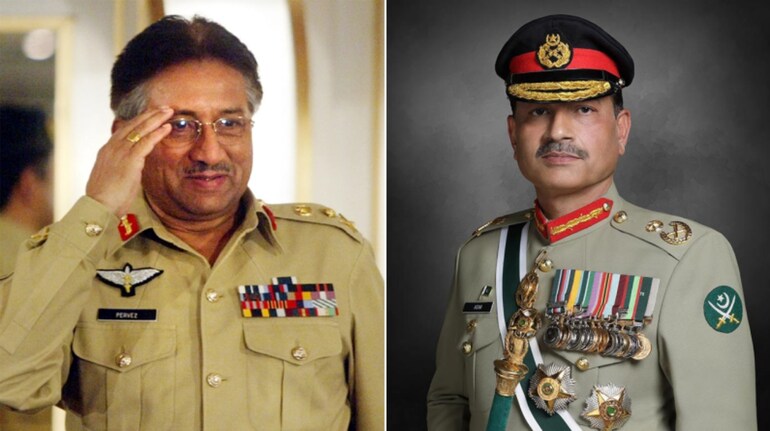
Pakistan’s all-powerful military ruler, Field Marshal Asim Munir, is reviving a dangerous old playbook: one built on terrorism, deceit, and hostility towards India. According to an India Today investigation, Munir has consolidated absolute control over the country’s military establishment and is now resurrecting the “bleed India” doctrine once championed by former dictator Pervez Musharraf. The strategy aims to destabilise India through proxy terror networks, even as Pakistan itself sinks deeper into political and economic chaos.
Under the 27th Constitutional Amendment, Munir has been elevated to Pakistan’s first-ever Chief of Defence Forces, giving him authority over the army, navy, air force, and nuclear command. The amendment effectively grants him indefinite tenure, making him Pakistan’s most powerful military figure in history, and rendering the civilian government little more than a facade.
A revived strategy of sub-conventional war against India
Munir appears to be “dusting off General Pervez Musharraf’s playbook” of low-intensity warfare and state-sponsored terror. The doctrine focuses on striking India below the threshold of open war, using militant groups like Jaish-e-Mohammed and Lashkar-e-Taiba to conduct attacks while hiding behind nuclear deterrence. The recent discovery of a Jaish-linked terror cell in Delhi, according to the report, fits into this broader pattern of Pakistan’s “hub-and-spoke” terror network designed to keep India under constant pressure.
This marks a worrying return to the era of “nuclear-enabled terrorism,” where Pakistan’s leadership combined the shield of its nuclear arsenal with the sword of cross-border terrorism. India Today warns that Munir’s approach mirrors Musharraf’s 1999 Kargil-style adventurism, aimed at bleeding India through a thousand cuts while maintaining plausible deniability.
A country in decline
Munir’s renewed hostility toward India comes even as Pakistan faces its worst internal crises in decades. Inflation, food shortages, and separatist violence in Balochistan and Khyber Pakhtunkhwa have weakened the state from within. Yet instead of focusing on domestic reform, Munir has chosen confrontation. As India Today highlights, his agenda appears driven by the military’s need to retain dominance by fuelling nationalism and portraying India as an eternal enemy.
Munir’s own words betray his insecurity. In a recent interaction with the Pakistani diaspora, he reportedly admitted that “Pakistan was a dump truck full of gravel compared to India’s shiny Ferrari.” The statement, quoted by India Today, reflects Pakistan’s grim economic state and widening power imbalance with India, yet the military leadership seems intent on ignoring reality in favour of rhetoric.
The risk for India and the region
The India Today report also outlines how India’s firm response policy has changed Pakistan’s calculations. Cross-border strikes in 2016 and 2019, followed by the swift retaliation to Pakistan’s recent provocations, have made it clear that India will not tolerate continued aggression. Despite this, Munir’s reliance on terror proxies and political repression risks pushing the region toward another cycle of instability.
For Pakistan, the costs could be far greater. With international pressure mounting and its economy on the brink, the continued use of terrorism as state policy risks further sanctions, diplomatic isolation, and deepening public discontent at home.
Discover the latest Business News, Sensex, and Nifty updates. Obtain Personal Finance insights, tax queries, and expert opinions on Moneycontrol or download the Moneycontrol App to stay updated!
Find the best of Al News in one place, specially curated for you every weekend.
Stay on top of the latest tech trends and biggest startup news.