
Tensions between the United States and Iran escalated sharply this week after the US military shot down an Iranian drone that flew close to an American aircraft carrier in the Arabian Sea, even as both sides prepare for talks on Iran’s nuclear programme.
According to the US military, the incident took place on Tuesday when an Iranian Shahed 130 drone approached the USS Abraham Lincoln as it was transiting international waters around 500 miles from Iran’s southern coast. The drone was intercepted and destroyed by an F-35C fighter jet launched from the carrier.
The episode comes days before US and Iranian officials are expected to meet on Friday, February 6, raising questions about whether military tensions could undermine diplomatic efforts.
US shoots down Iranian drone
US Central Command said the Iranian drone “aggressively approached” the USS Abraham Lincoln despite warnings. Captain Tim Hawkins, a CENTCOM spokesperson, said US forces took defensive action after the aircraft ignored attempts to de escalate the situation.
“The Iranian drone continued to fly toward the ship despite de-escalatory measures taken by US forces operating in international waters,” Hawkins said.
He added that an F-35C fighter jet was deployed to neutralise the threat. “No American service members were harmed during the incident, and no US equipment was damaged,” Hawkins said.
Iranian media outlet Tasnim News Agency confirmed that Iran lost contact with a drone operated by the Islamic Revolutionary Guard Corps while it was on what it described as a “reconnaissance, surveillance, and filming” mission over international waters in the Arabian Sea.
Tasnim reported that the drone had already transmitted its footage back to operators. “The reason for this loss of contact is being investigated, and details will be announced once it is confirmed,” the agency said.
Second incident near Strait of Hormuz
Soon after the drone episode, tensions rose further when two Iranian gunboats approached the M V Stena Imperative, a US flagged chemical tanker, in the Strait of Hormuz. According to Hawkins, the Iranian vessels threatened to board and seize the ship, prompting a response from US forces.
The Strait of Hormuz is one of the world’s most critical oil shipping routes, and any military confrontation there carries global economic risks.
Why the USS Abraham Lincoln matters
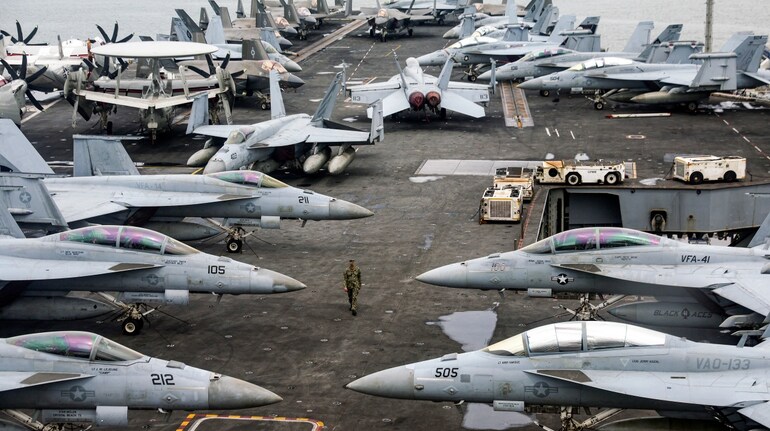
The incident has drawn renewed attention to the USS Abraham Lincoln, one of the US Navy’s most powerful aircraft carriers. Named after the 16th president of the United States, the carrier is often described by defence analysts as a symbol of American military strength.
Commissioned in 1989, the USS Abraham Lincoln is a nuclear-powered aircraft carrier of the Nimitz class. It is over 1,000 feet long and weighs more than 100,000 tonnes. Unlike conventional warships, it can operate for 20 to 25 years without refuelling its nuclear reactors.
The carrier functions like a floating military base. It carries a crew of more than 5,600 sailors and supports up to 90 aircraft, according to the Associated Press. These include F-35 Lightning II fighter jets, F/A-18 Super Hornets, early warning aircraft, and SH-60 Seahawk helicopters.
It was one of the carrier’s F-35 jets that shot down the Iranian drone on Tuesday.
The ship is also heavily armed, with systems such as the NATO Sea Sparrow missile, the Phalanx close-in weapon system, and the RAM missile system designed to intercept incoming threats. It also uses decoy systems like the AN SLQ-25A Nixie to confuse enemy torpedoes.
Surrounding the carrier is an entire strike group made up of destroyers, cruisers, and submarines, significantly increasing its defensive and offensive reach.
Long history in conflict zones
The USS Abraham Lincoln has a long record of deployment in tense regions. It took part in Operation Desert Storm in 1991 and spent nearly 300 days deployed during heightened tensions with Iran in 2019 and 2020.
More recently, in 2024, it carried out strikes against Houthi targets in Yemen and was used to deter Iranian activity in West Asia.
Earlier this January, the US announced that the carrier strike group was heading back to the region amid growing concerns about a possible confrontation with Tehran. Since last month, Washington has steadily increased its military presence in West Asia.
What happens next
The drone incident risks further aggravating US President Donald Trump, who has been weighing tougher action against Iran. However, the White House indicated that diplomacy remains on the table.
Press Secretary Karoline Leavitt said the planned US-Iran meeting was still expected to go ahead. “The meeting is still scheduled as of right now, but of course the president always has a range of options on the table, and that includes the use of military force,” she said.
For now, the shoot-down of the Iranian drone highlights how quickly tensions in the region can flare, even as both sides publicly signal interest in dialogue.
Discover the latest Business News, Sensex, and Nifty updates. Obtain Personal Finance insights, tax queries, and expert opinions on Moneycontrol or download the Moneycontrol App to stay updated!
Find the best of Al News in one place, specially curated for you every weekend.
Stay on top of the latest tech trends and biggest startup news.