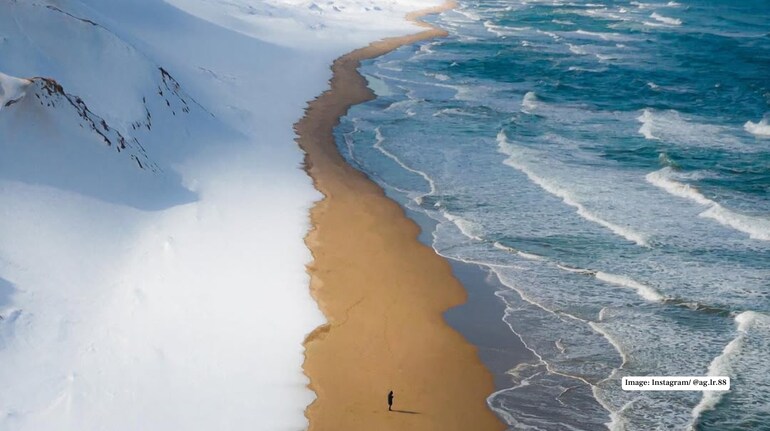

When people imagine winter in Japan, the images are almost predictable—snow festivals glowing at night, skiers carving through powdery slopes, steam rising from outdoor onsens as flakes fall gently around them. A beach, however, rarely enters that picture.
And yet, in the depths of winter, Japan reveals one of its most unexpected natural spectacles: snow-covered beaches where the sea remains wide awake.
Along parts of northern and western Japan, thick snow settles softly over golden sand while waves continue to roll in from an unfrozen ocean. It’s a scene that feels almost unreal—snow, sand, and sea coexisting in perfect contrast. Stillness meets motion. Silence meets sound. Winter meets water.
This phenomenon unfolds most dramatically in Hokkaido and along the San’in Kaigan coast, offering winter travellers a coastal experience found in very few places on Earth.
Hokkaido: Japan’s Most Surreal Winter Coastline
Hokkaido, Japan’s northernmost island, is one of the rare regions in the world where deep winter snowfall meets an open ocean. As Arctic winds sweep down from Siberia, the land is buried under snow—but the surrounding seas stay active, dark blue and constantly moving.
Snow clings to rocks, dusts the beach in soft curves, and blankets the shoreline, while waves crash rhythmically just metres away. The contrast is striking: frozen land against living water.
One of the most mesmerising sights appears near the Tokachi River mouth in Toyokoro, where chunks of crystal-clear ice—known as “jewellery ice”—form upstream and drift into the sea. These translucent ice blocks wash up on the sand, glittering in the winter light like scattered gemstones.
Other beaches, such as Shirahama, offer equally dramatic views, where snow-dusted sand meets rolling waves from the Sea of Japan, creating a palette of white, gold, and deep blue.
Best time to visit: January and February, when snowfall is heavy and temperatures are at their lowest.
San’in Kaigan Geopark: Japan’s Lesser-Known Winter Coast Secret
While many assume this snowy beach phenomenon belongs only to Hokkaido, western Japan quietly offers a similar spectacle through the San’in Kaigan UNESCO Global Geopark.
Stretching from Kyogamisaki Cape in Kyoto Prefecture to Tottori Prefecture, this geopark showcases dramatic geological diversity—ria coastlines, cliffs, valleys, volcanic formations, and Japan’s famous Tottori Sand Dunes.
In winter, cold seasonal winds bring heavy snowfall that transforms these sandy shores into surreal landscapes. Snow settles over dunes and beaches while the Sea of Japan remains unfrozen, producing the same rare snow–sand–sea combination.
Key locations include:
Hakuto Coast (Tottori Prefecture): Known for its snow-covered beaches meeting bright blue waters.
Tottori Sand Dunes: Even more striking when blanketed in white, offering a once-in-a-lifetime winter view of Japan’s most famous dunes.
This region is often overlooked by international travellers, making it even more special for those seeking quieter, uncrowded winter experiences.
Why This Phenomenon Is So Rare
Japan’s unique geography and climate make this possible. Cold Siberian air brings snow inland, while ocean currents keep the Sea of Japan active, preventing it from freezing. The result is a natural contradiction—winter landscapes without frozen seas.
When to See Snow, Sand and Sea Together
Season: December to February.
Peak months: January and February.
Best conditions: After fresh snowfall, during clear or lightly overcast days for dramatic contrast.
Early mornings are particularly stunning, when untouched snow blankets the beach and soft winter light reflects off the sea.
Why Winter Travellers Should Put This on Their List
This isn’t just a scenic anomaly—it’s an experience that rewires how you think about winter travel. Standing on a quiet beach, snow underfoot, waves crashing nearby, feels both peaceful and powerful.
There are no crowds, no beach umbrellas, no summer noise—just nature performing a rare balancing act.
In a world where travel often feels predictable, Japan’s snow-covered beaches remind us that the most unforgettable places are often the ones we never thought to look for.

Discover the latest Business News, Sensex, and Nifty updates. Obtain Personal Finance insights, tax queries, and expert opinions on Moneycontrol or download the Moneycontrol App to stay updated!
Find the best of Al News in one place, specially curated for you every weekend.
Stay on top of the latest tech trends and biggest startup news.