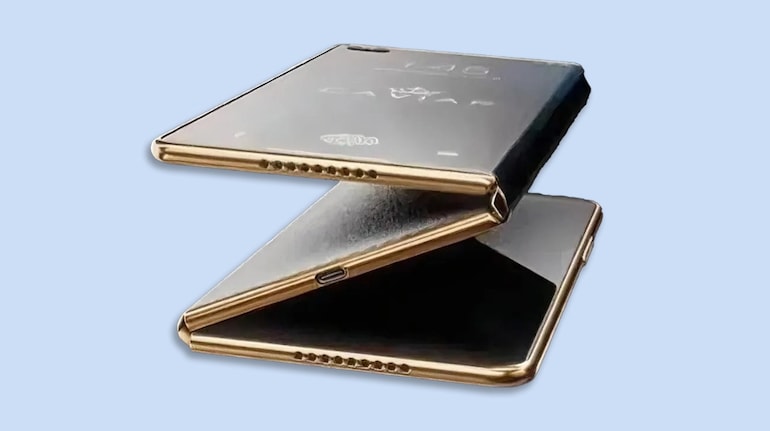
Samsung’s ambitious Galaxy Z TriFold has suffered a dramatic failure in a widely watched durability test, exposing the risks that come with adding more moving parts to an already fragile category. While Samsung’s recent foldables have shown real progress in structural strength, the TriFold appears to fall well short when pushed beyond ideal conditions.
In a durability teardown video by JerryRigEverything, the Galaxy Z TriFold was subjected to the usual battery of stress tests including scratching, exposure to heat, dirt ingress and bending. On the surface, the early stages were predictable. The display scratched easily, reinforcing the long-standing reality that foldable glass remains significantly softer than conventional smartphone screens.
Things deteriorated rapidly once the test moved beyond cosmetic damage. Dirt resistance emerged as a clear weakness. Fine particles introduced near the hinges caused immediate crunching and grinding sounds as the phone was opened and closed across all three panels. Unlike Samsung’s newer book-style foldables, the TriFold’s hinge system struggled to isolate internal mechanisms from debris, an issue that becomes more severe as the number of hinges increases.
The real failure came during the bend test. When pressure was applied in the wrong direction, something most slab phones can survive, the Galaxy Z TriFold simply gave up. With what appeared to be a moderate amount of force, pixels across the display tore and went dark. One hinge snapped at the lower section, effectively killing the device as a usable product. While data recovery might still be possible, screen replacement would almost certainly be prohibitively expensive.
This marks the first time a recent Galaxy foldable has catastrophically failed a reverse bend test so quickly. By comparison, the Galaxy Z Fold 7 endured a similar test with visible damage but remained functional, highlighting just how much more vulnerable the TriFold’s design is under stress.
Earlier durability demonstrations for the Galaxy Z TriFold had focused on hinge longevity rather than structural abuse. Those tests suggested the device could survive more than 150,000 full fold cycles, aligning with Samsung’s own claim of up to 200,000 folds. That figure may still hold true under ideal conditions, where the device is folded and unfolded exactly as intended.
What those claims do not account for is real-world misuse. The TriFold has no published tolerances for outward pressure applied opposite to its folding direction. When forced that way, the phone folds in on itself incorrectly, placing extreme stress on hinges, display layers and internal components. In this test, that stress proved fatal.
One small relief was that the battery did not puncture during the failure. However, the teardown also revealed a new pull-tab battery system that introduces another potential risk. When removed, the ultra-thin batteries appear prone to bending, raising concerns about long-term serviceability and repair safety.
The takeaway is blunt. While Samsung continues to push the boundaries of foldable design, the Galaxy Z TriFold demonstrates that adding complexity comes at a steep durability cost. More hinges mean more points of failure, and in this case, there was simply more to break.
For now, the Galaxy Z TriFold looks like a technical showcase rather than a device built to survive real-world abuse. Until foldable materials and hinge engineering catch up, triple-fold designs may remain impressive concepts that struggle outside controlled environments.


Discover the latest Business News, Sensex, and Nifty updates. Obtain Personal Finance insights, tax queries, and expert opinions on Moneycontrol or download the Moneycontrol App to stay updated!
Find the best of Al News in one place, specially curated for you every weekend.
Stay on top of the latest tech trends and biggest startup news.