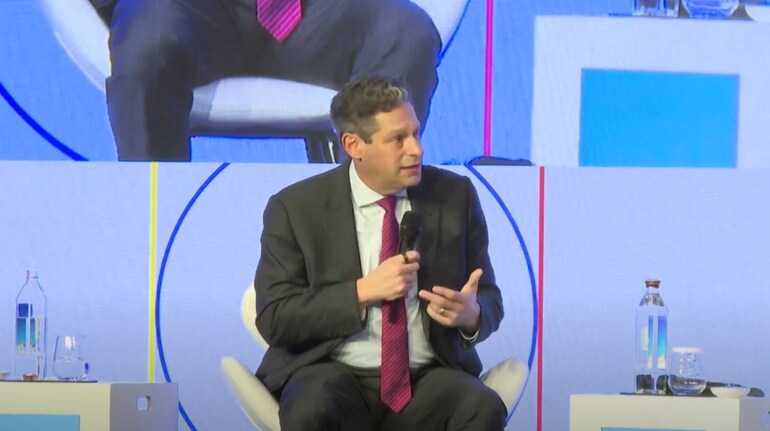
The regulatory choices made by democratic nations such as India and the United States will determine whether the future of technology is built on shared values like openness and transparency or follows an alternative model emerging from countries like China, said Joel Kaplan, chief global affairs officer at Meta, Facebook’s parent company.
Kaplan's comments come as the internet, once a borderless utopian space where information flowed freely, is becoming increasingly fragmented due to geopolitical tensions and growing government control over digital infrastructure and data flows through regulations.
"I don't think that's a future that we should accept...There are real opportunities to make progress in ensuring that's not the case," Kaplan said during a panel discussion at Raisina Dialogue 2025 in New Delhi on March 19. The panel also consisted of India's external affairs minister S Jaishankar, Fincantieri CEO Pierroberto Folgiero, and Swift's EMEA CEO Marianne Demarchi.
Kaplan said that it "was gratifying" to see Prime Minister Narendra Modi embracing the idea of open source artificial intelligence (AI) at the Paris AI summit in February 2025. "I'm really optimistic about what I see in India and it makes me think we can avoid that kind of future" he said.
In January, Meta chief executive Mark Zuckerberg announced plans of investing $60 billion to $65 billion in capital expenditure in 2025 to bolster the company's AI efforts amid intensifying competition among tech giants. This includes building "powerful, advanced, performative foundational (AI) models" which Meta plans to make available to developers across the world for free.
The company plans to launch Llama 4, the next major version of its Llama open AI models, in the coming weeks. Kaplan said that developers can build upon these AI models to fine-tune, modify, customise, and apply their local language datasets "A country that is really thriving in taking advantage of that opportunity is India" he said.
Also read: Meta bets on India's AI talent with Llama 3.1, Hindi support
"This is how we can ensure that the shared values of the world’s great democracies are embedded in the technology of the future. We recognize that it's not just American tech companies like Meta making these investments and developing open-source AI technologies" Kaplan said.
He was referring to the meteoric rise of Chinese AI startup DeepSeek, which claims to be offering an AI model capable of rivaling top-tier models from US companies such as Meta, OpenAI, and Google at a fraction of the cost.
Kaplan said that the Chinese are fierce competitors in this area and they understand that this is "one of the technological battlefields of the future". Hence, it is critical to determine whether a "global open-source standard will emerge", he mentioned.
In the past technological advances, both Linux and Android followed an open-source model and have the "shared democratic values of openness and transparency" he said.
Also read: Meta to pour hundreds of billions into AI infrastructure as Zuckerberg shrugs off DeepSeek threat
Trump vs Biden administrationKaplan, a longtime Meta executive with close Republican ties, was promoted as global affairs head of the social networking giant in January 2025, following Nick Clegg's departure after a six-year stint. The move was part of Meta's efforts to strengthen its ties with the US administration as Donald Trump took office on January 20.
During the panel discussion, he said that US President Trump and his administration are much more interested in expanding the freedom of expression online than the previous Joe Biden administration.
"The bigger change we're experiencing as a company and as a sector is that we have an administration in Washington that is interested in promoting American technology, and defending American tech companies against what it perceives to be a discriminatory regulations, particularly in the European Union in recent years," he said.
On Community Notes rolloutMeta also overhauled its content moderation policies in January, ditching its third-party fact checking system in favour of a crowdsourced approach with Community Notes, which was first introduced by Twitter (now X) prior to its acquisition by tech billionaire Elon Musk.
The company started testing Community Notes on Facebook, Instagram, and Threads in the United States from March 18.
"The third-party fact checking system we had put in place several years ago to deal with misinformation just proved to be too prone to political and partisan bias. It had destroyed at least as much trust and credibility as it had built, so we decided to replace the system" Kaplan said.
He said the social networking firm will take its time to ensure it "understands how the system is working and gets it right" before looking to expand to other countries.
"We will take into consideration the different information ecosystems and news ecosystems that exist in different countries and we will make sure that we do it deliberately and carefully," Kaplan said.



Discover the latest Business News, Sensex, and Nifty updates. Obtain Personal Finance insights, tax queries, and expert opinions on Moneycontrol or download the Moneycontrol App to stay updated!
Find the best of Al News in one place, specially curated for you every weekend.
Stay on top of the latest tech trends and biggest startup news.