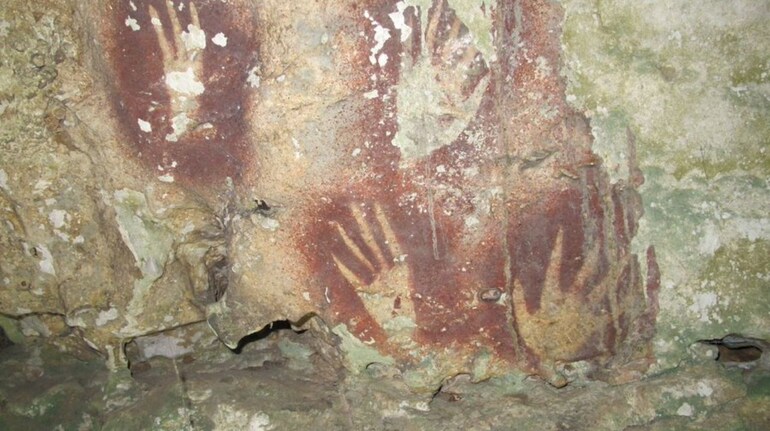

Scientists have uncovered what may be humanity’s earliest known art. The cave is located on Muna Island in Sulawesi, Indonesia. Faded hand stencils are visible on the limestone walls clearly. Researchers dated the art to at least 67,800 years ago. This pushes back known symbolic human behavior in Southeast Asia significantly.
The stencils were made by placing hands and blowing pigment. Some fingers appear stylized, showing deliberate artistic choices by humans. The discovery challenges previous assumptions about where art first emerged.
Ancient Hands on Limestone Walls
The stencils were created by blowing pigment around human hands. This technique left a negative outline of the hand on rock. Fingers in some stencils were intentionally narrowed or altered noticeably. It suggests early humans understood symbolic representation and abstract meaning. Such behavior indicates cognitive complexity far earlier than previously believed.
How Scientists Dated the Art?
Researchers used uranium-series dating on mineral layers over pigment. Tiny calcite deposits formed naturally over thousands of years precisely. This method gives a minimum age of 67,800 years for the art. It confirms the stencils predate other famous European cave artworks. Advanced dating techniques strengthen understanding of early human migration patterns.
Oldest Cave Art Known.The cave art dates back at least 67,800 years, according to research published in Nature. pic.twitter.com/t7slEOgxBI — Brian Roemmele (@BrianRoemmele) January 21, 2026
Who Made This Masterpiece?
The stencils were made by early Homo sapiens, modern humans. They lived in Sulawesi during the Late Pleistocene era. Symbolic hand art indicates cognitive and cultural sophistication existed already. This challenges earlier assumptions that Europe was the cradle of art. Human creativity was widespread and advanced in multiple prehistoric regions.
Comparison With Other Ancient Cave Art
European cave art is much younger than Indonesia’s hand stencils. For example, Chauvet Cave in France dates around 37,000 years. Australian rock art is about 50,000 years old at earliest. Indonesia’s stencils now hold the record as the oldest known art. This shows early human creativity was widespread, not just European-centered.
What Made This Art the World’s Oldest?
The art was dated using uranium-series analysis of mineral layers. Calcite deposits formed naturally over and above the pigments precisely. This method gives a minimum age of 67,800 years for the stencil. Stylized finger shapes suggest symbolic or communicative intention by humans.
Future Plans for This Art
Caves like these require careful preservation to prevent damage or decay. Researchers are documenting the stencils digitally for archival and study purposes. Monitoring humidity, human access and environmental factors is essential. It reveals that early humans in Southeast Asia were symbolic thinkers. This discovery highlights the universality of creativity in our species.
Discover the latest Business News, Sensex, and Nifty updates. Obtain Personal Finance insights, tax queries, and expert opinions on Moneycontrol or download the Moneycontrol App to stay updated!
Find the best of Al News in one place, specially curated for you every weekend.
Stay on top of the latest tech trends and biggest startup news.