India’s newest radar satellite has started work with a scene both familiar and fresh. Its first detailed view of the country marks a moment many scientists had waited for.
What did Nisar record in its first release?
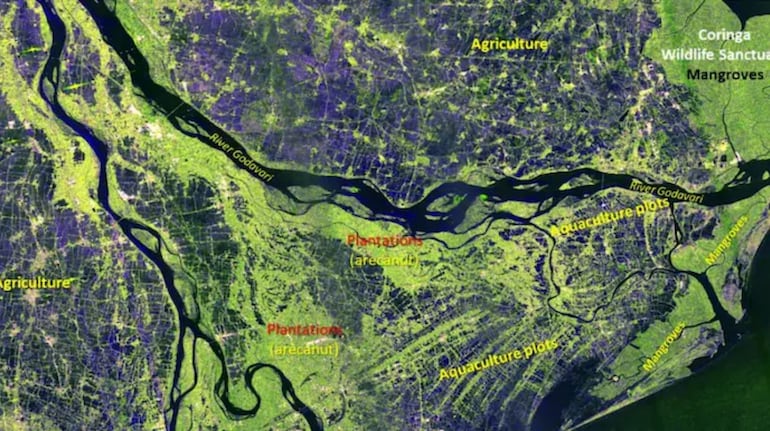
Nisar’s S-Band radar captured the Godavari River Delta with striking detail, showing mangroves, fields, arecanut crops and aquaculture ponds. ISRO released the high-resolution image as the mission completed 100 days in orbit. The satellite lifted off on July 30, 2025, aboard ISRO’s GSLV-F16 from Sriharikota, starting a long sequence that prepared it for operations.
 Mangroves and varied land use across the Godavari Delta, Andhra Pradesh (Image: ISRO)
Why was the early deployment so complex?
The spacecraft carries a 12-metre reflector, NASA’s largest in Earth orbit. It sits on a 9-metre boom that unfolded slowly from August 9 to 15. Teams at ISRO’s ISTRAC in Bengaluru and NASA’s JPL coordinated the release of its wrist, shoulder, elbow and root joints. Checks confirmed both S-band and L-band radars worked as designed, allowing the mission to proceed.
How did Nisar prove its imaging accuracy?
The satellite began collecting data on August 19, scanning India and several global calibration sites. Corner reflectors near Ahmedabad helped refine pointing checks, while passes over the Amazon rainforest confirmed image consistency. These tests produced data suited for farming studies, forestry work, hydrology, geoscience mapping and Himalayan ice tracking. Analysts noted its strength in scanning deltas at night or through cloud cover.
What can Nisar monitor from its high orbit?
The satellite circles at 747 km in a sun-synchronous path, covering land and ice every 12 days. Its dual-frequency system can detect tiny surface shifts, allowing earlier warnings for disasters, ecosystem changes and climate pressures.
Nisar’s progress highlights a major India-US partnership, supported by a $1.5 billion mission plan. The satellite’s regular mapping promises steady environmental insight at a time when precise data is needed worldwide. Its start of science operations shows the mission is ready for a long period of detailed observation.
Discover the latest Business News, Sensex, and Nifty updates. Obtain Personal Finance insights, tax queries, and expert opinions on Moneycontrol or download the Moneycontrol App to stay updated!
Find the best of Al News in one place, specially curated for you every weekend.
Stay on top of the latest tech trends and biggest startup news.