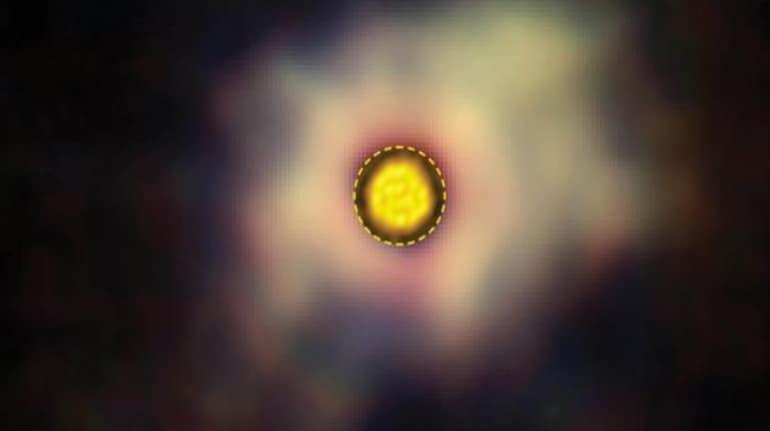
New research reveals that starlight alone cannot push dust from giant stars. This overturns decades of assumptions about how essential atoms spread. Astronomers studied the red giant star R Doradus, a nearby cosmic neighbour. It sheds gas and dust, containing carbon, oxygen, and nitrogen. These elements are vital for planets, life, and the galaxy’s chemistry.
What Did the Study Say?
The research shows that the long-held idea of starlight pushing dust outward is incomplete. Dust grains around giant stars are too tiny to be propelled effectively. This challenges previous beliefs about how carbon, oxygen, and nitrogen reach space. The findings suggest alternative mechanisms may play a crucial role in stellar winds.
Where and Who Conducted This Study?
The study was led by astronomers from Chalmers University of Technology in Sweden.
They focused on the nearby red giant star R Doradus, which sheds large amounts of gas and dust. The results were published in the journal Astronomy & Astrophysics.
“We thought we had a good idea of how the process worked. It turns out we were wrong. For us as scientists, that’s the most exciting result”, says Theo Khouri, astronomer at Chalmers and joint leader of the study.
Can Starlight Really Push Dust Outward?
For years, scientists believed starlight drove dust outward from stars. Observations with the Very Large Telescope’s SPHERE instrument challenged this idea. The dust grains are far too small to be moved effectively. Computer simulations confirmed starlight lacks the force to drive stellar winds.
What Forces Could Be Driving Stellar Winds Instead?
Alternative mechanisms may be key to launching dust into space. Stellar pulsations, convective bubbles, or dynamic dust formation could be responsible. These processes may determine how atoms essential for life travel. Understanding them reshapes our view of cosmic chemical enrichment.
Does This Research Have Any Future Prospects?
The study opens new avenues for understanding how life’s building blocks travel across the galaxy. Researchers may explore stellar pulsations, convective bubbles and dynamic dust formation as alternative mechanisms. Findings could reshape models of planet formation, star evolution, and cosmic chemical distribution. This discovery provides fresh insights into the journey of atoms essential for life.
Discover the latest Business News, Sensex, and Nifty updates. Obtain Personal Finance insights, tax queries, and expert opinions on Moneycontrol or download the Moneycontrol App to stay updated!
Find the best of Al News in one place, specially curated for you every weekend.
Stay on top of the latest tech trends and biggest startup news.