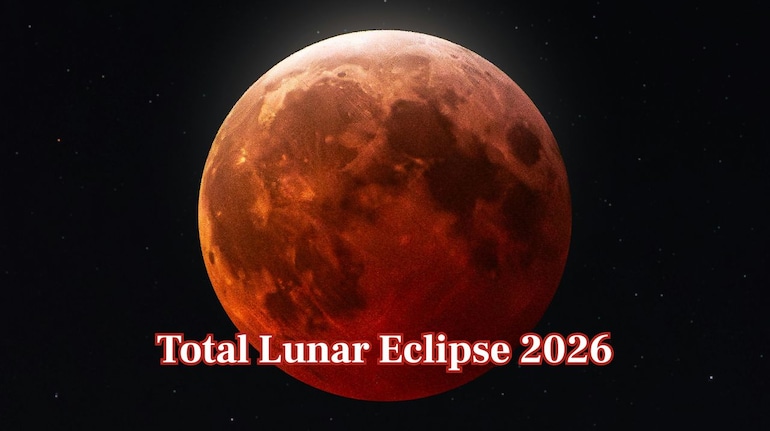

India will witness a total lunar eclipse on 03 March 2026, offering skywatchers a brief evening spectacle weeks after many missed February’s annular solar eclipse.
Astronomers say the event will unfold shortly after sunset. A lunar eclipse occurs under precise alignment. Earth moves directly between the Sun and Moon. Its shadow then stretches across the lunar surface. Unlike solar eclipses, viewing spans vast regions. Anyone on the night side can observe.
Lunar Eclipse 03 March 2026: Timing In India
On 03 March, India will see limited stages. The Moon will rise already partly eclipsed. In New Delhi and Noida, timing remains exact. Moonrise aligns with the partial phase. The visible period will be short.
The observable stage begins at 18:22 IST. Maximum visibility follows at 18:27 IST. The eclipse ends locally by 18:47 IST. Clear skies will determine viewing success. Unobstructed horizons will improve the spectacle.
Why India Missed February’s Solar Eclipse
Many across India missed February’s solar event. The annular solar eclipse occurred on 17 February 2026. During that alignment, the Moon appeared smaller. It was positioned near apogee then.
At apogee, the Moon looks slightly reduced. It cannot completely cover the Sun. This produces the Ring of Fire effect. Solar eclipses require narrow geographic positioning. Observers must stand along a thin corridor. That corridor avoided the Indian subcontinent entirely. The disappointment was therefore largely geographical.
Why The Moon May Turn Red
Eclipses are often described as shadow play. On 03 March, Earth casts its umbra outward. When the umbra fully covers the Moon, totality occurs. India is expected to witness totality briefly.
The Moon may appear deep red. This phenomenon is known as a Blood Moon. The colour shift results from Rayleigh scattering. Earth’s atmosphere bends incoming sunlight. Blue wavelengths scatter more readily away. Longer red wavelengths continue through atmosphere. Those red tones reflect back from the Moon. The result is a coppery glow.
Because Earth is far larger, its shadow spreads widely. Nearly half the planet can watch. Lunar eclipses are therefore easier to observe. For Indian skywatchers, the display begins at moonrise. Though brief, the moment promises lasting memories.
Discover the latest Business News, Sensex, and Nifty updates. Obtain Personal Finance insights, tax queries, and expert opinions on Moneycontrol or download the Moneycontrol App to stay updated!
Find the best of Al News in one place, specially curated for you every weekend.
Stay on top of the latest tech trends and biggest startup news.