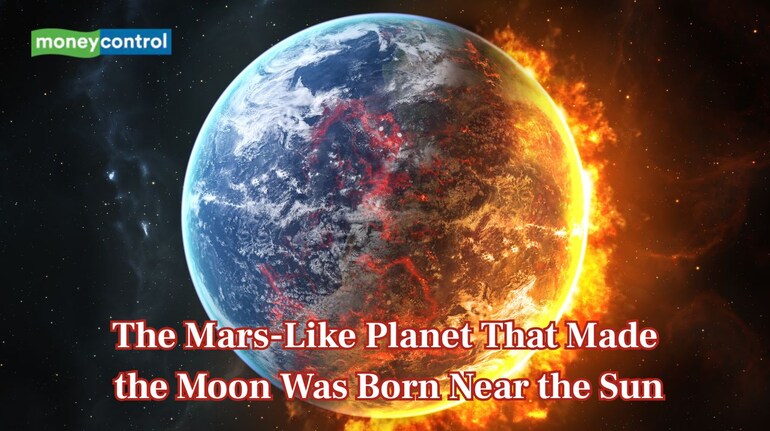
A quiet question has long hovered over lunar science. How did the Moon gain its make-up, and why does it resemble Earth so closely? A new study now offers a clearer view, suggesting the missing answers may lie closer to the Sun.
Theia Origin Clues From Earth Rocks
Scientists believe a planet named Theia struck early Earth. That impact created debris which later formed the Moon. But why are Earth and Moon compositions so alike?
Researchers from the Max Planck Institute for Solar System Research led the study. They examined iron isotopes in 15 Earth rocks. They then compared these with six lunar samples from Apollo missions. Their work was reported by Scientific American.
The team also measured molybdenum and zirconium isotopes. These elements helped outline Theia’s size and structure. Their findings indicate Theia held a rocky body with a metal core. It likely formed in the inner Solar System, even closer to the Sun than Earth.
Heavy Elements Reveal Impact History
The work helps explain heavy elements inside Earth’s mantle. Scientists say Earth gained molybdenum and zirconium from Theia during the collision.
The study suggests Theia held about 5–10% of Earth’s mass. These details refine models of the early Solar System. Sara Russell at London’s Natural History Museum said the findings show how violent events shaped the Earth–Moon system.
What Questions Guide Future Research?
How did the isotope signatures survive the collision? How did inner Solar System materials mix so evenly?
Researchers plan to run new simulations using their updated data. They hope future lunar missions will return fresh samples. These may reveal more about the impact that shaped the Moon.
Scientists continue exploring the ancient event that formed Earth’s closest companion.
Discover the latest Business News, Sensex, and Nifty updates. Obtain Personal Finance insights, tax queries, and expert opinions on Moneycontrol or download the Moneycontrol App to stay updated!
Find the best of Al News in one place, specially curated for you every weekend.
Stay on top of the latest tech trends and biggest startup news.