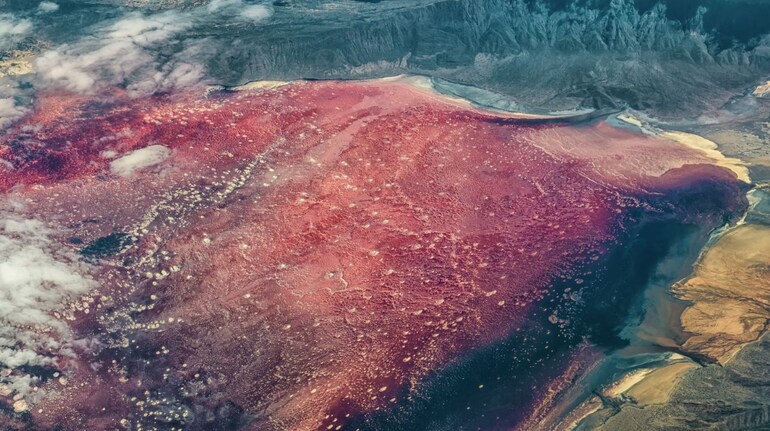

At first glance, Lake Natron looks like a surreal painting, its waters glowing red beneath the African sun, yet beneath this beauty lies one of the most hostile natural environments on Earth, where chemistry, geology and life collide in striking and unsettling ways.
Lake Natron chemistry creates deadly yet beautiful waters
Lake Natron lies in northern Tanzania, near Kenya’s border. The lake formed nearly 1.5 million years ago. Powerful tectonic movements shaped the East African Rift. Volcanic activity further altered the surrounding landscape. Nearby rises Ol Doinyo Lengai, revered by the Maasai. The volcano’s eruptions released sodium rich ash. These minerals flowed into the shallow lake basin. Over time, evaporation concentrated salts dramatically.
The lake’s water reached extreme alkaline levels. Its pH measures around 10.5. This matches the corrosiveness of household ammonia. Such water can burn skin and eyes. Animals entering the lake often suffer dehydration quickly. Survival becomes nearly impossible for unadapted species. The environment earned a reputation as lethal. Yet its danger also fuels its haunting beauty.
Red waters and the mystery of petrified animals
Lake Natron’s colour shifts throughout the year. During dry periods, evaporation intensifies salinity levels. Salt loving microorganisms flourish under these conditions. Haloarchaea and cyanobacteria dominate the ecosystem. Their pigments tint the water red and orange. From high altitudes, the lake appears blood red. This striking colour can be seen from aircraft.
Animals dying near the shoreline often appear petrified. Sodium carbonate preserves their bodies remarkably well. This process resembles ancient Egyptian mummification techniques. Decomposition slows dramatically under these conditions. Carcasses stiffen and harden into stone-like forms. Photographs of these remains spread widely online. They reinforce the lake’s fearsome global reputation.
How life survives in a hostile African lake
Despite its dangers, Lake Natron supports specialised life. Lesser flamingos rely heavily on the lake. They feed on the abundant algae present. Massive breeding colonies gather along the shores. The lake’s harsh chemistry keeps predators away. What appears deadly becomes a protective refuge.
Flamingos have adapted to withstand alkaline waters. Their legs and skin resist chemical burns. The lake provides a rare safe nesting ground. This makes Lake Natron ecologically significant. It supports a large portion of global populations.
Across cultures, water symbolises life and renewal. Rivers like the Ganga are worshipped deeply. The Jordan River holds spiritual importance worldwide. Lake Natron stands apart from these traditions. It inspires awe rather than reverence.
Here, beauty and danger exist together. The lake tells a deeper ecological story. Extreme environments still nurture adapted species. Lake Natron remains a reminder of nature’s contradictions. It shows how life survives at the edge.
Discover the latest Business News, Sensex, and Nifty updates. Obtain Personal Finance insights, tax queries, and expert opinions on Moneycontrol or download the Moneycontrol App to stay updated!
Find the best of Al News in one place, specially curated for you every weekend.
Stay on top of the latest tech trends and biggest startup news.