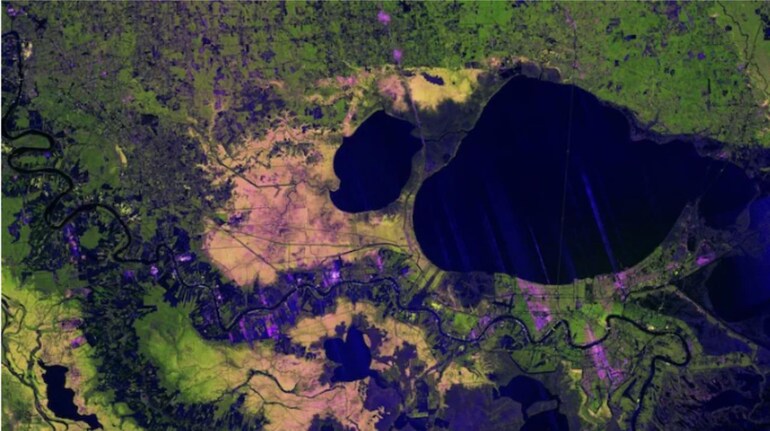

A newly released satellite image highlights how radar technology can reveal Earth’s surface even through thick cloud cover, offering early insight into NASA and ISRO’s ambitious NISAR mission.
The image, captured in late autumn, focuses on the Mississippi River Delta in southeastern Louisiana. It marks one of the first public demonstrations of NISAR’s ability to map land clearly despite challenging weather conditions. Produced while the satellite was still undergoing post launch system checks, the image also coincides with the release of early sample datasets for scientists worldwide.
What the NISAR radar image reveals
The colourful radar image shows a broad sweep of southern Louisiana landscapes. Major landmarks include New Orleans, Baton Rouge, Lake Pontchartrain, and the winding Mississippi River. Wetlands, forests, farmland and residential areas appear together in striking detail.
Unlike optical satellite images taken the same day, clouds did not obscure this view. The radar instrument used microwaves capable of passing through cloud cover. This allows scientists to study terrain and vegetation regardless of weather conditions.
Captured on 29 November, the image highlights subtle surface differences. Urban neighbourhoods in New Orleans appear in green and magenta tones. These colours depend on building layouts and street orientations affecting radar reflections.
The Lake Pontchartrain Causeway is also visible. The twin bridges stretch nearly 39 kilometres and are recognised as the world’s longest continuous bridge over water.
Why the technology matters
The radar data came from NISAR’s L band synthetic aperture radar. Developed by NASA’s Jet Propulsion Laboratory in California, it uses wavelengths about 24 centimetres long. These signals can distinguish trees, crops, water and built environments.
Healthy forests west of the Mississippi River appear bright green. In contrast, parts of the Maurepas Swamp show mixed colours. Scientists say these patterns may indicate thinning tree populations.
Agricultural fields also stand out clearly. Darker areas suggest fallow land, while brighter sections indicate taller vegetation. Such detail could support global crop monitoring and food security planning.
What comes next for the NISAR mission
NASA officials say thousands of mission data files will be released in late February. These will be available through the Alaska Satellite Facility in Fairbanks. The archive manages and distributes NASA’s radar satellite data.
NISAR was launched on 30 July from India’s Satish Dhawan Space Centre. It is a joint mission between NASA and the Indian Space Research Organisation. The satellite carries two radar instruments operating at different wavelengths.
It will observe Earth’s land and ice surfaces every 12 days. The spacecraft uses a 12 metre wide drum shaped reflector. NASA says it is the largest radar antenna reflector ever sent into space.
Scientists expect NISAR data to support disaster response, infrastructure monitoring and agricultural management worldwide.
Discover the latest Business News, Sensex, and Nifty updates. Obtain Personal Finance insights, tax queries, and expert opinions on Moneycontrol or download the Moneycontrol App to stay updated!
Find the best of Al News in one place, specially curated for you every weekend.
Stay on top of the latest tech trends and biggest startup news.