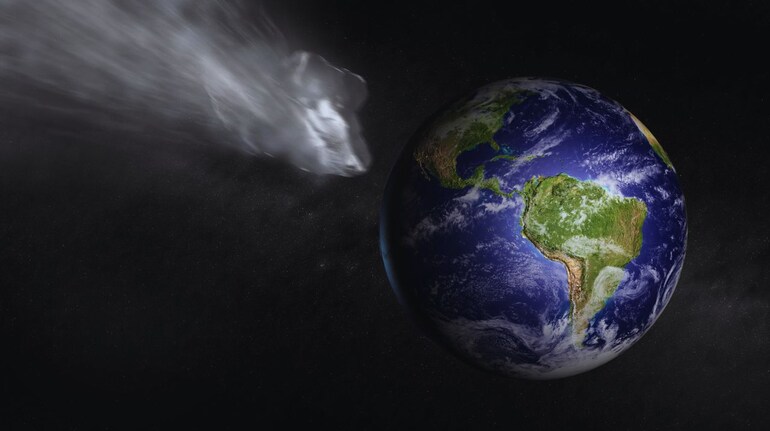
NASA’s Jet Propulsion Laboratory (JPL) is closely tracking two asteroids, 2023 HB7 and 2017 TU1, which are set to make a safe pass by Earth on August 5, 2024. Although neither asteroid poses any danger, their close approach offers a great chance for scientific study and observation.
Asteroid 2023 HB7: A Big Space Rock with a Safe Distance
Asteroid 2023 HB7 is about 99 feet wide, which makes it a significant object in space terms. It is classified as potentially hazardous because of its size and speed. However, there’s no need for concern, as it will safely zoom past Earth at a distance of 3,470,000 kilometres —much farther than the Moon.
- Approximate Size: 99 Feet (About the Size of a Small Airplane)
- Closest Earth Approach: 3,470,000 Kilometres
- Date of Closest Approach: August 5, 2024
Asteroid 2017 TU1: Smaller but Closer
The second asteroid, 2017 TU1, is slightly smaller at about 70 feet in diameter. It will come closer to Earth than 2023 HB7, passing within 2,400,000 kilometres of our planet. Despite its closer approach, it poses no threat.
- Approximate Size: 70 Feet (Similar to a Small Airplane)
- Closest Earth Approach:2,400,000 Kilometres
- Date of Closest Approach: August 5, 2024
NASA’s Ongoing Vigilance
NASA’s JPL constantly monitors space for potentially hazardous asteroids, keeping track of their paths and any possible risks they may pose. This vigilance helps scientists learn more about these ancient space rocks that date back to the early solar system.
While it’s exciting to think about large asteroids approaching Earth, there’s no need for alarm. Both 2023 HB7 and 2017 TU1 are expected to pass safely by our planet, with no danger to us.
Discover the latest Business News, Sensex, and Nifty updates. Obtain Personal Finance insights, tax queries, and expert opinions on Moneycontrol or download the Moneycontrol App to stay updated!
Find the best of Al News in one place, specially curated for you every weekend.
Stay on top of the latest tech trends and biggest startup news.