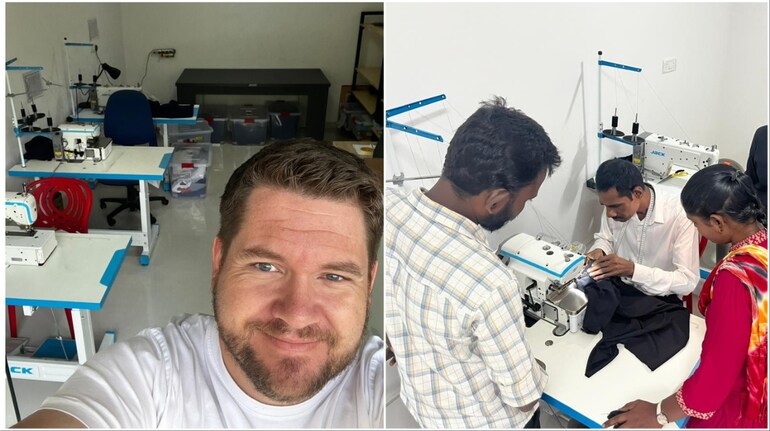
An Australian entrepreneur who moved to Bengaluru about two years ago and opened a garment company said that he faced losses of about Rs 30 lakh due to the unprofessional attitude of local workers. Chris H, 38, said that despite paying high wages and offering good working conditions, the workers he had employed would quit without notice, leaving him in a lurch.
"I would receive orders worth lakhs, but suddenly have no workers to make the clothes," he told Moneycontrol. "Because of this, I have lost AU$ 50,000 (around Rs 30 lakh) in a year.... I think India might have beaten me."
High wages, safe environment for workers
The 38-year-old said he moved to Bengaluru's Whitefield from Australia after his wife, a software engineer, bagged a job with a tech company in the city. At the time, he was a business consultant, and after reading up on the exploitation that garment industry workers, especially women, face, Chris decided to open his own company, Benevolentia, close to his Bengaluru home, which would focus on ethically-made clothes. He also offered his tailors wages exponentially higher than the market rates.
"I read news reports on 100 percent of garment workers interviewed, female garment workers, were verbally abused, and many of them were sexually abused as well. I wanted to do something to change it and decided to open a garment business, giving garment workers a better and safe environment. For example, in factories, tailors get paid Rs 8,000 a month. I offer compensation worth Rs 30,000 a month, including incentives. But yet, there have been a series of complicated issues since then," Chris said.
Cultural differences cause complications
One of the complications included a woman worker quitting because her husband did not approve of Chris praising her work. "My first tailor, a lady, was forced to quit by her husband because I gave her 'too much praise'," the Australian entrepreneur said. "I put in the time and money to train her, and since she was doing well in the new skills she had learned, I praised her. Once, it was raining, and I moved her shoes away so that they wouldn't get wet, and that upset her husband. I mean, in Australia, we would have done that for anybody. "
In another instance, a social media manager he hired and asked to post daily on Instagram, shared three posts in two months.
Chris also faced obstacles in hiring workers and in retaining them. "Someone came for an interview, but refused to give me any details about any skills or experience. Another applicant demanded payment for transport to attend the interview, showed up anyway and then refused three times to do any skills demonstration until after we hired them," he said.
'Indian work culture is very hierarchical'
Realising that the challenges were caused by his not being familiar with the local culture, Chris hired an operational manager to help him understand the different management styles that Indian workers would prefer to the ones he was used to in Australia.
"The Australian culture is very egalitarian. The Indian culture seems to be the exact opposite -- very hierarchical. So now my operational manager is teaching me how to be less approachable and friendly and more bossy," Chris laughed.
But he has a limited amount of time to turn things around. "I can't keep bleeding money. I'd like to give the company a few more months before drawing the final straw," Chris concluded.
Discover the latest Business News, Sensex, and Nifty updates. Obtain Personal Finance insights, tax queries, and expert opinions on Moneycontrol or download the Moneycontrol App to stay updated!
Find the best of Al News in one place, specially curated for you every weekend.
Stay on top of the latest tech trends and biggest startup news.