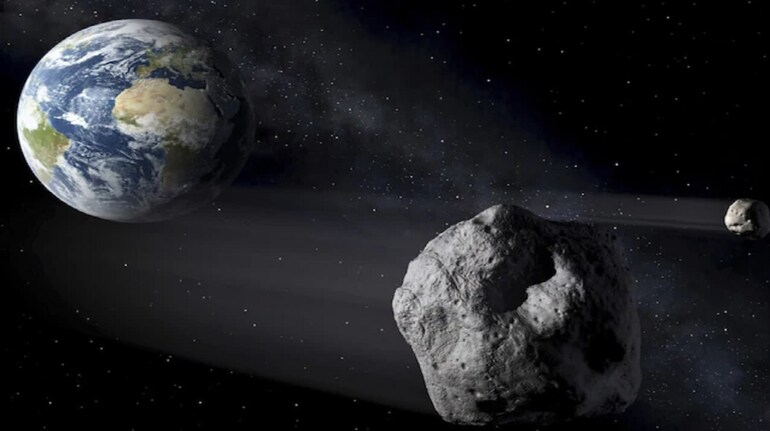

Scientists are closely tracking asteroid 2024 YR4 after new research suggested it could strike the Moon in 2032, potentially triggering visible flashes and intense meteor activity across Earth’s skies.
The asteroid, discovered on Dec. 27, 2024, briefly alarmed astronomers after calculations showed a record probability of Earth impact for an object its size. Later observations ruled out any Earth collision during its Dec. 22, 2032, flyby, but NASA estimates a remaining 4.3% chance of lunar impact.
What scientists say about the Moon impact
A study published in 2025 on the arXiv preprint server examined possible outcomes if the asteroid collides with the Moon. The research was led by Yifei Jiao, a postdoctoral scientist at the University of California, Santa Cruz, and involved international collaborators.
The team described the event as a rare opportunity to study a predictable cosmic collision. Using detailed computer simulations, researchers modelled the asteroid’s journey through the inner solar system.
Scientists ran 10,000 simulations adjusting the asteroid’s possible trajectories. These simulations included the Sun, planets, Earth and the Moon.
Results suggested a likely impact zone stretching roughly 3,000 kilometres across the lunar surface. The corridor lies just north of the Moon’s Tycho crater, according to The Planetary Society.
Bright flashes and lunar debris storms
Researchers also simulated the impact itself across a 500-second timeframe. The collision could release energy equal to 6.5 million tonnes of TNT.
The impact would likely produce a flash as bright as Venus. Researchers said the light could last between 200 and 300 seconds.
First author Yifan He of Tsinghua University said the flash would remain visible for at least 10 seconds. The predicted impact time is 10:19 a.m. EST, or 15:19 UTC.
This timing would allow visibility across East Asia, Oceania, Hawaii and western North America. However, 70% of the Moon will be illuminated that day.
Scientists estimate only a 2.85% chance the impact occurs on the Moon’s dark side. Even so, amateur telescopes would still detect the flash.
What it could mean for Earth observers
The impact could trigger thousands of secondary flashes as debris falls back. These flashes would be dimmer and harder to observe without instruments.
The study also predicts up to 100 million kilograms of lunar material could escape toward Earth. This debris could create extreme meteor storms days or weeks later.
Yixuan Wu of Tsinghua University described these as super meteor storms. They could appear between two and 100 days after impact.
Wu told Live Science such an event would help confirm impact science theories. Researchers stress the collision remains uncertain but scientifically significant.
Discover the latest Business News, Sensex, and Nifty updates. Obtain Personal Finance insights, tax queries, and expert opinions on Moneycontrol or download the Moneycontrol App to stay updated!
Find the best of Al News in one place, specially curated for you every weekend.
Stay on top of the latest tech trends and biggest startup news.