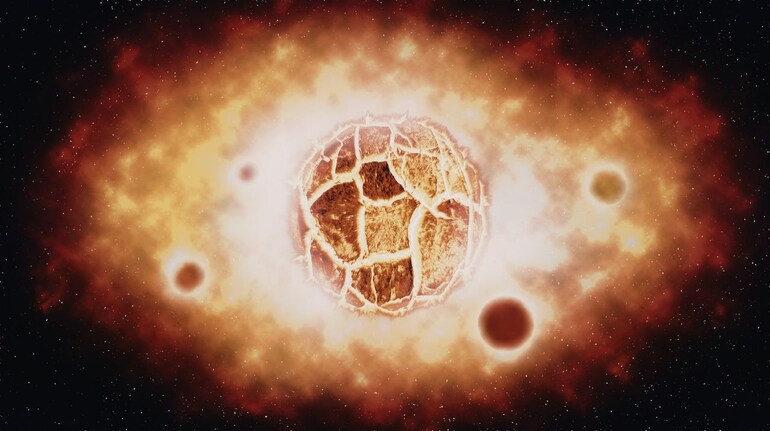

One of the universe’s largest known stars has changed dramatically since 2014, and astronomers now believe it may be edging closer to a powerful supernova explosion.
The findings come from new research. The study was led by Gonzalo Muñoz-Sanchez at the National Observatory of Athens. It was published in Nature Astronomy today. Scientists examined the massive star WOH G64 in detail.
WOH G64 and the Large Magellanic Cloud
WOH G64 was first identified decades ago. It lies within the Large Magellanic Cloud. That dwarf galaxy orbits the Milky Way. The star was discovered during the 1970s. Astronomers soon realised its extraordinary size.
It measures over 1,500 times the Sun’s radius. Few stars known exceed that scale. In 2024, astronomers achieved another milestone. The Very Large Telescope Interferometer captured detailed images. It marked the first detailed image beyond our galaxy.
The image revealed a dusty cocoon clearly. That dust confirmed heavy mass loss. Scientists already suspected late stage instability.
 Image of WOH G64 captured by the GRAVITY instrument at the European Southern Observatory’s Very Large Telescope Interferometer (ESO’s VLTI). (Image: ESO/K. Ohnaka et al)
From Red Supergiant to Yellow Hypergiant
The new research suggests major change. In 2014, WOH G64 altered classification. It appears to have shifted stage. Researchers say it became a yellow hypergiant.
Previously, it was labelled red supergiant. Red supergiants burn helium in cores. Hypergiants are even rarer stellar phases. They form during rapid internal transitions.
During this phase, stars shed outer layers. Their cores contract while temperatures rise. Such transitions are brief astronomically. Hypergiants are believed near supernova fate.
WOH G64 remains cosmically young still. Its age is under 5 million years. That contrasts with the Sun’s 4.6 billion years. Massive stars live short intense lives.
Why Did the Transformation Occur
Researchers explored possible causes carefully. One theory involves violent surface ejection. Large sections may have blown outward. Spectral data revealed companion star presence. Interactions may have triggered instability.
Another explanation involves internal pulsations. Scientists describe a possible superwind phase. Fuel inside the core depletes quickly. Strong pulses drive extreme stellar winds.
These processes may signal imminent explosion. Predicting exact timing remains extremely difficult. Stars of this size inevitably explode. The question concerns when, not if.
Astronomers rarely witness such evolution directly. Observing change beyond our galaxy astonishes researchers. If fortunate, humanity may see its end. Such an event would illuminate stellar physics profoundly.
Discover the latest Business News, Sensex, and Nifty updates. Obtain Personal Finance insights, tax queries, and expert opinions on Moneycontrol or download the Moneycontrol App to stay updated!
Find the best of Al News in one place, specially curated for you every weekend.
Stay on top of the latest tech trends and biggest startup news.