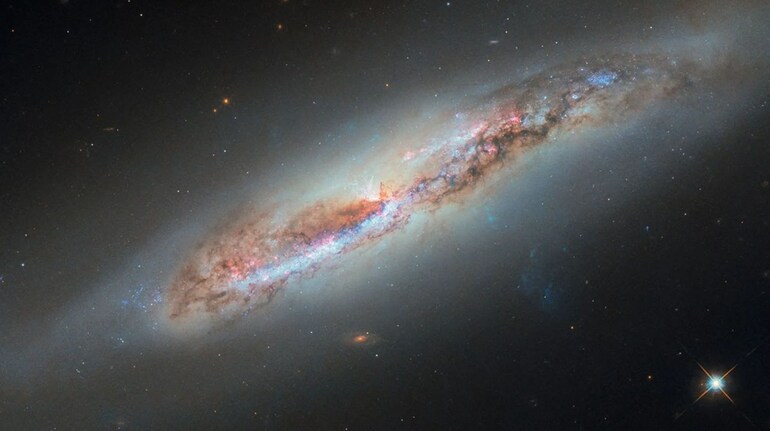
NASA’s Hubble Space Telescope has spotted a galaxy in trouble. It shows gas escaping while the galaxy speeds through space. The discovery reveals how harsh environments reshape galaxies. The image captures a rare moment in galactic life. Scientists say such events are difficult to observe. The finding answers long-standing questions about galaxy behaviour.
A galaxy caught mid-escape by Hubble
The galaxy is known as NGC 4388. It lies inside the Virgo galaxy cluster. NASA shared the image through its Hubble Glimpses programme. The picture shows gas streaming away from the galaxy. This gas normally fuels star formation. Without it, galaxies slowly grow quiet and old. The image captures this transformation in progress.
Where this cosmic drama unfolded?
NGC 4388 resides about 60 million light years away. It moves through the dense Virgo cluster environment. The cluster contains thousands of galaxies. It is filled with extremely hot, diffuse gas. Galaxies travel quickly through this crowded region. Such conditions are hostile to gas-rich spiral galaxies.
The invisible force tearing a galaxy apart
Astronomers blame a process called ram-pressure stripping. It happens when galaxies rush through hot cluster gas. The surrounding gas acts like a strong wind. This wind pushes gas out of the galaxy. Stars remain mostly unaffected by this force. Gas is stripped away over millions of years. Eventually, star formation slows or stops completely.
The hidden detail Hubble almost missed
Earlier Hubble images failed to reveal the gas plume. It was too faint to detect clearly. New image processing exposed ionised gas structures. Multiple wavelengths were combined for better clarity. The glowing plume stretches far from the galaxy’s disk. Its brightness suggests intense energy at work.
Why scientists are excited?
The image provides direct evidence of galaxy evolution. It shows environmental forces shaping cosmic structures. Scientists can test long-standing theoretical models. The glow may be powered by a central black hole.
Shock waves could also energise the escaping gas. Future observations will study similar galaxies closely. Hubble has captured a fleeting cosmic moment. NGC 4388’s fate is being rewritten by its surroundings.
Discover the latest Business News, Sensex, and Nifty updates. Obtain Personal Finance insights, tax queries, and expert opinions on Moneycontrol or download the Moneycontrol App to stay updated!
Find the best of Al News in one place, specially curated for you every weekend.
Stay on top of the latest tech trends and biggest startup news.