News18
February 18, 2022 / 10:36 IST
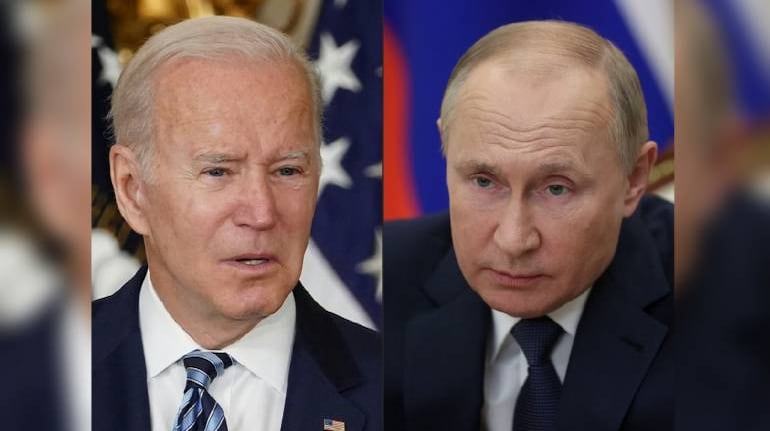
Joe Biden and Vladimir Putin held talks on Monday over the Russia-Ukraine crisis.
It was never about Ukraine Yes, the current geopolitical standoff between Russia and the United States ha little to do with Ukraine and more to do with the big picture-The European lattice that is unravelling at the force of two major poles, Washington DC and Moscow. It's all centred upon what iden wants and what Putia wants for Europe Northwestern Europe.
And to be more precise, Germany But to understand the present, we must look into the past. Just months after President Joe Biden entered the White House in 2021, a standoff with Russia at the Ukraine bordes took shape and war frysteria took over.
Story continues below Advertisement
Separatist rebels in the Donbas region of Ukraine have been fighting Ukrainian forces for eight years now, backed by Russia. All these years Moscow's pressure has prevented Ukraine from taking a drastic military step to reclaim Luhansk and Donetsk from the rebels. What changed in 2021 is that Biden decided to confront Vladimir Putin en if that meanst more escalation.
Ukraine, meanwhile, functioned more like a battleground, where a greater power play manifested itself in the form of Russian military buildups, USA's diplomatic support and a radical pressure to fiercely oppose Putin and Europe's thumbs up from a distance. Then, Putin and Biden had a meeting, and things cooled down and Ukrainian President Volodymyr Zelensky was left hanging in the lurch.
Story continues below Advertisement
One more thing that happened in 2021 was this. Sometime around five months ago, Europe started facing an acute energy crisis, something that Putin could address if he was not busy manufacturing it-if European cries are anything to go by. And indeed Russia's state-owned Gazprom was at the centre of it and still is. Gas prices since have been skyrocketing in Europe as supplies from Russia are running short. This event is a message to Europe from Putin that Russia has undue leverage over the continent and would not shy away from using it as a pressure tactic or a punitive measure.
In this case, it's a pressure tactic. But what's Putin's goal?PHOTOSWHAT PUTIN WANTSWe have all by now heard of Putin's three key demands that the USA refuses to fulfil. The first being no further NATO expansion to the east, including barring ex-Soviet states like Georgia and Ukraine's entry into the US-led military alliance. The second, no deployment of strike weapons near Russian borders and finally the rollback of NATO's military infrastructure in Europe to 1997 levels.Such a proposed treaty was a 'non-starter for the US, even as Russia stepped up its military buildup at the Ukraine bordes. Instead, the US gave Putin a choice, that is, to negotiate or fight a war. Russia's diplomatic and military posturing is being portrayed by the Biden Administration as a sure-shot, definite plan to invade and topple Kyiv, playing Putin's own moves against him.But why did Putin play such a strong hand in the first place when it came to placing such demands, and why now? For one, Russia has Europe's arms twisted with the demonstration of the "Gas' leverage: the perfect time to get Europe to push the US into agreeing with Putin. Moscow may have considered that such a thing could indeed happen with Olaf Scholz, Germany's new Chancellor, whose Social Democratic Party (SPD) is known to toe a soft line on Russia. SPD's former chancellor Gerhard Schroder even joined the board at Gazprom and is friendly' with Putin. Also, Ukraine may not be welcomed into the NATO anytime soon, but decades down the line, it could prove to be a formidable military threat to Russia. So, Putin's demands correspond with Russia's long-term goal of containing Ukraine.
Putin has also put a higher price on peace with Russia with these demands, the effect of which is felt directly by Europe, most of all Germany, which sources 50 to 75% of its gas needs from Russia. And now, coming to the main underpinning factor, the biggest bone of contention that is driving this deadlock-The Nord Stream 2 gas pipeline.THE NORDIC HUSTLEThe Nord Stream 2 pipeline, owned by Gazprom, is sitting ready to pump about 110 billion cubic metres annually of Russian gas into Europe, doubling the amount currently pumped by Nord Stream 1. On the map, the Nord Stream 2 makes a clean-cut way into Germany through the Gulf of Finland and the Baltic Sea. It's a massive and ambitious project that will bolster Moscow's hold over Europe's energy security, bypassing existing pipelines running through Central Asia and Eastern Europe-more notably, bypassing Ukraine.
Discover the latest Business News, Sensex, and Nifty updates. Obtain Personal Finance insights, tax queries, and expert opinions on Moneycontrol or download the Moneycontrol App to stay updated!