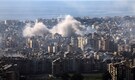
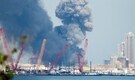
Oil sinks 11% as Trump predicts Middle East de-escalation
Brent futures were down $10.45, or 10.6%, at $88.51 a barrel by 1504 GMT (11:04 a.m. EDT), while U.S. West Texas Intermediate (WTI) crude was down $10.61, or 11.2%, at $84.16

A capitulating market — Is it time to buy the panic?
Middle East conflict delivers a triple shock to India’s economy, testing the resilience of corporate earnings and equity valuations
Geopolitical shocks trigger sharp market corrections followed by strong rebounds
Market reactions to such events over the past three decades have followed a somewhat similar pattern
G-7 ready to release oil stockpiles if needed to help supply
Brent oil futures surged as much as 29% at one stage on Monday before sharply paring their gains when it emerged that the G-7 would discuss a possible stockpile release
Crude retreats but holds above $104 as G7 weighs emergency oil reserve release
Stocks, bonds and precious metals slid on Monday as investors, spooked by the impact of surging oil prices on global inflation and economic growth, turned risk-averse and cashed in on some of their most profitable trades
'Markets fall. They fall a lot:' Why Buffett and Lynch's old market wisdom is going viral as war hammers stocks
Oil above $100 and global stocks sliding have revived viral clips of Warren Buffett and Peter Lynch explaining why market crashes are inevitable.
Why China may dodge the worst of the Iran war oil shock even as crude tops $100
China’s large crude reserves, EV push and renewable expansion may reduce its exposure to oil shocks from the Iran war
US market bloodbath soon amid Iran war? Veteran strategist revises forecast
The shift in those weightings comes as oil prices surge above $100 a barrel and investors brace for a prolonged conflict in the Middle East that could send energy costs even higher.
Three-fourths of Nifty 500 stocks trade below 200-DMA as market sell-off deepens
Nearly 75 percent, or 374 stocks, in the Nifty 500 index are trading below their 200-day moving average. Among the Nifty 50, about 66 percent, or 33 stocks, are currently below the key technical level.
Chart of the Day | Strait to catastrophe
The closure of the Strait of Hormuz has unleashed a multi-layered crisis, sending oil above $100 while threatening catastrophic ripple effects through global food production, industrial metals, and supply chains
Crude surges past $117: Sensex, Nifty post sixth-biggest single-day decline as oil shock rattles markets
The Sensex dropped more than 2,400 points while the Nifty fell about 702 points, making it the sixth-largest fall in absolute points for the two benchmark indices.
Circuit breaker in South Korea: When global markets last halted trading
South Korea’s stock exchange triggered a circuit breaker on Monday after sharp losses in equities amid rising concerns over the Middle East conflict and surging global oil prices.
Jobs fall, gas prices jump, stocks slip: Trump’s ‘roaring economy’ faces an early test
US job losses, rising gasoline prices and stock market declines challenge Trump’s claim of a “roaring economy” amid the Iran conflict.
Iran war shock sends oil up 30%, pushing prices above $118
Even if the fighting ends quickly, analysts warn that damage to infrastructure, disrupted logistics and heightened risks to shipping could keep fuel prices elevated for weeks or months, affecting businesses and consumers worldwide.
Dollar surges as US-Iran war pushes oil past $100 a barrel
Surprisingly weak US jobs data had on Friday briefly stalled dollar gains, and raised expectations for US rate cuts, but that faded somewhat on Monday morning and US stock futures tumbled, too, with S&P 500 futures down 1.6%.
Dow sinks 900 points as Trump’s Iran warning sends oil surging
US stocks fall as oil tops $90 and jobs data shows payroll decline, raising concerns about economic growth amid US-Iran war.
Business in the Week Ahead: March 9-13, 2026
Three new IPOs will open for subscription. OPEC and IEA will release oil market reports.
RBI fires $12 billion defence as Middle East war sends rupee to record low
The RBI’s heavy intervention comes against the backdrop of India’s foreign-exchange reserves, which at over $723 billion, are among the largest in the world.
Pharma exporters brace for Rs 5,000-crore hit as US-Iran war drives up freight costs
Exporters face steep surcharge of $4,000–$8,000 per shipment, driving up logistics costs for drugmakers heavily dependent on the Gulf and the wider West Asia market
Weekly Tactical pick: Why should you buy the SAMHI Hotels stock?
The company stands to benefit from better connectivity as well as increasing exhibitions and conferences
India Gold ETF inflows slow to $565 million in February
So far in 2026, inflows have surged to $3.06 billion, pushing assets under management close to $20 billion. This compares with $4.69 billion in inflows during 2025, $1.29 billion in 2024, $310 million in 2023 and just $33 million in 2022.
Dow drops 600 points as oil jumps after Iran tanker strike; investors watch Strait of Hormuz
U.S. stocks fell Thursday with the Dow down 600 points as oil prices surged after a tanker strike and investors tracked Gulf tensions.
China’s 2026 growth target drops below 5% for the first time in decades, what changed?
China sets 2026 growth target at 4.5–5% at the National People’s Congress, the first sub-5% benchmark in decades as Beijing signals a slower growth trajectory.
Hospitals brace for 'soft' quarter as US-Iran war disrupt international travel
West Asia is not just a source market, it is also India’s primary aviation corridor that connects Africa, Central Asia and Europe to India
Fear or the strength of fundamentals — What matters more for markets?
A historical analysis of how geopolitical shocks actually impact oil, gold, and global equities