








Indian stocks may face near-term pressure as tensions in West Asia escalate and crude oil prices surge past $100, but history shows geopolitical shocks usually trigger brief corrections before equities rebound.
Market reactions to such events over the past three decades have followed a somewhat similar pattern. An analysis of six major geopolitical shocks between 1990 and 2026 showed that such events typically lead to an average correction lasting about four weeks. From those lows, markets have historically delivered average returns of roughly 28 percent over three months and 38 percent over six months.
The current conflict between the US and Iran has entered its seventh day, with India's benchmark indices falling nearly 7 percent. During the Russia-Ukraine conflict, the indices fell about 11 percent over 23 weeks. The Pulwama attack and the 26/11 Mumbai terror attack saw declines of 2-3 percent, with corrections lasting about one week each. The World Trade Center attacks in 2001 triggered a two-week correction with markets falling about 18 percent, while during the Kargil war, the market correction lasted around six weeks, with the Sensex declining roughly 11 percent.
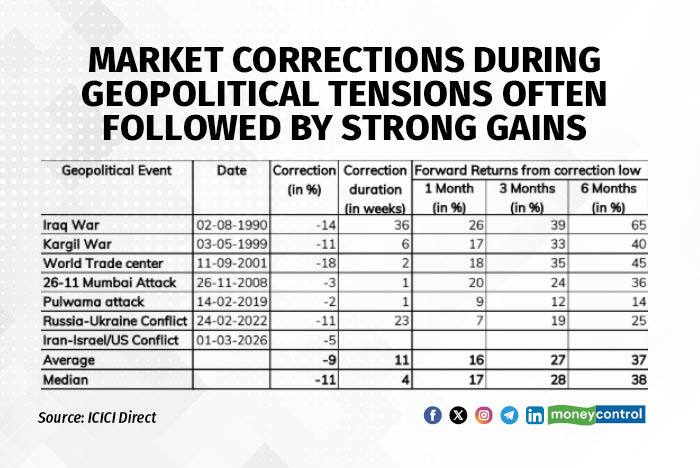
According to ICICI Direct, each of these events ultimately formed a major market bottom. The brokerage said that investing during periods of panic with a long-term perspective has been rewarding, adding that the same approach may apply in the current environment as well.
Historically, markets have also rebounded strongly after such episodes. Following the Russia-Ukraine war, returns from the correction low stood at 7 percent after one month, 19 percent after three months, and 25 percent after six months. Similarly, after the Pulwama attack, returns from the correction low were 9 percent after one month, 12 percent after three months, and 14 percent after six months. Following the 26/11 Mumbai attacks, the market rebounded strongly with 20 percent returns after one month, 24 percent after three months, and 26 percent after six months from the correction lows.
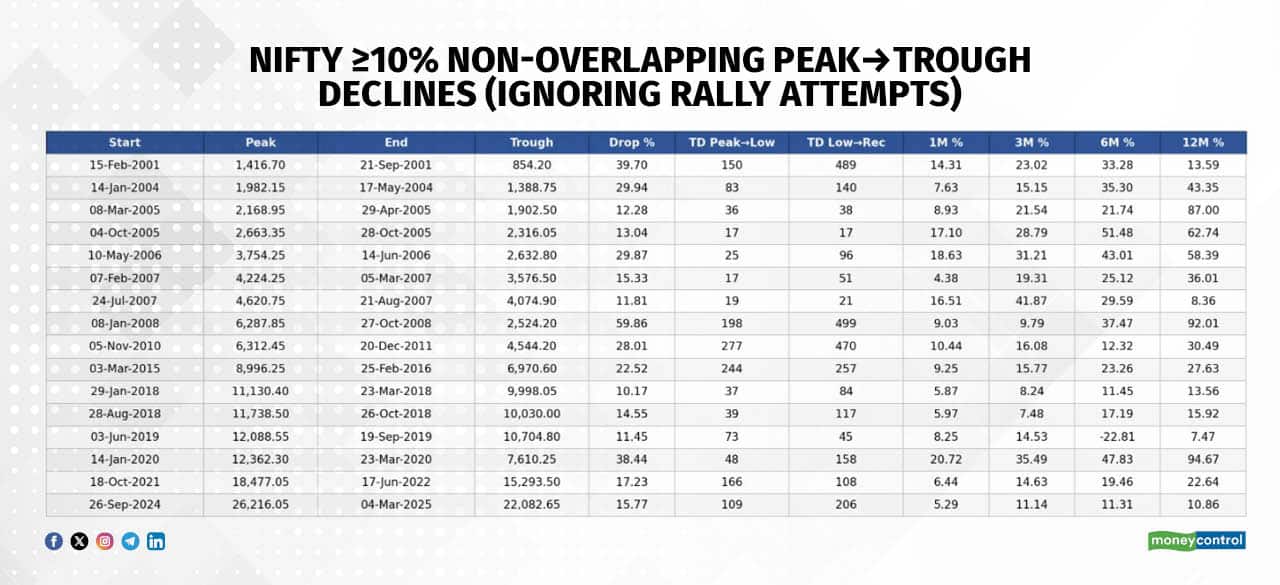
Akshay Chinchalkar, Managing Partner and Head of Markets Strategy at Wealth Co, said that historical analysis of the Nifty beginning 2001, using a minimum correction threshold of 10 percent and avoiding double counting till the market reached a new high, the average decline in such instances has been around 23 percent, with the fall from peak to trough typically lasting about 96 trading days. From the lows, the average one-month return has been about 11 percent, while three-month returns average around 20 percent, six-month returns around 25 percent, and 12-month returns roughly 39 percent.
“Buying at the lows has historically yielded strong returns, with an average gain of about 32.6 percent over 12 months,” Chinchalkar said, adding that most corrections typically resolve within three to six months, except during systemic crises such as the global financial crisis or the dot-com bust.
India’s economic links with the Middle East remain significant, with the region accounting for about 17 percent of India’s exports, supplying roughly 55 percent of its crude oil, and contributing about 38 percent of worker remittances. A prolonged conflict accompanied by a sharp surge in energy prices could therefore pose a macroeconomic risk for India. However, the few experts expect the recent regional conflicts have generally been temporary and that market corrections could provide buying opportunities.
In its recent note of Jefferies India sectors such as oil marketing companies, travel and hospitality, and rate-sensitive stocks could face near-term pressure, while the defence sector may benefit. The brokerage added that the trajectory of crude oil prices following any disruption in the Strait of Hormuz will be critical. A prolonged closure and sustained high oil prices would be negative for the economy. Every $10 per barrel increase in crude oil could widen India’s current account deficit by about 35 basis points.
Retail fuel prices in India have remained largely unchanged for about two and a half years, with oil marketing companies absorbing fluctuations through marketing margins. If crude prices remain above $80 per barrel, retail fuel price adjustments or a reduction in fuel excise duties may become necessary. Jefferies estimates that every $10 per barrel increase in crude prices could raise consumer inflation by about 20–25 basis points if passed on to consumers or increase fiscal pressure if the government chooses to reduce taxes instead.
Oil surged past $100 a barrel on Monday as more West Asian producers cut output, including OPEC leader Saudi Arabia, amid a standstill in tanker traffic through the vital Strait of Hormuz that was choking off supplies to the rest of the world.
Discover the latest Business News, Sensex, and Nifty updates. Obtain Personal Finance insights, tax queries, and expert opinions on Moneycontrol or download the Moneycontrol App to stay updated!
Find the best of Al News in one place, specially curated for you every weekend.
Stay on top of the latest tech trends and biggest startup news.





