








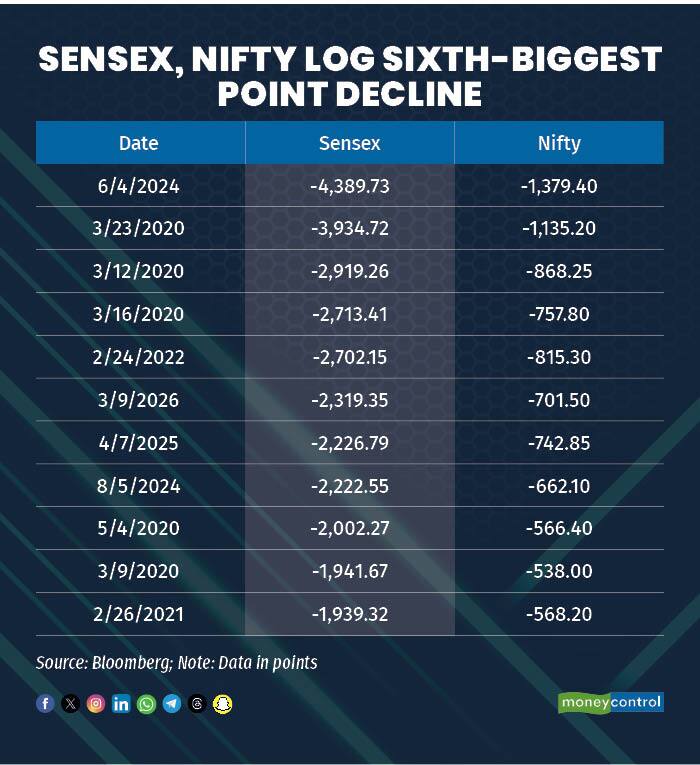
Amid escalating geopolitical tensions in the Middle East, Indian markets on March 9 witnessed a sharp selloff, with the benchmark Sensex and Nifty posting their sixth-largest single-day decline in terms of points. Both indices fell over 3 percent, marking their steepest percentage decline since June 4, 2024, when markets had corrected about 5.7 percent.
The Sensex dropped more than 2,400 points while the Nifty fell about 702 points, making it the sixth-largest fall in absolute points for the two benchmark indices.
The biggest decline in terms of points was recorded on June 4, 2024, when the Sensex plunged about 4,390 points and the Nifty fell 1,380 points. This was followed by March 23, 2020, when the Sensex dropped around 3,900 points and the Nifty declined 1,135 points during the pandemic-led market crash.
On March 16, 2020, the benchmarks recorded their third-largest fall, with the Sensex dropping 2,920 points and the Nifty declining 869 points. Another sharp decline occurred on March 12, 2020, when the Sensex fell 2,713 points and the Nifty dropped 758 points. More recently, on February 24, 2022, when Russia invaded Ukraine, the benchmarks recorded their fifth-largest fall, with the Sensex declining 2,320 points and the Nifty dropping 701 points.
The selloff came as crude oil surged above $117 a barrel for the first time since 2022, as the US-Israel conflict with Iran showed no sign of easing and both sides appeared set to prolong the confrontation. Investors rushed toward the US dollar as a safe-haven asset, adding pressure on risk assets globally.
Equity markets across Asia also witnessed sharp declines. Asia’s benchmark share index fell as much as 5.6 percent, the biggest drop since April, with South Korea sliding about 8 percent and Japan nearly 7 percent. Futures for US and European equity indices dropped more than 2.5 percent, indicating that the selloff could spread across global markets. Treasuries also declined.
The turmoil intensified as Brent crude oil surged as much as 29 percent to $119.50 a barrel, extending last week’s 28 percent rally as the conflict entered a second week. Major oil producers began curbing output, while traffic through the Strait of Hormuz effectively halted, raising concerns about global energy supply.
Meanwhile, Iran named the son of the late Ayatollah Ali Khamenei as its new supreme leader, while President Donald Trump said higher oil prices were “a very small price to pay” for “safety and peace.”
Bond markets also came under pressure. US Treasuries sold off on concerns over rising inflation, with benchmark 10-year yields turning positive for the year. Australia’s policy-sensitive three-year bond yield surged to its highest level since 2011, while German bund futures slumped to nearly a 15-year low.
Selling swept across regions and asset classes as the geopolitical flare-up added fresh stress to markets already facing pressure from AI-related disruptions and concerns over potential cracks in credit markets. The escalating crisis has left investors caught between the risk of renewed inflation driven by higher oil prices and signs of cooling in the US labor market, creating heightened volatility across global financial markets.
Discover the latest Business News, Sensex, and Nifty updates. Obtain Personal Finance insights, tax queries, and expert opinions on Moneycontrol or download the Moneycontrol App to stay updated!
Find the best of Al News in one place, specially curated for you every weekend.
Stay on top of the latest tech trends and biggest startup news.





