

As the selloff in Indian equities widens amid escalating tensions in the Middle East and a sharp surge in crude oil prices, nearly three-fourths of stocks in major indices are now trading below their 200-day moving averages, highlighting the extent of the ongoing market weakness.
Nearly 75 percent, or 374 stocks, in the Nifty 500 index are trading below their 200-day moving average. In the broader markets, about 63 percent, or 94 stocks, in the BSE 150 MidCap index are below this level, while 78 percent, or 194 stocks, in the BSE 250 SmallCap index are trading under their 200-day moving averages. Among the Nifty 50, about 66 percent, or 33 stocks, are currently below the key technical level.
The 200 DMA is the average price of a stock or index over the past 200 trading days, and it is widely used to identify the long-term trend in the market. When a stock or index trades above its 200 DMA, it is generally considered to be in a long-term uptrend, while trading below the 200 DMA is often viewed as a sign of weakness or a potential downtrend, making it an important technical indicator for investors and traders.
The market decline has been accompanied by broad-based selling pressure. As many as 245 stocks hit their lower circuit, while 737 stocks touched fresh 52-week lows out of the 4,214 listed companies on the BSE.
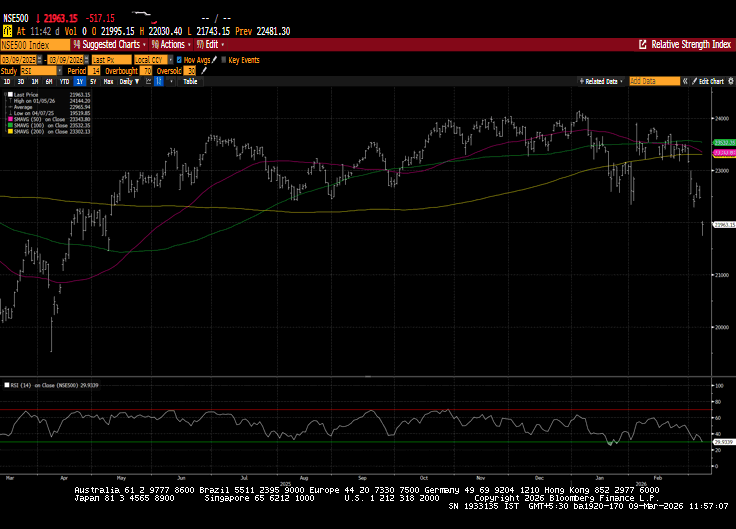
Akshay Chinchalkar, Managing Partner and Head of Markets Strategy at The Wealth Company, said the Nifty 50 confirmed a weekly head-and-shoulders breakdown recently, indicating that the 23,400–23,500 zone will be a crucial support level.
“This zone has so far remained untested even with today’s gap-down opening. On the upside, 24,250 will be a key hurdle, above which bulls may attempt a broader rebound. Weekly momentum has entered a zone that has marked prior significant troughs, but unless there is evidence of a turn, investors should remain cautious and avoid FOMO,” he said.
Chinchalkar added that the Nifty 500 is currently sitting near the trendline drawn from the Covid-19 lows of 2020, and it remains to be seen whether the market can hold this level and stage a bounce during the week. He noted that roughly 70 percent of stocks in the Nifty 500 are currently trading below their respective 200-day averages. Historically, over the past decade, this metric has moved closer to 90 percent before bear markets have bottomed out.
“Technically, the market is not yet deeply oversold, but it is moving toward that territory. It would be advisable for volatility to settle before turning confident,” Chinchalkar added.
Indian equities came under pressure as crude oil surged above $100 per barrel for the first time since 2022, with the US-Israel conflict with Iran showing no signs of easing. The escalation has pushed investors toward the US dollar as a safe-haven asset, weighing on risk assets globally.
Indian markets saw sharp declines on March 9, with the Sensex and Nifty falling more than 2.5 percent in intraday trade. Broader markets also weakened, with the BSE 150 MidCap index dropping over 2.5 percent and the BSE 250 SmallCap index declining about 2.8 percent, while the BSE Bankex fell around 4 percent.
Global markets also faced heavy selling pressure. Asia’s South Korea dropped about 8 percent and Japan nearly 7 percent. Futures for US and European equity indices also declined more than 2.5 percent, indicating the selloff could extend to other regions.
The turmoil followed a sharp surge in oil prices, with Brent crude rising as much as 29 percent to $119.50 per barrel, adding to last week’s 28 percent jump as the conflict entered its second week. Major oil producers have also begun curbing output, while traffic through the Strait of Hormuz has effectively halted.
Morgan Stanley has adopted a more cautious stance on Asian equities, trimming its exposure to India amid concerns that the conflict could disrupt energy supply chains if oil flows through the Strait of Hormuz remain affected.
“We stay defensive,” Morgan Stanley strategists including Daniel Blake and Jonathan Garner wrote in a note dated March 5, adding that Asia remains heavily dependent on Middle Eastern supplies of crude oil, refined products and LNG.
The brokerage downgraded India from overweight to equal-weight, citing the country’s exposure to potential Qatari LNG supply disruptions. It also said that amid uncertainty around artificial intelligence-related sectors and elevated valuations, global investors may wait — possibly until the technology cycle in South Korea and Taiwan peaks — before shifting allocations back toward India.
Discover the latest Business News, Sensex, and Nifty updates. Obtain Personal Finance insights, tax queries, and expert opinions on Moneycontrol or download the Moneycontrol App to stay updated!
Find the best of Al News in one place, specially curated for you every weekend.
Stay on top of the latest tech trends and biggest startup news.