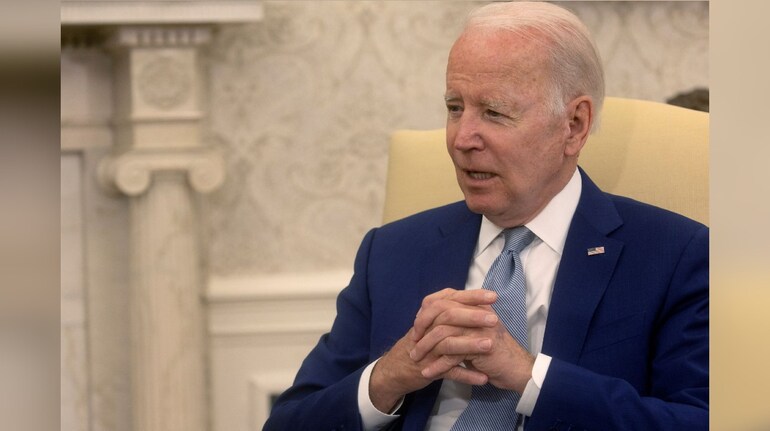
The rule of law should be respected, US President Joe Biden said the other day, “and we should never allow anyone to tear it down. It’s as simple as that.”
He was referring to a verdict — guilty on 34 counts — against his predecessor, which Donald Trump and his fans are loath to accept because they don’t like it. But Biden could just as well have been talking about international law, which faces the greatest threat of unraveling since the US shaped its modern features after World War II. If that happens, the US and its ally Israel will bear much of the blame.
Both countries’ ambivalence toward international law has a long history. But the current crisis dates to the sadistic massacre that Hamas committed against Israel on Oct 7, and Israel’s subsequent war of self-defense and retaliation in the Gaza Strip, where Hamas is callously using the civilian population as human shields.
This week, the US House of Representatives passed — the title says it all — the Illegitimate Court Counteraction Act. The bill takes aim at the International Criminal Court in The Hague, threatening sanctions against any of its staff who investigate citizens of the US or Israel. It’s meant as blowback for an application by the ICC’s prosecutor for arrest warrants against not only three commanders of Hamas but also two leaders of Israel, including Benjamin Netanyahu, the prime minister.
The prosecutor alleged, among other things, that Israel’s government used mass starvation as a weapon of warcraft, which would be a war crime. That said, his announcement was largely symbolic. The court’s judges would first have to grant his request. Even then, the US and Israel would ignore the warrants, because neither is a signatory to the Rome Statute that established the ICC.
The Illegitimate Court Counteraction Act, which stands no chance in the Senate, may be political theater. It’s also the latest scene in a tortuous drama about America’s on-again, off-again relationship with the ICC, and with international law generally. America helped draft the Rome Statute in the 1990s, then backed out of it. During the Trump administration, Washington sanctioned a judge and lawyer of the court. More recently, the Biden administration, with bipartisan support, began selectively co-operating with the ICC to hold Russian President Vladimir Putin to account for war crimes in Ukraine. Now the US has again turned against the court.
Separate but similar theatrics are unfolding elsewhere in The Hague, at the International Court of Justice, the tribunal before which all member nations of the United Nations can sue other states. In a case that has outraged most Israelis and many others, South Africa has charged Israel with genocide in the Gaza Strip.
The ICJ, moreover, is just one of the appendages of the United Nations. Its charter, drafted in large part by American jurists in the 1940s, in theory represents a sort of world constitution, while its Security Council is a rough analog to a world legislature, with the prerogative of passing binding resolutions that can be enforced with military might.
Israelis, however, increasingly regard the entire UN system as “the central vehicle for hijacking and perverting international ‘law’ and the principles of universal ‘human rights’ in the service of warfare and antisemitism,” as a report for the Jerusalem Center for Public Affairs puts it. Gilad Erdan, who is ending his term as Israeli ambassador to the UN, demonstratively shredded its charter during a recent speech and thinks that the whole institution should be defunded.
The Security Council is indeed easy to mock or disdain. Five of its 15 members are permanent and wield a veto, and they include the three “great powers” of China, Russia and the US. Increasingly, and especially since Oct 7, the autocratic duo among them vetoes anything the US proposes and vice versa; or, using abstentions, they allow only the most diluted resolutions to pass. Eight months since the massacre, the council has yet to pass either clear condemnation of Hamas or a ceasefire resolution — the US is currently circulating another draft.
Then again, are domestic legislatures and judiciaries paragons of rational and unbiased decision making? Ultimately, the predicament is the same as that facing Trump, or anybody: You can’t respect the law only when you happen to agree with it.
The international arena, moreover, is by necessity more chaotic than any national assembly or tribunal, because sovereign states have clashing interests and worldviews. So don’t mock the UN unless you’re also prepared to advocate for a world government (and to explain how, short of war, we’d choose one).
Americans in particular should ask themselves what the alternative would be to the legal regime that postwar US leadership made possible. When respect for the law erodes, within or between nations, the result is always anarchy, which in world politics usually means more war.
Picture a world of Putins, invading and conquering as their military might permits, and of smaller nations and victims who’d have no recourse to norms or law in the international community. Picture the Melians in the 5th century BCE, whose men the Athenians killed and whose women and children they enslaved — for no other reason, according to Thucydides, than that the Athenians could.
What, then, should the US and Israel do instead of dissing the courts in The Hague? I asked David Scheffer, a former US Ambassador at Large for War Crimes Issues who led the American team negotiating the Rome Statute in the 1990s and wrote its early drafts.
They should both stop maligning the ICC, Scheffer thinks. Israel’s judiciary should instead begin its own investigation into the prosecutor’s allegations. Scheffer himself drafted the “complementarity” article (the one he’s most proud of), which says that the ICC may only intervene if a state can’t or won’t bring a genuine case in its own judicial system. Autocracies like China or Russia can’t credibly argue that they would; democracies like the US or Israel can. The credibility derives from the process, moreover, not from the outcome, whether conviction or exoneration.
Scheffer of course also wants the US to join the Rome Statute — that’s why Bill Clinton told him to negotiate it, after all. That way, Washington would also have sway inside the court, probably even a judge on the bench. The same logic applies to the ICJ. The US and Israel should trust the tribunal’s processes, professionalism and fairness, and Israel should keep arguing its case, which it can probably win.
The US should pledge to respect the verdict, whatever it is. It can’t afford not to. Wherever Scheffer and other American diplomats go, the first gripe they hear is that Washington has double standards, one for itself and its allies, another for everybody else. This perception of hypocrisy undermines US soft power and global clout, hobbling Washington as it competes with Beijing and Moscow.
In 2024, America’s commitment to the rule of law is being tested at home as abroad. The principle that should prevail is that everyone is presumed innocent until proven guilty, but no one, not even a former president, and no nation, not even a superpower, is above the law.
Credit: BloombergDiscover the latest Business News, Sensex, and Nifty updates. Obtain Personal Finance insights, tax queries, and expert opinions on Moneycontrol or download the Moneycontrol App to stay updated!
Find the best of Al News in one place, specially curated for you every weekend.
Stay on top of the latest tech trends and biggest startup news.