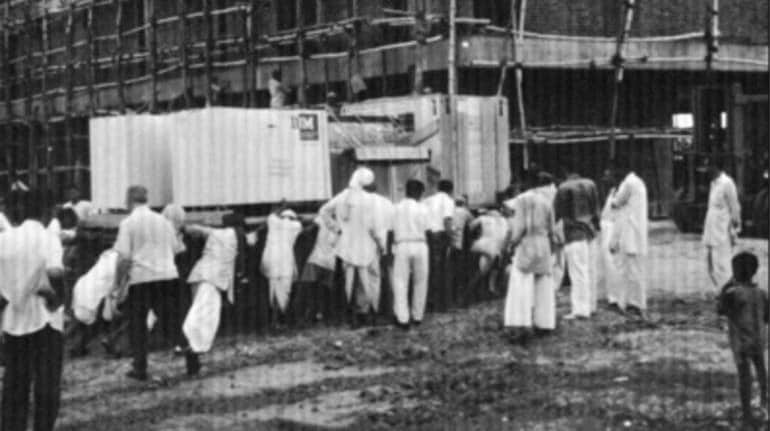
An IBM 1620 computer arrived in IIT Kanpur in August 1963. Talking about the machine, V. Rajaraman says, ‘The machine was state-of-the-art, at that time. It was a very popular machine with the universities. It was a reasonable-cost machine and was probably of the order of (Rs) 25 lakh or so at that time.’ The IIT Kanpur computer centre had a central processor with 40,000-digit core storage (IBM 1620), three 7330 magnetic tape units, a 1622 card input-output unit, twenty key-punch machines, and an IBM 407 accounting machine that was used as a printer.
Narrating the story of how the IBM 1620 arrived in Kanpur, Rajaraman says, ‘The machine arrived by plane at Chakeri airport at Kanpur, and from there they took it (to the institute) by bullock carts with inflated tyres. They were worried about bringing it by truck—the vibration of the truck on the bad roads of Kanpur might essentially ruin a lot of the electronic circuits. When the machine was brought, we found that the door (of the IIT Kanpur computer centre) was too small to take in the machine. One of the walls was
broken and the computer was installed.'
Prof. Harry Huskey, who, along with his American colleagues, Prof. Forman Acton and Prof. Irving Rabinowitz, oversaw the installation of the computer, adds some more colour to the arrival of the IBM 1620 in India: ‘The logistics of shipping the computer from the US to India was not easy. So, when the computer came up, they set it out by a chartered DC-8. One problem with DC-8s was that you couldn’t land them at the commercial airport in Kanpur. So, they flew it down to the military airport there. So, we had to load the stuff and bring it through the town.
‘And in India, they had road blocks every once in a while, where they collected customs taxes to pay for roads and so on. So, the question was how do we get AID to pay this customs fee. And we decided, we’ll breeze through like we owned the place. And it worked, and we got the computer out to the institute. But the trouble was the computer room still wasn’t finished. This was monsoon season and there was about an inch of water on the floor in the room where the computer was to go!
‘Also, India power is 50 cycles and a slightly different voltage. And the computer was 60 cycles. So, we had to convert from 60 to 50 cycles and adjust the voltage a little bit. There were a lot of telegrams sent back and forth between IBM and Kanpur. But anyway, we got the power on, and in about three weeks we had the machine up and running.’
Take a moment to imagine this unlikely scenario—a state-of-the-art digital computer being hauled on bullock carts in 1963 through the dusty, potholed roads of an Indian city, surviving the scrutiny of zealous customs officials, and the computer centre having to contend with the Indian monsoons and getting ready to install the computer in typical Indian style!
The IBM 7044, PDP-1 and Other Computers in IIT KanpurIt was decided that an IBM 7044 computer would follow the IBM 1620 to Kanpur. Commenting on the technical negotiations with IBM, Gio Wiederhold, who was a KIAP professor, says, ‘IBM was not anxious to provide its most up-to-date equipment. Fortunately, I had worked at IBM in the US and knew about their latest machines. I insisted on, and got, the latest high-density tape drives which used error-correcting codes. The older models only had error-checking and in effect had a much worse failure rate in dusty surroundings.’
In 1968, IIT Kanpur had two batch-processing second-generation computers—an IBM 7044/1401 and an IBM 1620. The IBM 1620 was used primarily to teach programming to all students, and the IBM 7044/1401 was used by research students and faculty, besides by a large number of guest users from several neighbouring universities and research laboratories.
Around this time, John McCarthy, a faculty at Stanford University and the person who coined the term ‘artificial intelligence’, visited the computer centre at IIT Kanpur and offered to donate the time-sharing machine installed at the Stanford Artificial Intelligence Laboratory. Thus the PDP-1 came to IIT Kanpur in 1969, and became the first time-shared computer to be installed in India. One of the first computer games, Spacewar!, was
developed on the PDP-1 at MIT. The IIT Kanpur students would
play the game and many of them got addicted to it. Some things
were not very different from today!
'Against All Odds: The IT Story Of India' (320 pages, Rs 799), by authors S Kris Gopalakrishnan, N Dayasindhu, Krishnan Narayanan, is published by Penguin Random House.
Discover the latest Business News, Sensex, and Nifty updates. Obtain Personal Finance insights, tax queries, and expert opinions on Moneycontrol or download the Moneycontrol App to stay updated!
Find the best of Al News in one place, specially curated for you every weekend.
Stay on top of the latest tech trends and biggest startup news.