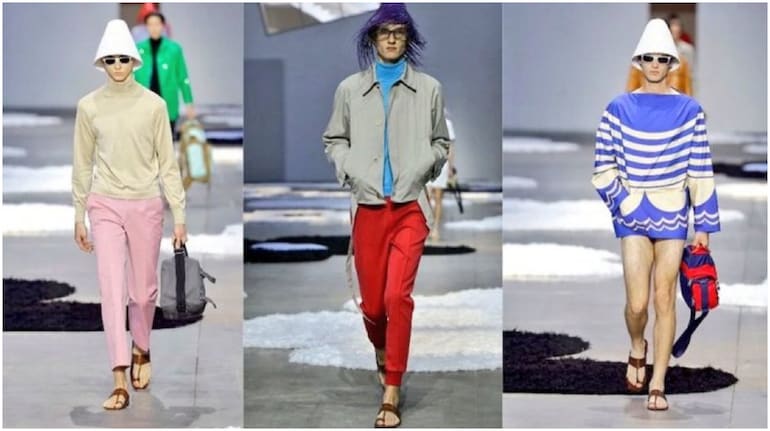
The Kolhapuri chappal, a centuries-old symbol of Indian craftsmanship, appears to have made its way onto the global high fashion stage. During the unveiling of its Men’s Spring/Summer 2026 collection at the Deposito of the Fondazione Prada in Milan, Italian luxury house Prada showcased models wearing sandals that bore a striking resemblance to the iconic hand-stitched leather footwear native to Maharashtra, India.
While Indian fashion insiders celebrated the growing influence of desi aesthetics on international runways, many were quick to point out the absence of any acknowledgement of the chappals’ roots. The show, curated by Miuccia Prada and Raf Simons, leaned heavily into contrasts—brown leather jackets paired with briefs, grey suits layered over red turtlenecks—and was themed as a “shift of attitude—dismantling of meaning, and dismantling power.” However, critics said the only “dismantling” was of historical context and cultural attribution.
Social media erupted shortly after the show, with Indian viewers noting the unmistakable silhouette of the Kolhapuri chappal—a slim build, skeletal frame, and prominent toe-ring design. The resemblance was so strong that many saw it as a repeat of previous controversies in the fashion world where traditional Indian attire and motifs were repackaged with Western names.
One user on X (formerly Twitter) wrote, “Prada SS26 includes Kolhapuri chappal, which originated from Kolhapur, Maharashtra, India, and is known for its intricate design and craftsmanship. Just like the ‘Scandinavian scarves,’ the Western fashion industry is ripping off Indian fashion again.”
"They say if you don’t value your culture, someone else will and that’s exactly what’s happening. Prada is now selling Kolhapuri chappals for hundreds of dollars, while our artisans, who’ve kept this craft alive for generations, get no credit or fair pay," another user commented.
A user remarked, "So after the Scandinavian scarves & a million other Indian things, the world has now blatantly stolen our beloved Kolhapuri chappals. This is the Prada men's spring collection 2026 & I'm appalled & curious to know what they'd call it. Handcrafted leather thong chappals?"
"Prada's latest season offerings - kolhapuri chappals! Is there no geo-tagging of Kolhapuri chappals? Can they steal our legacy and sell it for insane amounts?" a user questioned.
The footwear appeared in four of the collection’s 56 looks, worn by models styled in exaggerated minimalism and earthy tones. Despite the sandals’ distinctly Indian construction, no reference to Kolhapuri heritage was made in any official material accompanying the show.
The controversy deepened when attendees shared images of their show invites, which included a “leather ring” as a token takeaway—a feature believed to be a direct nod to the toe-ringed structure that defines a Kolhapuri chappal. Fashion critics questioned whether Prada was deliberately invoking Indian design without the courtesy of acknowledgment.
This latest episode has been likened to the now-infamous “Scandinavian scarf” incident, when a Western label styled a traditional Indian dupatta and dubbed it a Nordic minimalist accessory. Similar accusations arose during a previous Cannes appearance by Indian actress Alia Bhatt, where a custom saree designed by Sabyasachi was described by international fashion media as a “gown.”
The Kolhapuri chappal, rooted in 12th–13th century Maharashtra, has long stood as a symbol of durability, comfort, and handmade excellence. Historically worn by peasants and royalty alike, the sandals were famously promoted in the 18th century by King Shahu Maharaj. Today, they remain a mainstay of Indian street style and celebrity fashion, embraced by everyone from influencers to Bollywood stars.
Fashion critics called this a “Scandi scarf scandal 3.0,” alluding to what they believe is a pattern of cultural cherry-picking. References were also made to the “Ibiza aesthetic” trend, which has previously co-opted traditional Indian embroidery and applique without citation.
Discover the latest Business News, Sensex, and Nifty updates. Obtain Personal Finance insights, tax queries, and expert opinions on Moneycontrol or download the Moneycontrol App to stay updated!
Find the best of Al News in one place, specially curated for you every weekend.
Stay on top of the latest tech trends and biggest startup news.