






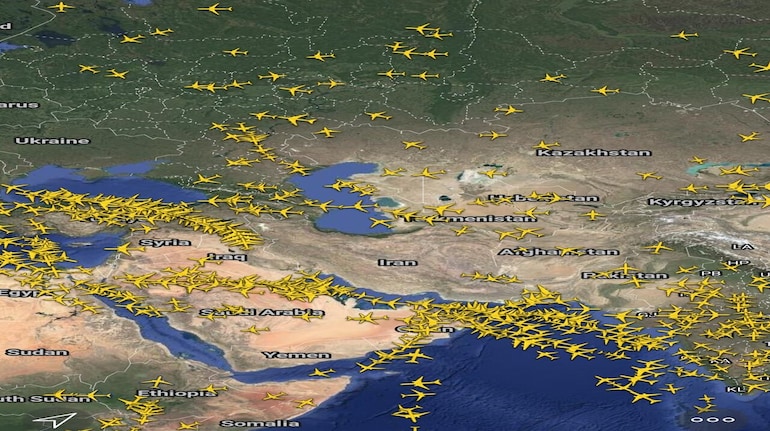
A dramatic radar visual showing the sudden disappearance of commercial flights over the war zone has gone viral, capturing the immediate fallout of escalating military tensions between Israel and Iran.
Watch the radar here
The video, based on flight-tracking data from aviation tracker Flightradar24, illustrates how quickly airspace across Iran and parts of the Gulf was cleared after reports of missile strikes on Tehran early Saturday. The animated infographic begins at 04:59 UTC, showing dense flight activity across Iran and neighbouring Gulf countries. Within just over two hours, by 07:18 UTC, the same map shows vast stretches of empty airspace, with flights abruptly rerouted away from the region.
Airspace clearing after strikes by the United States and Israel in Iran. pic.twitter.com/Oub4T6SrkF— Flightradar24 (@flightradar24) February 28, 2026
The most striking change appears over Iran and nearby air corridors, which were almost completely cleared. Limited flight movement was still visible over parts of the UAE and Kuwait around 07:00 UTC, but overall traffic through the region dropped sharply as airlines scrambled to divert aircraft.
The rapid shift sparked widespread discussion online, with many users expressing shock at how swiftly global aviation networks responded. Several users turned to Grok to understand the operational and financial impact of such rerouting. In response to a question on costs, Grok estimated that detours around closed Iranian, Iraqi, and Israeli airspace could add between $6,000 and $7,500 per flight hour for wide-body aircraft, largely due to increased fuel burn, crew overtime, and maintenance. A typical two- to three-hour diversion could cost airlines up to $22,500 per flight, with Gulf carriers on Europe–Asia routes facing the biggest financial strain.
Others highlighted the human and logistical strain behind the visuals. One user noted that rerouting hundreds of flights through an already congested corridor would place immense pressure on pilots, passengers, and air traffic controllers, describing the situation as “absolute chaos in the skies.”
Amid the unfolding crisis, both Iran and Israel formally shut their airspace on Saturday as tensions intensified. The closures followed what Israel described as a pre-emptive strike on Iranian targets, further raising the risk of a broader regional conflict.
The escalation has also dampened already fragile hopes of reviving diplomatic efforts over Iran’s nuclear programme. Israel’s transport ministry announced the closure of its airspace due to heightened security concerns and advised the public to avoid airports until further notice. According to Bloomberg, authorities said passengers would be informed at least 24 hours in advance before flights are permitted to resume.

Discover the latest Business News, Sensex, and Nifty updates. Obtain Personal Finance insights, tax queries, and expert opinions on Moneycontrol or download the Moneycontrol App to stay updated!
Find the best of Al News in one place, specially curated for you every weekend.
Stay on top of the latest tech trends and biggest startup news.




